We have compiled a list of manufacturers, distributors, product information, reference prices, and rankings for Furnace.
ipros is IPROS GMS IPROS One of the largest technical database sites in Japan that collects information on.

Furnace Product List and Ranking from 410 Manufacturers, Suppliers and Companies | IPROS GMS

Last Updated: Aggregation Period:Jun 17, 2026~Jul 14, 2026
This ranking is based on the number of page views on our site.

Furnace Manufacturer, Suppliers and Company Rankings

Last Updated: Aggregation Period:Jun 17, 2026~Jul 14, 2026
This ranking is based on the number of page views on our site.

  1. テクノファイアリング Gifu//Manufacturing and processing contract
  2. ナガノ Tokyo//Industrial Electrical Equipment
  3. アドバンテック東洋 Tokyo//Testing, Analysis and Measurement
  4. 4 SHOEI MFG.CO.,LTD. Japanese Headquarters Nara//Industrial Machinery
  5. 5 サーモニックENG Chiba//Other manufacturing

Furnace Product ranking

Last Updated: Aggregation Period:Jun 17, 2026~Jul 14, 2026
This ranking is based on the number of page views on our site.

  1. Leave entrusted firing and commissioned firing to us. テクノファイアリング
  2. [Case Study of High-Temperature Furnace] Achieving firing at up to 2,000℃ and shortening test cycles. ナガノ
  3. High-temperature atmosphere heat treatment furnace "HFQ-1100" [Capable of heating up to 1100°C] ハイブリッジ 東京営業所
  4. 4 Electric Muffle Furnace FUW Series アドバンテック東洋
  5. 5 Vacuum Heat Treatment Technology for the Aerospace Industry - Chuden Heat Treatment Research Institute 中遠熱処理技研

Furnace Product List

1441~1470 item / All 1562 items

Displayed results

Small Carbon Furnace | Design Structure Realizing Low Oxygen x 3000℃ Class

Vacuum replacement, high airtight structure, and graphite heating achieve both low oxygen and treatment at 3000°C level.

The "small carbon furnace" we handle is a heating furnace capable of achieving both a low oxygen atmosphere and ultra-high temperature processing at around 3000°C. In high-temperature processing, residual oxygen and minor leaks within the furnace can lead to oxidation, re-oxidation, and material degradation. This equipment enables ultra-high temperature processing while minimizing the effects of oxygen through vacuum pumping for replacement, a high airtight seal design, and efficient heating with graphite heaters. It is suitable for applications where conventional electric furnaces are insufficient in temperature or atmosphere, such as the graphitization of carbon materials, sintering of ceramics like SiC and B4C, and heat treatment of high melting point materials. 【Features】 ■ Reduction of residual oxygen in the furnace through vacuum replacement ■ Suppression of minor leaks with a high airtight seal design ■ Rapid heating to ultra-high temperature ranges with graphite heaters ■ Stable attainment up to the 3000°C class ■ Structure that easily maintains a low oxygen atmosphere even during long-term operation *For more details, please download the materials or contact us.

  • Industrial Furnace
  • Furnace

Added to bookmarks

Bookmarks list

Bookmark has been removed

Bookmarks list

You can't add any more bookmarks

By registering as a member, you can increase the number of bookmarks you can save and organize them with labels.

Free membership registration

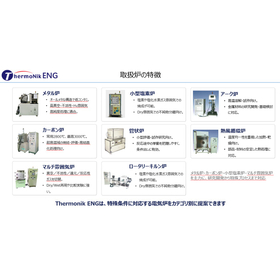
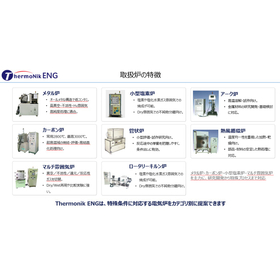
Metal furnace | Reducing the influence of O, C, and H₂O in an ultra-high vacuum and high-purity atmosphere.

Control of degassing, dehydration, and decarbonization of oxide and nitride materials in ultra-high vacuum to reducing atmosphere.

The "metal furnace" we handle is an electric furnace designed for high-purity heat treatment in an ultra-high vacuum atmosphere. By constructing the hot zone inside the furnace with metal materials, it suppresses outgassing and carbon contamination from graphite materials, insulation materials, and organic substances, creating a clean heat treatment environment that reduces the influence of oxygen, carbon, and moisture. The metal furnace accommodates atmosphere control from ultra-high vacuum to Ar/N₂/H₂, thanks to its metal heater and metal chamber structure, making it suitable for degassing, dehydration, decarbonization, and reduction treatment of high-purity powders and ceramic components. **Features** - Supports ultra-high vacuum atmosphere - Achieves vacuum levels of 10^-3 to 10^-5 Pa - Metal hot zone construction - Reduces contamination from furnace materials due to metal heater and chamber structure - High-precision temperature and atmosphere control - Accommodates atmosphere control tailored to specific needs, including vacuum, Ar, N₂, and H₂ - Scalable from small to large - After confirming conditions with a small unit, expansion to a larger furnace can be considered Additionally, we can conduct firing tests using actual samples as a condition check before equipment installation. *For more details, please feel free to contact us.*

  • Industrial Furnace
  • Furnace

Added to bookmarks

Bookmarks list

Bookmark has been removed

Bookmarks list

You can't add any more bookmarks

By registering as a member, you can increase the number of bookmarks you can save and organize them with labels.

Free membership registration

Metal furnace | Brazing ceramics and metals in a high-purity atmosphere

Strongly sealing in a clean atmosphere while controlling the thermal expansion difference between ceramics and metals.

The "Metal Furnace" we handle is a high-purity atmosphere furnace suitable for sealing, brazing, and diffusion bonding of ceramics and metals. Trace amounts of O2/H2O/hydrocarbons affect wettability, interfacial reactions, and airtightness. The Metal Furnace enables heat treatment with reduced carbon and organic contamination due to its high vacuum atmosphere and Mo/W-based metal hot zone. It is also applicable for high-purity annealing and sealing treatments of thin films, electrodes, and optical components. 【Features】 ■ Reduces the impact of residual gases in a high vacuum atmosphere ■ Maintains a clean atmosphere with a metal hot zone ■ Temperature uniformity within ±1°C and long-term stable control ■ Compatible with metal jigs and load mechanisms ■ Supports miniaturization of samples and localized heating tests *For more detailed information, please download the materials or feel free to contact us.

  • Industrial Furnace
  • Furnace

Added to bookmarks

Bookmarks list

Bookmark has been removed

Bookmarks list

You can't add any more bookmarks

By registering as a member, you can increase the number of bookmarks you can save and organize them with labels.

Free membership registration

Metal furnace | High-purity heat treatment furnace free from contamination, such as extreme vacuum and furnace materials.

High-purity heat treatment with reduced contamination from furnace materials using extreme vacuum and metal hot zones.

The "Metal Furnace" we handle is an electric furnace designed for high-purity heat treatment in an ultra-high vacuum atmosphere. By constructing the hot zone inside the furnace with metal materials, we suppress outgassing and carbon contamination from graphite materials, insulation materials, and organic substances, creating an environment that facilitates the evaluation of the material's inherent surface reactions and phase changes. In the metal furnace, clean heat treatment is possible by using metal-based materials for the inner walls, heaters, and fixtures, thereby minimizing contamination from the furnace materials. It is particularly suitable for materials that are sensitive to contamination from furnace materials, those that require accurate evaluation of surface reactions and phase changes, and for annealing precious metals, transition metals, thin films, electrode materials, and optical components. **Features** ■ Compatible with ultra-high vacuum atmosphere - Capable of forming an ultra-high vacuum atmosphere that is difficult to achieve with other electric furnaces - Supports high-purity heat treatment while minimizing the effects of oxygen, moisture, and residual gases ■ Suppression of contamination from furnace materials - Easier to mitigate the effects of furnace material degradation, powdering, and outgassing over long-term use - Applicable to materials that are sensitive to contamination from insulation materials and graphite components Additionally, we can accommodate firing tests using actual samples to confirm conditions before equipment installation. *For more details, please feel free to contact us.*

  • Industrial Furnace
  • Furnace

Added to bookmarks

Bookmarks list

Bookmark has been removed

Bookmarks list

You can't add any more bookmarks

By registering as a member, you can increase the number of bookmarks you can save and organize them with labels.

Free membership registration

Carbon furnace | Supports ultra-low oxygen and high-temperature firing tests at 3000°C level.

Re-evaluation of high-temperature treatment at around 3000°C using vacuum replacement and carbon gettering.

We can accommodate ultra-low oxygen and ultra-high temperature sintering tests before equipment installation. Even at a stage where temperature, atmosphere, and processing time are not yet determined, you can consult us about the test conditions tailored to your objectives. Through preliminary evaluations using actual samples, we can confirm graphitization, recrystallization, grain growth, phase formation, and oxidation effects, which can be utilized in the consideration of equipment specifications. Our "carbon furnace" addresses challenges such as the time-consuming condition setting and the difficulty of achieving reproducibility in short cycles. By evacuating the air inside the sample in advance, we shorten the replacement time. Additionally, with the flexibility of tray arrangement and shelf configuration, we can arrange rectangular containers in parallel, allowing for the evaluation of thickness variation effects. We also have test equipment available. Please feel free to contact us when needed. [Reasons Why Our Carbon Furnace is Effective (Partial)] ■ Sintering under ultra-low oxygen partial pressure - Vacuum → staged replacement with Ar/N2 - Reduction of residual O2/oxidizing species through the getter effect of carbon materials ■ Ultra-high temperature processes - Long-term stable operation in the range of 2800°C for regular use, up to a maximum of 3000°C - Precise control of grain growth and rearrangement through gradual heating and holding in the range of 1200°C to 2600°C *For more details, please feel free to contact us.

  • Industrial Furnace
  • Furnace

Added to bookmarks

Bookmarks list

Bookmark has been removed

Bookmarks list

You can't add any more bookmarks

By registering as a member, you can increase the number of bookmarks you can save and organize them with labels.

Free membership registration

Carbon furnace | Compatible with ultra-low oxygen and high-temperature firing at 3000°C level.

Reproducibly perform graphitization, carbonization, nitridation, and high-temperature modification in an extremely low oxygen atmosphere.

The "carbon furnace" we handle is an electric furnace designed for high-temperature processing at around 3000°C in an extremely low-oxygen atmosphere. By using vacuum replacement, the air inside the furnace is preemptively expelled, and the getter effect of the carbon material reduces residual oxygen and oxidizing components. It is structured to suppress oxidation, decarburization, and re-oxidation in high-temperature regions, making it easier to reproduce processing conditions such as graphitization, carbonization, nitridation, and high-temperature modification. It can be applied to high-temperature processing of carbon materials, carbon black, CNT, CNF, graphite sheets, ceramics, powder metallurgy materials, semiconductor fixtures, and more. 【Features】 ■ High-temperature sintering in an extremely low-oxygen atmosphere ■ Usable at a constant 2800°C, with a maximum of 3000°C ■ Reduction of residual air in the furnace through vacuum replacement ■ Oxygen getter effect from the carbon material ■ Design allows for simultaneous processing of multiple samples with a saya-tray configuration *For more details, please download the materials or contact us.

  • Industrial Furnace
  • Furnace

Added to bookmarks

Bookmarks list

Bookmark has been removed

Bookmarks list

You can't add any more bookmarks

By registering as a member, you can increase the number of bookmarks you can save and organize them with labels.

Free membership registration

Small Chlorine Furnace | Test furnace for safely handling chlorine and hydrogen chloride gas

Safe consideration of Cl2/HCl treatment in a small furnace with negative pressure operation, corrosion-resistant design, and scrubber interlock.

In processes using corrosive gases such as Cl2 and HCl, safety design is crucial to address issues like gas leaks, corrosion of piping and furnace materials, exhaust of unreacted gases, and waste treatment. Our company offers a "small chlorine furnace" for research and development purposes. This equipment is a compact furnace that can safely and controllably handle chlorine and hydrogen chloride, and it can be used for condition testing in material testing with corrosive gases, removal of metal impurities, selective chlorination, and jig cleaning. By combining a furnace and piping structure made of corrosion-resistant materials, scrubber interlocks, corrosive gas monitors, emergency shutdowns, and interlocks, we can consider configurations that make it easier to safely conduct Cl2/HCl processing even for research applications. 【Features】 ■ Compatible with corrosive gas processing such as Cl2/HCl ■ Reduces the risk of gas leakage outside the furnace through continuous negative pressure operation ■ Furnace and piping structure made of corrosion-resistant materials ■ Possible integration with scrubbers, corrosive gas monitors, and emergency shutdowns *For more details, please download the materials or contact us.

  • Industrial Furnace
  • Furnace

Added to bookmarks

Bookmarks list

Bookmark has been removed

Bookmarks list

You can't add any more bookmarks

By registering as a member, you can increase the number of bookmarks you can save and organize them with labels.

Free membership registration

Multi-atmosphere furnace |Precision design with dual axes of atmosphere and temperature

Vacuum replacement → Program switch to air/N2/Ar/(small amount of H2 as needed). Reproduce and evaluate phase transition, phase stability, and surface chemistry well.

Our company offers a "Multi-Atmosphere Furnace" that is precisely designed for material evaluation and phase transition testing in oxidation/reduction atmospheres, utilizing a dual-axis of "atmosphere x temperature." It features a built-in vacuum system that allows for vacuum replacement before and after processing, followed by replacement with the specified gas, thereby reducing the risk of residual gas during furnace opening. Additionally, the high degree of freedom in tray design allows for parallel DOE (Design of Experiments) under the same conditions and multiple samples, enabling the extraction of optimal conditions for scale-up in a short cycle. [Reasons why our carbon furnace is effective for graphitization] - Compatible with generated gases such as NH3 and CO: Designed with materials, piping temperature control, and instrumentation tailored to gas characteristics. - Built-in vacuum system: Allows for vacuum replacement before and after processing, followed by replacement with the specified gas, reducing the risk of residual gas during furnace opening. - Rectangular casing x stacked design: High flexibility in tray design allows for parallel DOE under the same conditions and multiple samples, enabling the extraction of optimal conditions for scale-up in a short cycle. *For more detailed information, please download the materials or feel free to contact us.

  • Industrial Furnace
  • Furnace

Added to bookmarks

Bookmarks list

Bookmark has been removed

Bookmarks list

You can't add any more bookmarks

By registering as a member, you can increase the number of bookmarks you can save and organize them with labels.

Free membership registration

Tube furnace | Visualizing temperature, flow rate, and pressure during ceramics sintering

Synchronize the recording of temperature, flow rate, and pressure during firing to streamline the condition setting.

We handle a "tubular furnace" suitable for examining the conditions of the ceramics firing process. In ceramics firing, temperature, pressure, atmosphere gas, and flow conditions significantly affect the firing results. General-purpose tubular furnaces may only evaluate before and after firing, making it difficult to grasp temperature changes, pressure fluctuations, and gas flow during firing. This equipment incorporates MFCs, pressure gauges, thermocouples, sampling lines, and other components according to the application, allowing for the recording of temperature, flow, and pressure during firing with the same timestamp. 【Features】 ■ Synchronized logging of temperature, flow, and pressure ■ Implementation of MFCs, pressure gauges, and thermocouples according to application ■ Design of sampling ports and exhaust lines ■ Compatible with various atmospheres such as vacuum, inert gas, and H2 ■ Ideal for comparing ceramics firing conditions and verifying reproducibility *For more details, please download the materials or contact us.

  • Industrial Furnace
  • Furnace

Added to bookmarks

Bookmarks list

Bookmark has been removed

Bookmarks list

You can't add any more bookmarks

By registering as a member, you can increase the number of bookmarks you can save and organize them with labels.

Free membership registration

Multi-atmosphere furnace | Improvement of reproducibility in ceramics sintering and densification conditions

Manage dew point and oxygen concentration to reproducibly evaluate ceramics sintering and densification conditions.

In the sintering and densification of ceramics, not only temperature but also atmospheric gas, dew point, oxygen concentration, and heating conditions affect density, porosity, grain growth, and surface condition. In particular, when managing firing in a humid atmosphere, switching between oxidizing and reducing atmospheres, or controlling atmospheric history such as drying → humidifying → drying, it can be difficult to reproduce conditions with conventional electric furnaces or tube furnaces. Our multi-atmosphere furnace can switch to various atmospheric gases such as N2, Ar, Air, H2, and NH3 after displacing the air in the furnace through vacuum replacement. Additionally, by connecting a Wetter, it is possible to examine ceramic firing conditions that manage humid atmospheres and dew points. 【Features】 ■ Capable of switching to various gas atmospheres after vacuum replacement ■ Supports humid atmosphere and dew point control through Wetter connection ■ Can manage atmospheric history such as drying → humidifying → drying ■ Enables examination of sintering, densification, and high-density conditions for ceramics ■ Condition management combining dew point meters and O2 meters can also be considered *For more details, please download the materials or contact us.

  • Industrial Furnace
  • Furnace

Added to bookmarks

Bookmarks list

Bookmark has been removed

Bookmarks list

You can't add any more bookmarks

By registering as a member, you can increase the number of bookmarks you can save and organize them with labels.

Free membership registration

Multi-Atmosphere Furnace | Dew Point Control and Metal Surface Treatment with Humid Atmosphere

Manage dew point and oxygen concentration to prevent oxidation, modify, and pre-treat metal surfaces.

In the surface treatment of metal parts and powder materials, not only temperature but also ambient gas, dew point, oxygen concentration, and treatment time significantly affect the surface condition and quality. In particular, for oxidation prevention, surface modification, coating pretreatment, and hydrophilization/hydrophobicity treatment, it is important to reproducibly examine conditions while switching between dry, humid, and reducing atmospheres. Our multi-atmosphere furnace can switch between various ambient gases such as N2, Ar, Air, H2, and NH3 after displacing the air in the furnace through vacuum replacement. Additionally, by connecting a Wetter, it is possible to manage surface treatment conditions with controlled humid atmospheres and dew points. 【Features】 ■ Capable of switching to various gas atmospheres after vacuum replacement ■ Supports humid atmosphere and dew point control through Wetter connection ■ Can manage atmosphere history such as dry → humid → dry ■ Applicable for oxidation prevention, surface modification, and pretreatment of metal surfaces ■ Condition management combining dew point meters and O2 meters can also be considered *For more details, please download the materials or contact us.

  • Industrial Furnace
  • Furnace

Added to bookmarks

Bookmarks list

Bookmark has been removed

Bookmarks list

You can't add any more bookmarks

By registering as a member, you can increase the number of bookmarks you can save and organize them with labels.

Free membership registration

Multi-atmosphere furnace | For firing environmental purification materials and exhaust gas evaluation

Support for the firing of environmental purification materials and exhaust gas evaluation with atmosphere control such as vacuum, air, and NH3.

In the development of environmental purification materials and catalyst materials, the atmosphere, temperature, and exhaust gas components during firing can affect material performance. Particularly in the firing of materials containing organic components, the activation of catalysts, and treatments involving the generation of gases such as NH3 and CO, controlling the furnace atmosphere and considering exhaust gas treatment equipment are crucial. Our multi-atmosphere furnace can accommodate multiple atmospheres such as vacuum, air, N2, Ar, and NH3, and can be custom-designed according to the firing conditions and exhaust gas generation conditions of the materials. For the firing and heat treatment of environmental purification materials, catalyst materials, adsorbents, and ceramic materials, we can provide a comprehensive examination from the furnace body to gas supply, exhaust, and pollution control equipment. ■ I want to examine the firing conditions for environmental purification materials and catalyst materials. ■ I want to consider exhaust equipment assuming the generation of gases such as NH3 and CO. ■ I want to process in multiple atmospheres such as vacuum, air, N2, Ar, and NH3. ■ The existing furnaces do not match the gas types, furnace dimensions, and exhaust gas treatment conditions. ■ I would like to consult from research and development to prototype and pre-mass production evaluation. * The materials include points for consideration such as the basic configuration of the multi-atmosphere furnace, compatible atmospheres, temperature specifications, gas supply and exhaust equipment, and exhaust gas treatment.

  • Industrial Furnace
  • Furnace

Added to bookmarks

Bookmarks list

Bookmark has been removed

Bookmarks list

You can't add any more bookmarks

By registering as a member, you can increase the number of bookmarks you can save and organize them with labels.

Free membership registration

Metal furnace | For hermetic sealing, brazing, and high vacuum heat treatment of semiconductor components

Supports airtight sealing and reliability improvement of semiconductor components in a high vacuum and high purity atmosphere.

In semiconductor components, ensuring long-term reliability requires airtightness during the sealing process and the suppression of oxidation and contamination. In particular, the sealing of ceramics and metals, brazing, annealing, and firing are influenced by the cleanliness of the furnace and the control of vacuum and atmosphere. Our metal furnace is constructed with metal components, making it easier to minimize the impact of dust and impurities from insulation materials, and it is suitable for heat treatment in a clean, high-purity atmosphere. Additionally, it can be easily reduced to high vacuum compared to conventional insulation furnaces, allowing for the sealing, brazing, oxidation prevention, and annealing of semiconductor components in vacuum, N2, Ar, and H2 atmospheres. ■ I want to consider the airtight sealing conditions for semiconductor components. ■ I want to stabilize the bonding and sealing quality of ceramics and metals. ■ I want to process in a high-purity atmosphere that suppresses oxidation and contamination. ■ I want to perform heat treatment in high vacuum, N2, Ar, and H2 atmospheres. ■ The vacuum level, cleanliness, and internal dimensions of off-the-shelf furnaces do not meet my requirements.

  • Industrial Furnace
  • Furnace

Added to bookmarks

Bookmarks list

Bookmark has been removed

Bookmarks list

You can't add any more bookmarks

By registering as a member, you can increase the number of bookmarks you can save and organize them with labels.

Free membership registration

Metal furnace for sample preprocessing analysis | Compatible with high vacuum and high purity atmosphere

Supports degassing, oxidation prevention, and stabilization of samples before analysis in a high vacuum and high purity atmosphere.

In analysis and evaluation, factors such as oxidation of the sample surface, adsorbed moisture, residual gases, organic components, and contamination by impurities can affect the measurement results. Particularly before conducting high-precision analysis, surface analysis, or material evaluation, it is important to thermally treat the analytical sample under high vacuum and high purity conditions to stabilize its state. Our metal furnace is constructed with metal components, which makes it easier to minimize the influence of dust and impurities from insulation materials, allowing for cleaner high-purity atmospheres for firing and heat treatment compared to other types of furnaces. Additionally, it is easier to achieve high vacuum compared to conventional insulated furnaces, enabling degassing, oxidation prevention, reduction treatment, annealing, and consideration of heat treatment conditions for samples in vacuum, N2, Ar, H2, and other atmospheres. ■ I want to degas the sample in high vacuum before analysis. ■ I want to minimize the effects of surface oxidation and adsorbed moisture. ■ I want to thermally treat the analytical sample in a high-purity atmosphere. ■ I want to perform sample pretreatment in vacuum, N2, Ar, H2 atmospheres. ■ The existing furnaces do not meet the required vacuum level, cleanliness, or internal dimensions.

  • Industrial Furnace
  • Furnace

Added to bookmarks

Bookmarks list

Bookmark has been removed

Bookmarks list

You can't add any more bookmarks

By registering as a member, you can increase the number of bookmarks you can save and organize them with labels.

Free membership registration

Metal furnace for research and development | Compatible with vacuum, reduction atmosphere, and high-temperature heat treatment

Support for material development and high-temperature heat treatment in a vacuum and reducing atmosphere.

In research and development as well as prototype evaluation, a high-temperature furnace that can meticulously examine temperature, atmosphere, and processing time for each material is essential. Particularly in the bonding of ceramics and metals, brazing, annealing, firing, and reduction atmosphere treatments, the cleanliness and atmosphere control within the furnace significantly affect quality. Our metal furnace is a high-temperature atmosphere furnace that uses metal heaters such as Mo and W, and it can accommodate atmospheres like vacuum, N2, Ar, and H2. We offer custom designs based on the material, size, temperature, and atmosphere of the items being processed, suitable for material evaluation, prototyping, and pre-production studies at universities, research institutions, and corporate research labs. ■ Looking for a high-temperature furnace for research and development ■ Want to consider bonding and sealing of ceramics and metals ■ Want to evaluate brazing, annealing, and firing conditions ■ Want to process in vacuum, N2, Ar, and H2 atmospheres ■ Standard furnaces do not meet temperature, internal dimensions, and atmosphere conditions

  • Industrial Furnace
  • Furnace

Added to bookmarks

Bookmarks list

Bookmark has been removed

Bookmarks list

You can't add any more bookmarks

By registering as a member, you can increase the number of bookmarks you can save and organize them with labels.

Free membership registration

Metal furnace | For sealing, brazing optical components, and high-purity atmosphere sintering.

Support for sealing, brazing, and heat treatment of optical components in a high-purity atmosphere.

In the manufacturing of optical components, it is important to process materials while minimizing oxidation and contamination, under stable temperature and atmospheric conditions. In particular, the cleanliness of the furnace atmosphere and temperature uniformity significantly affect the quality in processes such as hermetic sealing of ceramics and metals, glass sealing, brazing, annealing, and sintering. Our metal furnace is a high-temperature atmosphere furnace that uses metal heaters such as Mo and W, and can accommodate atmospheres like vacuum, N2, Ar, and H2. We offer custom designs based on the material, size, temperature, and atmosphere of the items being processed, including optical components, sensor components, electronic components, and ceramic components. ■ I want to perform hermetic sealing of ceramics and metals. ■ I want to consider brazing and annealing conditions for optical components. ■ I want to conduct heat treatment in an atmosphere that minimizes oxidation and contamination. ■ I want to process in vacuum, N2, Ar, or H2 atmospheres. ■ The temperature, internal dimensions, and atmospheric conditions of off-the-shelf furnaces do not meet my needs.

  • Industrial Furnace
  • Furnace

Added to bookmarks

Bookmarks list

Bookmark has been removed

Bookmarks list

You can't add any more bookmarks

By registering as a member, you can increase the number of bookmarks you can save and organize them with labels.

Free membership registration

Carbon furnace for aerospace heat-resistant components | Maximum 3000°C, compatible with vacuum atmosphere

Supports the development and manufacturing of heat-resistant components for aerospace applications through high-temperature firing at up to 3000℃ in a low-oxygen atmosphere.

In the aerospace field, the quality stability of heat-resistant components and composite materials used in high-temperature environments is crucial. For the firing of turbine parts, rocket-related components, C/C composites, and ceramic materials, not only temperature conditions but also vacuum and inert atmosphere control to suppress oxidation are required. Our carbon furnace supports high-temperature heating up to 3000°C and enables high-temperature firing in a low-oxygen atmosphere by replacing the environment with Ar, N2, etc., after vacuuming. We offer custom designs based on the material, size, temperature, and atmosphere of the items being processed, including firing, carbonization, graphitization, sintering, and heat treatment conditions for heat-resistant components. ■ I want to consider firing conditions for heat-resistant components for aerospace applications. ■ I want to perform high-temperature processing above 2000°C. ■ I want to process C/C composites and ceramic materials. ■ I want to fire in a vacuum or inert atmosphere that suppresses oxidation. ■ I would like to consult from research and development to prototype and pre-mass production evaluation.

  • Industrial Furnace
  • Furnace

Added to bookmarks

Bookmarks list

Bookmark has been removed

Bookmarks list

You can't add any more bookmarks

By registering as a member, you can increase the number of bookmarks you can save and organize them with labels.

Free membership registration

Ceramics High-Density Carbon Furnace | Maximum 3000°C, Inert Atmosphere Compatible

Supports high-density and sintering of ceramics in a high-temperature firing of up to 3000℃ and low-oxygen atmosphere.

In the densification of ceramic materials, it is necessary to examine the optimal heat treatment conditions for each material, including debinding, pre-sintering, sintering, pressure sintering, and atmosphere control. In particular, when high-temperature processing is desired while suppressing oxidation, or when the temperature, atmosphere, and furnace dimensions of a conventional electric furnace do not meet requirements, the use of a carbon furnace is effective. Our carbon furnace supports high-temperature heating up to 3000°C and enables firing in a low-oxygen atmosphere by replacing the environment with inert gases such as Ar or N2 after vacuum pumping. Custom designs tailored to specific purposes are possible, ranging from research and development to mass production equipment, for applications such as densification of ceramics, promotion of sintering, phase formation, and high-temperature processing after debinding. We can address challenges such as the following: ■ I want to increase the density of ceramics. ■ I want to consider high sintering temperatures. ■ I want to consistently perform firing and densification after debinding. ■ I want to fire while suppressing oxidation and compositional changes. ■ I want to process in atmospheres such as Ar, N2, or vacuum. ■ The dimensions and temperature conditions of off-the-shelf furnaces do not meet my needs. ■ I want to consult from lab testing to mass production furnaces.

  • Industrial Furnace
  • Furnace

Added to bookmarks

Bookmarks list

Bookmark has been removed

Bookmarks list

You can't add any more bookmarks

By registering as a member, you can increase the number of bookmarks you can save and organize them with labels.

Free membership registration

How to Choose a Atmosphere Furnace | Comparison Table by Furnace Type

Aren't you just choosing based on the maximum temperature? Comparison materials for furnace type selection.

Are you having trouble selecting a furnace or electric furnace? If you choose an electric furnace based solely on maximum temperature, mismatches may occur in terms of operating atmosphere, vacuum level, gas flow, sample size, safety measures, and exhaust gas treatment. This document compares multi-atmosphere furnaces, tube furnaces, metal furnaces, carbon furnaces, and small chlorine furnaces in terms of temperature range, compatible atmospheres, preferred applications, and points to note. ■ Quickly understand the differences between furnace types ■ Useful for specification discussions before equipment installation ■ Effective for preliminary organization of firing tests and condition exploration ■ Also addresses confirmation of firing feasibility in special atmospheres

  • Industrial Furnace
  • Furnace

Added to bookmarks

Bookmarks list

Bookmark has been removed

Bookmarks list

You can't add any more bookmarks

By registering as a member, you can increase the number of bookmarks you can save and organize them with labels.

Free membership registration

Electric Furnace Introduction Pre-Check List | 10 Items to Confirm in Specification Review

Organizing 10 items to check before introducing an electric furnace.

Before introducing an electric furnace, are there any omissions in the specification review? It is necessary to organize the specifications not only for the maximum temperature but also for the processing purpose, atmosphere gas, pressure conditions, sample conditions, containers and fixtures, exhaust gas treatment, safety measures, and installation conditions. This document organizes 10 items to check before the introduction of electric furnaces and atmosphere furnaces in a checklist format. ■ For organizing specifications before equipment introduction ■ For confirming conditions before firing tests ■ For initial considerations of special atmospheres, vacuum, reduction, and nitriding treatments ■ Can be used as internal confirmation materials before requesting estimates Please feel free to consult us even if you are at the stage of "not knowing which conditions to communicate to the manufacturer."

  • Industrial Furnace
  • Furnace

Added to bookmarks

Bookmarks list

Bookmark has been removed

Bookmarks list

You can't add any more bookmarks

By registering as a member, you can increase the number of bookmarks you can save and organize them with labels.

Free membership registration

Pre-introduction firing test of equipment | Confirming condition exploration, safety, and mass production deployment

Before deciding on the equipment specifications, confirm the reactivity with a small sample.

Before deciding on the specifications for electric furnaces and atmosphere furnaces, have you organized the conditions that should be confirmed through firing tests? In firing tests conducted before equipment installation, it is important to verify whether "the desired reaction occurs," "it can be processed safely," and "it can be scaled up to mass production conditions" using small sample sizes. This document organizes the planning items for confirming reactivity, safety, and reproducibility by varying temperature, atmosphere, processing time, flow rate, and pressure, focusing on processes such as firing, debinding, reduction, oxidation, nitriding, degassing, and impurity removal. ■ For exploring conditions before equipment installation ■ To prevent omissions in firing test planning ■ For consideration of furnace volume, gas systems, exhaust gas treatment, and jig specifications ■ For making scale-up decisions to mass production furnaces

  • Industrial Furnace
  • Furnace

Added to bookmarks

Bookmarks list

Bookmark has been removed

Bookmarks list

You can't add any more bookmarks

By registering as a member, you can increase the number of bookmarks you can save and organize them with labels.

Free membership registration

Differences between sintering, heat treatment, degreasing, and reduction | Selecting electric furnaces by purpose

Organize electric furnaces suitable for sintering, heat treatment, degreasing, and reduction.

Are you able to organize the differences between firing, heat treatment, degreasing, and reduction? Even with the same "heat treatment," the necessary temperature range, atmosphere, exhaust gas measures, safety measures, temperature distribution, and sample collection methods change depending on the purpose. For example, in firing, reaction completion and temperature distribution are important; in degreasing, generated gases, tar, and rapid reactions are critical; in reduction, H₂ concentration, substitution management, and explosion limits are key; and in heat treatment, uniformity, cooling conditions, and high-purity atmosphere are essential. This document organizes the representative conditions, main atmospheres, key points, suitable types of furnaces, and pre-check items for firing, heat treatment, degreasing, and reduction in a list format. ■ For selecting electric furnaces and atmosphere furnaces that match the treatment purpose ■ For organizing conditions before equipment installation ■ For preliminary consideration of firing tests and condition exploration ■ Can be used as internal confirmation materials before requesting estimates

  • Industrial Furnace
  • Furnace

Added to bookmarks

Bookmarks list

Bookmark has been removed

Bookmarks list

You can't add any more bookmarks

By registering as a member, you can increase the number of bookmarks you can save and organize them with labels.

Free membership registration

How to Choose an Electric Furnace for Research and Development | Suitable for Prototyping, Condition Exploration, and Small-Scale Firing

Check the specifications of the electric furnace needed for trial production and condition exploration.

Are you selecting electric furnaces for research and development solely based on maximum temperature? In research and development, particularly in material development, there are cases where you want to compare multiple conditions of temperature, time, and atmosphere while the firing conditions are not yet established. Additionally, challenges may arise such as having a small sample size, wanting to use atmospheres like N₂, Ar, H₂, NH₃, O₂, vacuum, or humidified air, and needing to check safety aspects like powder dispersion, gas generation, corrosion, and explosion limits. This document organizes the specifications that should be confirmed when considering electric furnaces for research and development, as well as guidelines for selecting furnace types based on purpose. ■ For selecting electric furnaces in the research and development and material development stages ■ For initial considerations in prototyping, condition exploration, and small-scale firing ■ For considering firing tests in multiple atmospheres ■ For organizing specifications before requesting estimates ■ Can be used as internal discussion material before equipment introduction Even at a stage where conditions are not yet determined, we will propose ways to proceed with firing tests and equipment specifications based on sample shape, temperature range, and atmospheric conditions.

  • Industrial Furnace
  • Furnace

Added to bookmarks

Bookmarks list

Bookmark has been removed

Bookmarks list

You can't add any more bookmarks

By registering as a member, you can increase the number of bookmarks you can save and organize them with labels.

Free membership registration

Selection of O₂・Air Atmosphere Sintering Furnace | Compatible with Oxidation, Degreasing, and Pyrolysis Evaluation

Organize the types of furnaces suitable for oxidation, degreasing, and pyrolysis, along with exhaust measures.

Are you considering evaluating oxidation firing, debinding, and thermal decomposition in an O₂・Air atmosphere? For processing in an O₂・Air atmosphere, we focus on using tube furnaces for confirming the reaction behavior of small samples, while multi-atmosphere furnaces are primarily used for evaluating a variety of samples such as powders, substrates, and components with significant debinding amounts. In particular, for debinding and thermal decomposition, it is important to consider the generation of organic components, CO/CO₂, moisture, odors, and dust, and to include specifications that cover not only the furnace body but also the exhaust line, safety measures, and treatment of generated gases. This document organizes the differentiation between tube furnaces and multi-atmosphere furnaces for O₂・Air atmosphere firing, items to be confirmed in advance, and considerations for exhaust and safety measures. ■ For selecting furnace types for oxidation firing, debinding, and thermal decomposition evaluation ■ For confirming the differentiation between tube furnaces and multi-atmosphere furnaces ■ For confirming the reaction behavior of small samples ■ For evaluating the debinding of powders, substrates, and components ■ For firing tests and condition exploration before equipment installation

  • Industrial Furnace
  • Furnace

Added to bookmarks

Bookmarks list

Bookmark has been removed

Bookmarks list

You can't add any more bookmarks

By registering as a member, you can increase the number of bookmarks you can save and organize them with labels.

Free membership registration

Selection of furnace for Cl₂・HCl special atmosphere sintering | Corresponding to chlorination reaction and corrosion evaluation

Organize the firing conditions and safety specifications using corrosive gases.

Are you considering sintering, chlorination reactions, and corrosion evaluation in a special atmosphere such as Cl₂ and HCl? In sintering using corrosive and reactive gases like Cl₂ and HCl, it is necessary to consider specifications not only for temperature and gas concentration but also for materials inside the furnace, jig materials, sealing materials, piping, valves, exhaust piping, pollution control devices, and safety interlocks. In particular, for chlorination reactions and volatile separation, the volatility of the generated chlorides, condensation location, recovery methods, insulation of exhaust piping, and pollution control capabilities are important. Additionally, since corrosive gases are handled, leak prevention measures, gas detection, exhaust routes, and safety shutdown conditions significantly impact equipment specifications. This document organizes the treatment objectives, gas conditions, furnace type selection, and key points for confirming jigs, piping, exhaust, pollution control, and safety measures in Cl₂ and HCl special atmosphere sintering. - For sintering and reaction evaluation in Cl₂ and HCl atmospheres - For consideration of chlorination reactions, volatile separation, and impurity removal - For removal of deposits from jigs and components, and evaluation of corrosion and durability - For insulation of exhaust, condensation measures, and specification review of pollution control devices - For sintering tests and condition exploration before equipment installation

  • Industrial Furnace
  • Furnace

Added to bookmarks

Bookmarks list

Bookmark has been removed

Bookmarks list

You can't add any more bookmarks

By registering as a member, you can increase the number of bookmarks you can save and organize them with labels.

Free membership registration

Global market size of vacuum aluminum brazing furnaces (VAB)

This report systematically analyzes the medium to long-term growth trends of the vacuum aluminum brazing furnace (VAB) market from both quantitative and qualitative perspectives.

This document provides an explanation of the global market size for vacuum aluminum brazing furnaces (VAB). It covers an overview of vacuum aluminum brazing furnaces (VAB), analysis by product type, analysis by application, analysis by company, analysis by region, technological innovations, and future market outlook. Our company, based in Tokyo, integrates industrial information from around the world and provides reports to support corporate decision-making. *For more details, please download the PDF or feel free to contact us.*

  • others
  • Furnace

Added to bookmarks

Bookmarks list

Bookmark has been removed

Bookmarks list

You can't add any more bookmarks

By registering as a member, you can increase the number of bookmarks you can save and organize them with labels.

Free membership registration

Three Major Features of the Tornado: <Hot Air Circulation Mechanism>

Pursuing cost reduction! After heating in the furnace, there is no need to reheat the outside air due to the circulation structure.

The "hot air circulation mechanism" controls heat and airflow by circulating hot air, maintaining a consistent overall temperature distribution, and evenly directing airflow onto the workpiece (product). After the temperature rises inside the furnace, there is no need to reheat outside air due to the circulation structure. Power consumption is 2/3 (compared to our company), and there is no need for a dryer or double pass. Please feel free to contact us when you need assistance. 【Features】 ■ Maintains a consistent overall temperature distribution ■ Can direct airflow evenly ■ No need to reheat outside air ■ Power consumption is 2/3 (compared to our company) ■ No dryer or double pass required *For more details, please refer to the PDF document or feel free to contact us.

  • Shrink Wrapping Machine
  • Furnace

Added to bookmarks

Bookmarks list

Bookmark has been removed

Bookmarks list

You can't add any more bookmarks

By registering as a member, you can increase the number of bookmarks you can save and organize them with labels.

Free membership registration

Important processes and technical points from spring re-tempering to painting.

[Reprint Private Spring Preparatory School Lecture 63] An explanation of changes in mechanical properties due to re-burning and the effects of time!

Tempering is a heat treatment for materials that have completed quenching, aimed at providing the most suitable toughness for the spring, making it the most important process for springs. Therefore, the furnace used for this process must be able to accurately match the desired temperature, ideally within plus or minus 5 degrees. Of course, it is preferable for the temperature distribution within the furnace to be uniform. The changes in mechanical properties due to tempering vary with temperature and holding time, but the influence of time is relatively minor. *For detailed content, please refer to the PDF. For more information, feel free to contact us.*

Added to bookmarks

Bookmarks list

Bookmark has been removed

Bookmarks list

You can't add any more bookmarks

By registering as a member, you can increase the number of bookmarks you can save and organize them with labels.

Free membership registration

Contract Analysis Services: Thermal Analysis

We will determine the temperature distribution of the structure, the incoming (outgoing) heat quantity, temperature gradient, heat flux, etc.

[Contracted Analysis Services] Thermal analysis involves determining the temperature distribution, incoming (or outgoing) heat, temperature gradients, heat flux, and so on of structures. It is also possible to conduct analyses to determine the deformation and stress of structures by refining the obtained temperature distribution. For more details, please contact us or refer to the catalog.

  • Other operation management software
  • Integrated operation management
  • Furnace

Added to bookmarks

Bookmarks list

Bookmark has been removed

Bookmarks list

You can't add any more bookmarks

By registering as a member, you can increase the number of bookmarks you can save and organize them with labels.

Free membership registration