

Osaka Vacuum Chemical Chemicolor
We take full responsibility for providing consistent service.
By printing resist ink on PET and PBT resins and allowing the colorant to permeate, it will not peel off.
- Company:大阪真空化学
- Price:Other
Last Updated: Aggregation Period:Aug 19, 2026~Sep 15, 2026
This ranking is based on the number of page views on our site.
Last Updated: Aggregation Period:Aug 19, 2026~Sep 15, 2026
This ranking is based on the number of page views on our site.
Last Updated: Aggregation Period:Aug 19, 2026~Sep 15, 2026
This ranking is based on the number of page views on our site.
271~300 item / All 2112 items
We take full responsibility for providing consistent service.
By printing resist ink on PET and PBT resins and allowing the colorant to permeate, it will not peel off.

We specialize in the manufacturing of cavities and cores for precision plastic molds!
At Sun S Co., Ltd., we specialize in the production of cavities and cores for precision plastic molds. Our company excels in the processing of relatively small precision mold components and precision machine parts, and we are capable of quick turnaround for NC lathe processing, complex lathe processing, and high-speed machining center processing. For any inquiries regarding cavities and cores for precision plastic molds, please feel free to contact us. *For more details, please refer to our catalog or feel free to reach out to us.

High-speed stable production with a tolerance of ±0.01mm! Designing original molds that take everything into consideration.
We would like to introduce the "Mold Manufacturing Business" of Sanwa Mold Co., Ltd. Original molds are designed with a comprehensive consideration of everything from line concepts to maintenance, replacement of consumable parts, and mass production performance. Additionally, the "H3 Mold" offers high precision of 0.01mm, high-speed processing at 120 strokes per minute, and efficient stable production. 【Features】 ■ Consideration from line concepts to maintenance, replacement of consumable parts, and mass production performance ■ Implementation of a unique mold structure through total tool design ■ Achieves maintainability ■ High-speed processing at 120 strokes per minute *For more details, please refer to the PDF materials or feel free to contact us.

Achieving quality and speed with the know-how we have built up! By utilizing multi-skilled workers and our unique production system, we significantly shorten the revision period.
"Have you ever struggled with the contradiction of high quality within a short delivery time?" At Sanwa Mold Co., Ltd., we achieve quality improvement, short delivery times, and cost reduction through comprehensive support from prototype development to production technology development and mass production startup. For example, in the modification of molds after trial completion, we reconstruct suitable processes based on the completed shapes and modification items, drawing from our extensive experience. With our multi-skilled workers and unique production system, we shorten the modification period. 【Features】 ■ Comprehensive support from prototype to mass production ■ Achieving quality improvement, short delivery times, and cost reduction ■ Reconstructing suitable processes based on extensive experience ■ Confidence in the cycle time from modification to retry *For more details, please refer to the PDF document or feel free to contact us.

Achieve quality improvement, short delivery times, and cost reduction with consistent support for measurement testing! Partial process support is also available.
Have you ever experienced a change in shape when a prototype was mass-produced? At Sanwa Mold Co., Ltd., we provide comprehensive support for all processes from prototype development to production technology development and mass production startup. By offering prototypes and molds that have minimal differences from the mass-produced items, we reduce the labor involved in dealing with the mass production department and clients. 【Features】 <Supporting New Product Development> ■ Providing prototypes and molds with minimal differences from mass production ■ Reducing labor for the mass production department and clients ■ Helping improve quality and shorten overall project delivery times by considering concerns during mass production *For more details, please refer to the PDF document or feel free to contact us.

Collect used molds, sort the steel types, and return special steel materials to the steel manufacturer.
Our company prices each type of steel based on the distribution prices of special steel manufacturers. As a result, we receive high evaluations from customers when compared to regular iron scrap prices. We can also perform steel type selection at our company (however, a sorting fee will be charged separately). Additionally, we are enhancing our collection and delivery services, ensuring a smooth collection pace. *Please feel free to consult us regarding collection boxes and other requests. 【Business Content】 ■ Cutting and sales of special steel, tool steel, and mold steel ■ Processing and sales of forging molds and mold parts ■ Processing and sales of die-casting molds and mold parts ■ Material and processing sales of die holders for forging presses ■ Processing and sales of main molds for die-casting molds (affiliated company: Amix Co., Ltd.) ■ Processing and sales of molds and mold parts for hot presses ■ Manufacturing and sales of processing release agents for molds ■ Sales of welding systems for molds ■ Mold recycling business *For more details, please refer to the PDF materials or feel free to contact us.

Every product from Nagumo Manufacturing is custom-made! If you have any issues with precision mold part processing services or precision mold design services, please leave it to us.
The products of Nagumo Manufacturing are all made to order. Our technical department takes the lead in conducting experiments and investigations in response to the issues raised by our customers. Based on the information obtained from this, we carry out prototypes and trials, allowing us to make proposals from the customer's perspective. Additionally, we aim to transform our customers' "impossibilities" into "possibilities" by utilizing the know-how accumulated from such information to solve their problems. 【Business Content】 ■ Lead frame molds (design and manufacturing) ■ Trim & forming molds (design and manufacturing) ■ Insert mold molds (design molds), various molds (design and manufacturing) ■ Ultra-hard alloy high-precision cutting processing ■ Processing of various parts and components, special pressing processing *For more details, please download the catalog or feel free to contact us.

If you're looking for a mold manufacturer that can have a long-term relationship, contact Nagumo Seisakusho Co., Ltd.
● The current mold shop is concerning due to the absence of a successor. ● I am looking for a mold shop with well-equipped facilities. ● I am searching for a mold shop with designers who can provide various consultations. To those in charge who have such concerns: ◎ We are celebrating our 73rd year since establishment and aim to become a 100-year company. ◎ We update our processing machines and measuring instruments with an annual investment of 100 million yen. ◎ Designers in our technical department will work closely with customers to solve problems.
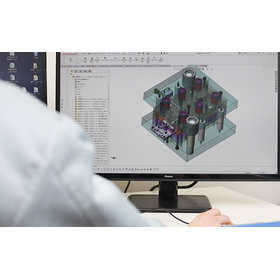
If you are looking for a supplier of molds, please contact Nagumo Seisakusho Co., Ltd.
● The mold supplier we have been dealing with has withdrawn from business, and we can no longer obtain molds. ● To avoid risk, we would like to shift from purchasing from one company to two companies. ● We would also like to try other mold manufacturers. ...To those in charge who have such concerns: ◎ For press molds, we can accommodate both "design and manufacturing by our company" and "manufacturing based on provided drawings." ◎ As a mold supplier, we provide molds that reduce the burden on our customers.

If you want to improve the precision of molds, contact Nagumo Manufacturing Co., Ltd.
● The product has significant burrs and warping, making post-processing difficult. ● There are many dimensional deviations, making sorting challenging. ● Every time the mold is maintained, adjustments are required, which is troublesome. ... To those in charge who have such concerns: ◎ We improve mold precision with machining technology of ±0.002mm. ◎ When mold precision increases, burrs, warping, and dimensional deviations are improved. ◎ When mold precision increases, reproducibility after maintenance improves, allowing for a reduction in adjustment time.
![[Precision Mold Design and Parts Processing Case] Punching of Fiber Materials](https://image.mono.ipros.com/public/product/image/35c/2000593612/IPROS15646106155092654825.png?w=280&h=280)
Design and manufacturing are possible with a minimum clearance of 0.003mm! Processing of new materials such as thin foil and high-strength fibers is also possible.
A consultation was received from an automotive parts manufacturer, stating that they were unable to punch out fiber materials with molds from other companies, resulting in poor productivity, and they wanted to process with our molds. In response, we proposed a minimal clearance of 0.003mm and improvements in mold structure and part accuracy. As a result, we were able to punch out the Vectran fiber material (t=0.05mm) due to the difference in clearance. 【Case Summary】 ■ Customer Industry: Automotive Parts Manufacturer ■ Consultation Content: Unable to punch out fiber materials with molds from other companies ■ Proposed Solution: Minimal clearance of 0.003mm ■ Technology Used: Improvements in mold structure and part accuracy *For more details, please refer to the PDF document or feel free to contact us.
![Press Die [Precision Mold Design and Parts Processing Case] Reduction of Product Burrs](https://image.mono.ipros.com/public/product/image/578/2000593614/IPROS00702503970914089870.png?w=280&h=280)
Eliminate burrs through mold manufacturing that meets the product requirements sought by customers! Introducing a case study from an electronic components manufacturer.
When extracting thin products, it is necessary to set a significantly narrow punch-die clearance, but it is difficult to reliably achieve the specified clearance in tolerance design. However, our company designs components from the planning stage to realize narrow clearances, so we can custom-manufacture both fabricated and purchased parts. As a result, we can produce molds that meet the required specifications for the products our customers seek. 【Case Summary】 ■ Customer's Industry: Electronic Component Manufacturer ■ Inquiry: Desire to cut thin products sharply ■ Proposed Solution: Ultra-small clearance punching die ■ Technology Used: Improvement of mold structure and component precision ■ Outcome: Eliminated burrs that could not be resolved previously *For more details, please refer to the PDF document or feel free to contact us.
![Press Mold [Precision Mold Case] Reduction of Chocolate Stops by Implementing Measures Against Scrap Rise](https://image.mono.ipros.com/public/product/image/cf9/2000726527/IPROS16314617492722742579.png?w=280&h=280)
Introducing examples of parts processing technology using ±2μm precision achieved through the introduction of a new type of processing machine!
At Nagumo Manufacturing, we prevent scrap accumulation and improve productivity by setting appropriate clearances, ensuring machining accuracy, and utilizing adjustment techniques to reduce downtime. We addressed the challenges faced by automotive parts manufacturers struggling with frequent downtime due to scrap accumulation. Our company implemented measures against scrap accumulation for these manufacturers. The average occurrence of scrap accumulation, which was happening 9 times a day, was improved to 0, resulting in a reduction in downtime and a significant increase in factory productivity. 【Overview】 ■ Customer Industry: Automotive parts manufacturing ■ Consultation Details: Frequent scrap accumulation during press processing, causing machine stoppages and inefficiency ■ Proposed Solution: Recommendations for appropriate clearance and changes in part shape ■ Technology Used: Introduction of a new processing machine for part machining with ±2μm accuracy ■ Results: Increased productivity *For more details, please refer to the PDF document or feel free to contact us.
![Press Mold [Precision Mold Parts Processing Example] Precision Machining Technology and Quality Assurance](https://image.mono.ipros.com/public/product/image/59d/2000726537/IPROS20785882145549294241.png?w=280&h=280)
Guaranteed with submicron order shape measurement! We will provide quality assurance in line with the improvement of precision processing technology.
We would like to introduce a case where a manufacturer of automotive parts solved their challenges by introducing a new machining center and wire electrical discharge machine. The manufacturer was struggling with the inability to produce high-precision products despite creating punches and dies through three-dimensional processing to accommodate the miniaturization and complex shapes of products. They faced issues not only with defects but also with the inability of conventional measuring instruments to adequately measure shapes, making it impossible to guarantee precision. To address this, they ensured shape measurement using a laser microscope, which could measure shapes that conventional contact-type tracers could not. 【Overview】 ■ Customer's Industry: Automotive parts manufacturing ■ Processing Technology: Parts processing with a precision of ±2μm using a new machining center and wire electrical discharge machine ■ Quality Assurance: Implementation of three-dimensional measuring instruments (from Mitutoyo, OGP, TESA) and a laser microscope (from KEYENCE) to guarantee shape measurement in the sub-micron order. *For more details, please refer to the PDF document or feel free to contact us.

In the mold shop column, we will be sharing various information about molds from time to time! (We also publish the mold shop column on our Instagram.)
In the previous column, we introduced that there are mainly three types of press molds, focusing on the single-stroke mold. In this column, we will introduce the progressive mold! A progressive mold refers to a type that incorporates multiple processing methods, such as punching, bending, and drawing, into a single mold. This processing method sends the material to the next stage with each press, shaping the product. The material used is typically in a rolled form (coil material) and is automatically fed to the next stage. The advantages include improved production efficiency and stable quality due to automation, as well as the ability to perform more complex processing compared to single-stroke molds since multiple processes can be incorporated. On the other hand, the disadvantages include the complexity of the mold design and manufacturing compared to single-stroke molds, which makes the production cost of the mold relatively high. Additionally, there is a possibility of a "boat bottom phenomenon," where a shift occurs at the tip of the product. (We plan to cover the "boat bottom phenomenon" and "shift" in a future column!) Products suitable for progressive molds are those that require mass production or complex processing. In the next column, we will explain the "transfer mold"!

In the mold shop column, we will continuously share various topics about molds! (We also publish the mold shop column on our company Instagram.)
In this column, I will introduce the "boat bottom phenomenon"! When you want to punch out terminal shapes like those in the icon diagram, processing them at every pitch, as shown in Figure A, results in a reduced area for holding during the punching process. This can lead to situations where the punch comes down with such force that the stripper plate cannot hold the product securely, causing it to tilt over. This is known as the boat bottom phenomenon. The tilted product resembles a boat bottom, hence the name. To avoid this, changes in layout are necessary. For example, one solution could be to use multiple pitch feeding as shown in Figure B. In the case of multiple pitch feeding, a single group is punched out in one go (all punches come down simultaneously), leaving no room for the product to tip over, thus preventing such issues. However, on the other hand, this will narrow the spacing between the dies, which raises concerns about die strength. It is essential to determine specifications based on strength calculations.

I have summarized the basic content regarding the impact of clearance discrepancies due to board thickness differences and the reduction of running costs achieved through uniform clearance.
Clearance (CL) refers to the gap between the punch and die of a mold. CL is set at 4-7% of the material thickness. The range of 4-7% is determined by the thickness of the material. In the PDF document, we introduce: - Examples of clearance settings by material thickness: t=0.1mm / t=0.05mm / t=2.0mm - The impact of uneven clearance based on material thickness - The benefits of achieving uniform clearance Table of contents: - What is clearance? - How to set clearance - Examples of clearance by material thickness - Benefits of achieving uniform clearance

【Kyushu Mechanical Components Technology Exhibition Participation】What causes burrs to occur? We will also introduce measures against burrs!
Burrs that inevitably occur when using press molds. Is there a way to reduce burrs? Why do burrs occur in the first place...? Many people may have such questions about whether it is possible to create molds that produce no burrs at all. If burrs can be minimized, there are many benefits, such as reducing the time for burr removal and ensuring product accuracy. In this document, we will explain in detail why burrs occur in press molds and what measures can be taken to minimize them. Nagumo Manufacturing will be exhibiting at the Kyushu Machine Element Technology Exhibition in Fukuoka, which will be held from November 29 (Wednesday). We look forward to your visit. *For details about the exhibition, please refer to the basic information!

Significantly reduce the burden of large-format and long-size paper folding work!
A zigzag paper folding machine compatible with large sheets and long paper. The folding width can be freely set from 50 to 600 mm, and there are no restrictions on the length of the paper; simply input the folding width on the operation panel. 【Features】 ◆ High folding precision with settings possible in 0.1 mm increments ◆ Folding width can be easily set from 50 mm to 600 mm with one touch ◆ Up to 10 different folding patterns can be registered ◆ Different folding widths can be incorporated during the folding process ◆ Folding can be done at any marked position on the paper (optional feature) ◆ The foldable table does not require much space ◆ The paper discharge direction can be changed, allowing for discharge from either the front or rear.

To enrich the lives of people and the environment.
Since its establishment in 1970, Shinwa Manufacturing has been a specialized company in molds, engaged in integrated production from mold design to assembly, responding to the needs of the times. We have also ventured into the field of plastic molding, further meeting the demands of the industry. For more details, please contact us or download our catalog.

We respond to the needs of every era through the manufacturing of molds for PET bottles.
In the blow molding mold division, we respond to the needs of every era through the manufacturing of molds for PET bottles. Driven by an uncompromising spirit of inquiry, we produce high-quality products. We not only hold meetings with our customers, but also conduct thorough discussions with the respective staff from sales, design, and development after receiving orders. We generously apply the technical know-how of Shinwa Seisakusho during the design and prototyping stages to meet the diverse requests of our clients. [Mold Business] - Blow molding molds - Injection molding molds - Aluminum casting molds For more details, please contact us or download the catalog.

We accommodate special shapes and various sizes, flexibly responding to all needs.
We respond flexibly to all needs, accommodating special shapes and various sizes. As a comprehensive plastic processing manufacturer capable of consistent production from design, data creation, and mold manufacturing to molding within our in-house factory, we have established a well-equipped and efficient production environment. We have equipped ourselves with the latest machining tools, enabling rapid and high-precision mold making. Through three-dimensional design and mold production, along with in-house consistent production and centralized management, we have made it possible to shorten delivery times and reduce costs. [Mold Business] ○ Blow molding molds ○ Injection molding molds ○ Aluminum casting molds For more details, please contact us or download the catalog.

Contributing to the further development of industrial technology through the manufacturing of molds for pistons for internal combustion engines and vehicle components.
The aluminum casting mold division contributes to the further development of industrial technology through the manufacturing of molds for internal combustion engine pistons and vehicle parts. The unique technological capabilities we have built are evident here, and their results have been demonstrated in various fields. Thanks to the unique technological capabilities developed by Shinwa Seisakusho, information regarding quality, processing conditions, and more is strictly managed for each user, enabling a consistent production system. The best quality that Shinwa Seisakusho aims for is based on outstanding technology. [Mold Business] - Blow molding molds - Injection molding molds - Aluminum casting molds For more details, please contact us or download the catalog.

As of November 20, 2012, some catalog products (standard items) will be discontinued.
As of November 20, 2012, some catalog products (standard items) will be discontinued. We apologize for any inconvenience this may cause and appreciate your understanding. ★The products marked with ■ (red text) in catalog KG904 are applicable★

Switching from conventional SKD material to carbide! A powder metallurgy mold that achieves improved mold life.
The "Super Hard Liner" is a powder molding die that achieves improved die life. By pursuing enhanced die life and total cost reduction, the die life is significantly improved. The increase in lifespan also shortens changeover losses. Additionally, our unique technology bonds super hard material to the molding parts. 【Features】 ■ Change from conventional SKD material to super hard ■ A die that pursues improved die life and total cost reduction ■ Significant improvement in die life ■ Reduction in changeover losses due to increased lifespan *For more details, please refer to the PDF document or feel free to contact us.

The casters are built sturdy, ensuring long-lasting durability! We offer the highest quality casters at a price that will satisfy you.
Our company's casters have received high praise and trust both domestically and internationally, and we are recognized for our technology to the extent that we have been designated as a partner by Panasonic. If you have any inquiries regarding purchases, please feel free to contact us. 【Product Features】 Product Name: 29 Series 414 Medium Load TPR Caster ○ The caster is built sturdy, ensuring a long lifespan and excellent durability. ○ Equipped with a double stopper that locks both the wheel rotation and the swivel part of the bracket simultaneously. 【Specifications】 ● You can choose from plate type/screw-in type (swivel/double stopper included/fixed type) for the mounting method. Our company is a manufacturer with over 30 years of extensive experience in the production of casters and bearings. We can also accommodate custom specifications. We offer a variety of casters suitable for different applications. Please feel free to contact us or download the catalog.

It is lightweight and non-combustible, making it ideal for general heating and cooling air conditioning ducts. It can withstand temperatures up to 250°C.
Flexible and adjustable, it can be easily installed on-site even in difficult construction situations. Since it is a compact flexible product, please stretch it out during use for installation.

The 4m type and 2m type are compact for easy portability. Please extend them for use during installation.
Uses high-strength steel foil. The surface is coated to resist rust, and it can withstand temperatures up to 350°C.

Ideal for die-cutting thin films and half-cutting multilayer films!
This is a one-piece Thomson punch (sculpting blade) capable of difficult die-cutting. It achieves precise die-cutting with a high-hardness, high-precision sculpting blade. The blade tip can be re-sharpened and can accommodate high-precision cutting edge shapes. It is ideal for die-cutting thin films and half-cutting multilayer films. For more details, please contact us or refer to the catalog.

A group of engineers continuously pursuing technological advancement!
Yoneyama Mold Manufacturing Co., Ltd. is committed to acquiring mold technology in its business activities related to the design and production of mold dies, providing high-precision products, contributing to the local community as a member of society, and continuing to develop. We are confident in our precision and speed with state-of-the-art equipment. In mold design, we have fully digitized the design process in 3D, constantly pursuing improvements in design efficiency and reliability. Additionally, our rich variety of accepted formats allows for rapid data transfer. In mold production, we manufacture molds in the 100-ton class. From programming with three-dimensional CAM to various machining and assembly adjustments, we respond to short delivery times with our advanced equipment and the technical skills of our employees. For more details, please contact us or refer to our catalog.
