

Recorder-equipped peel strength testing machine
Record measurement values in real time.
This is a device for measuring the peel strength of cover tape for embossed tapping products based on JIS standards.
- Company:ジェーシーシーエンジニアリング
- Price:Other
Last Updated: Aggregation Period:Dec 31, 2025~Jan 27, 2026
This ranking is based on the number of page views on our site.
Last Updated: Aggregation Period:Dec 31, 2025~Jan 27, 2026
This ranking is based on the number of page views on our site.
Last Updated: Aggregation Period:Dec 31, 2025~Jan 27, 2026
This ranking is based on the number of page views on our site.
2491~2505 item / All 3481 items
Record measurement values in real time.
This is a device for measuring the peel strength of cover tape for embossed tapping products based on JIS standards.

This is a device for measuring the peel strength of cover tape for embossed stepping products based on JIS standards.
There is a function to save the measured peel strength data. It is also possible to extract the data in formats such as CSV. 【Features】 - Data can be saved in the built-in memory of the main unit and verified by outputting to CSV on an SD card. - Simple design makes it easy to handle and portable.

Revolutionary friction and wear testing machine
It is compact and lightweight, making sample attachment and operation easy. It can measure ultra-light loads with low friction force of 50μN. Equipped with a micro-force sensor using a capacitive non-contact displacement meter (Patent Publication 2005-345456). It adopts a high-speed straight reciprocating drive mechanism with a maximum of 100Hz low vibration (Patent No. 4114935). The dedicated software allows data output to be input into a computer, making data verification and observation more convenient.

Arsenic Test Apparatus Type B, 16th Revision of the Japanese Pharmacopoeia Standards
This is a glass arsenic testing device type B, widely used for analysis and research, compliant with the standards of the 16th revision of the Japanese Pharmacopoeia.

High-precision drilling is possible.
The post-installed anchor method is a technique used in the construction of new concrete structures, as well as in renovation and seismic reinforcement work, and for the installation of various equipment. It involves drilling into already hardened concrete and fixing anchors within those holes. There are many types of post-installed anchors, which can be broadly classified into metal anchors and adhesive anchors. Common metal anchors expand by driving or tightening the inserted anchor portion in the drilled hole, creating a wedged state to achieve holding power, and are used for relatively light installations. Additionally, there are various types of adhesive anchors, with capsule-type anchors being commonly used due to their ease of quality control. Capsule-type anchors consist of a capsule that contains the main resin, curing agent, and aggregate separated within a glass tube. This capsule is inserted into a drilled and cleaned hole, and by applying rotational impact to the anchor with a hammer drill while stirring the capsule, the resin is chemically cured, allowing the anchor to bond with the base material, making it suitable for applications where strength is required.

A device for testing the heat dissipation performance of automotive radiator cooling systems based on JIS-D-1614.
This device is an apparatus for testing the heat dissipation performance of automotive radiator cooling systems based on JIS-D-1614.

There are two types of devices: those designed for carrier design/development and those for manufacturing lines.
This device measures the flow pressure loss characteristics, which is an important performance evaluation item of the catalyst support incorporated in automotive exhaust gas purification systems. It consists of a wind tunnel, a blower, and a control computer.

Compact yet professional! Reproducing realistic etching tests with a small amount of liquid.
This is a device designed for research and development that allows testing under conditions close to actual machines while being compact. It also supports etching tests for double-sided processing substrates, enabling etching tests to be conducted with less liquid volume compared to actual machines. It accommodates substrate sizes of 200mm or smaller, but we can also propose etching test machines that support substrate sizes larger than 200mm. Additionally, by using fixtures, it is easy to set up the substrates.

We will measure the cooling capacity of the air conditioning compressor installed in the automobile.
I have overseas experience in South Korea, China, Taiwan, Thailand, Indonesia, India, and Russia.

Usable in various environments! It is possible to check for equipment abnormalities, wear conditions, and airtightness.
The "Sherlog Mate" is an ultrasonic leak testing device developed by the Belgian company SDT. By detecting naturally occurring ultrasonic waves and artificially generated ultrasonic waves, it is possible to examine equipment abnormalities, wear conditions, and airtightness. A transmitter is installed in the hold, which sends ultrasonic waves, and the ultrasonic waves leaking from the leakage points (areas with poor airtightness) are received by a receiver. The volume level is displayed numerically and converted into an adjustable sound to indicate the loudness. 【Features】 ■ Inspections can be performed by 1 to 2 personnel in a short time ■ Inspections can be conducted without unloading cargo in the hold ■ Inspections can be carried out while docked or underway ■ Leakage points can be identified using the receiving sensor *For more details, please refer to the PDF document or feel free to contact us.


A new method for precisely measuring the surface strength of thin films and materials through commissioned analysis and testing. This innovative strength testing method utilizes impact energy, which is not present in conventional tests.
The testing method is a new mechanical property (strength) testing technique that can measure the strength of material surfaces with nanometer-level resolution. It has two innovative features: one is the ability to obtain a "continuous strength distribution from the surface to the interior," and the other is the "visualization of the dual characteristics of materials, such as being hard and brittle." It allows for the easy acquisition of strength distribution in thin films, coatings, and surface treatments, which can be useful for material evaluation and design quality assurance. [Purpose of Development] The MSE test is a technology developed to measure the precise mechanical properties (strength domain) of material surfaces, originating from a collaboration between industry and academia with Fukui University. [Technology] It measures strength by using the phenomenon of precisely eroding (fracturing) the test specimen with a large number of micro-particles. As a result, it enables strength measurement at various depths while eroding from the surface, creating a new effect of obtaining a continuous strength distribution from the surface to the interior. *For more details, please download the catalog or contact us!
![[Contract Analysis and Testing Examples] The strength of paint and coating films is measured precisely.](https://image.mono.ipros.com/public/product/image/b50/2000426253/IPROS02208309706323657744.png?w=280&h=280)
The method involves commissioned analysis and testing, allowing the durability of multi-layered coatings to be measured in the MSE test as "layer strength" and "interface strength"!
The technology for painting and coating has evolved tremendously, and there is an abundance of information about materials and processes. However, I have heard that those involved in development and adoption are struggling to make choices due to the overwhelming amount of information. This method involves contract analysis and testing, and while it could be done independently, the challenge lies in selecting the testing methods that will yield the desired information. When it comes to mechanical properties (strength), one piece of information we want to know is the continuous strength and distribution from the surface of a multilayer film to the substrate (fabric). Another aspect is the dual nature of hardness and brittleness, which reflects scratch resistance and impact resistance. **What can be done with MSE testing:** - It allows for precise measurement of continuous strength distribution from the surface to the substrate. → Regardless of the number of layers, the individual strength of each layer and interfacial strength can be understood, providing a clear cross-sectional profile of how each layer connects in terms of strength. - It can highlight the characteristics of hardness (Young's modulus) and toughness (brittleness). Please try the MSE test, which offers a new perspective that changes conventional testing concepts. We promise to provide information that will greatly assist in development and selection.
![[Contract Analysis and Testing Examples] Life Design Starts with Accurate Measurement of Degradation Level](https://image.mono.ipros.com/public/product/image/9bc/2000426255/IPROS97184693199377345949.png?w=280&h=280)
Manufacturing is greatly restricted by the sustainable international goals of the SDGs on Earth. We introduce MSE tests that are useful for material and process development.
The SDGs demand technological advancements aimed at reducing energy consumption, lightweighting, minimizing environmental impact, and extending lifespan in manufacturing. In materials, this translates to increased strength, enhanced functionality, and reduced manufacturing costs, necessitating boundary design and stable manufacturing technologies. This requires extensive trial and error and testing to accelerate development speed, making future IoT integration using AI essential. To create the necessary materials database (DB), it is crucial to have technology that accurately measures degradation lifespan based on material characteristics and aging. Future materials will involve not only material development but also multilayer and composite development. We have developed the MSE testing method as a means to quantify and compare the mechanical properties of a wide range of materials. **What can be done with MSE testing:** - Compare ceramics, metals, resins, and rubber materials on the same scale. - Visualize characteristics in hardness (Young's modulus) mode and toughness (brittleness) mode. - Obtain continuous distribution data from the surface to the interior of thin films and multilayer films. - Apply it to precisely test the degree of decline in mechanical properties due to material degradation. Please utilize this for high-speed screening of various material development processes and for creating a database of material strength.
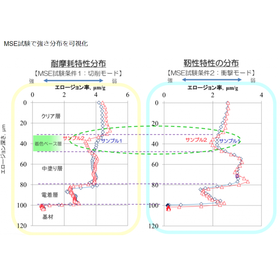
We are introducing a verification of the differences in automotive painting processes using case studies. This is a must-see for those struggling with durability analysis of paint films or painting processes!
We will present examples of performance comparisons due to differences in processes that reveal the functional characteristics of coatings. 【Process Details】 ● Sample 1 WET-ON-WET is a method where the curing process of the colored base layer is shortened, and after applying the clear layer, it is cured. ● Sample 2 A method where each layer is cured after application before the next layer is applied. 【Visualizing Strength Distribution with MSE Testing】 ■ Abrasion Resistance Distribution Test Condition 1: Cutting Mode ■ Toughness Characteristics Distribution Test Condition 2: Impact Mode 【Test Results】 It was found that the colored base layer and the clear layer in WET-ON-WET are smoothly connected. The above tests revealed that the WET-ON-WET process improves not only speed and energy efficiency but also painting quality based on the continuous strength distribution of the coating. Detailed results of the above tests can be viewed in the catalog. *For more information, please contact us or download the PDF materials for further details.

We will introduce the features of the MSE test and other testing methods.
The MSE testing method allows for the measurement of the strength of a film independent of the substrate, as well as the continuous measurement of strength distribution from the surface to the interior. In this case, we verified whether the MSE test can truly analyze the strength of the film. 1. Comparison of film strength with different substrates 2. Comparison of film strength with different thicknesses 【Differences from other testing methods】 Example: Pencil test ● Pencil hardness - The thicker the film, the harder it becomes. - The harder the substrate, the harder it becomes. → This evaluates the functionality including both the film and the substrate. ● MSE test Does not depend on film thickness or substrate. → This evaluates the film itself and the substrate itself. The "MSE test" can be used for various applications such as material evaluation, investigation of strength distribution within the film, and defect analysis. *For more details, please contact us or download the PDF document to view.
