We have compiled a list of manufacturers, distributors, product information, reference prices, and rankings for Electron microscope.
ipros is IPROS GMS IPROS One of the largest technical database sites in Japan that collects information on.

Electron microscope Product List and Ranking from 37 Manufacturers, Suppliers and Companies | IPROS GMS

Last Updated: Aggregation Period:Feb 04, 2026~Mar 03, 2026
This ranking is based on the number of page views on our site.

Electron microscope Manufacturer, Suppliers and Company Rankings

Last Updated: Aggregation Period:Feb 04, 2026~Mar 03, 2026
This ranking is based on the number of page views on our site.

  1. アズサイエンス 松本本社 Nagano//Trading company/Wholesale
  2. 一般財団法人材料科学技術振興財団 MST Tokyo//Testing, Analysis and Measurement
  3. ロンビック Mie//Resin/Plastic
  4. 4 アイテス Shiga//Electronic Components and Semiconductors
  5. 5 関西電力送配電 技術試験センター Hyogo//Electricity, Gas and Water Industry

Electron microscope Product ranking

Last Updated: Aggregation Period:Feb 04, 2026~Mar 03, 2026
This ranking is based on the number of page views on our site.

  1. In various fields such as the semiconductor industry, polymer material development and research, and quality control! アズサイエンス 松本本社
  2. [Introduction of Testing Equipment] Multi-Angle Lens VHX-D510 関西電力送配電 技術試験センター
  3. Observation of Cellulose Nanofibers (CNF) - Examples of SEM and TEM Observations ロンビック
  4. 4 JEM-1400Flash Electron Microscope アズサイエンス 松本本社
  5. 5 JEM-ARM200F NEOARM Atomic Resolution Analytical Electron Microscope アズサイエンス 松本本社

Electron microscope Product List

121~150 item / All 155 items

Displayed results

Technical Information Magazine 201910-02 DDS Technology

The technical information magazine The TRC News provides the latest information on analytical techniques that are useful for research and development, solving production troubles, and quality control.

**Abstract** In recent years, research and development have been focused on drug delivery systems (DDS) aimed at reducing side effects of pharmaceuticals and improving their efficacy. Carriers used in DDS include biomaterials such as liposomes, polymer micelles, inorganic nanoparticles, and drug conjugates (e.g., ADCs). Among these, our company is concentrating on establishing analysis and evaluation techniques for liposomes, introducing case studies of liposome analysis primarily using high-difficulty techniques such as TEM (transmission electron microscopy) and AFM (atomic force microscopy). **Table of Contents** 1. Introduction 2. Fundamental technologies of DDS and characteristics of various carriers 3. Case studies of liposome analysis and evaluation 4. Conclusion

  • Contract Analysis
  • Contract measurement
  • Technical and Reference Books
  • Electron microscope

Added to bookmarks

Bookmarks list

Bookmark has been removed

Bookmarks list

You can't add any more bookmarks

By registering as a member, you can increase the number of bookmarks you can save and organize them with labels.

Free membership registration

Technical Information Magazine 201902-01 Polymers Using DPC-STEM

The technical information magazine The TRC News provides the latest information on analytical techniques that are useful for research and development, solving production troubles, and quality control.

**Abstract** Differential Phase Contrast (DPC) - Scanning Transmission Electron Microscopy (STEM), one of the measurement techniques of STEM, enables the measurement of electric fields at microscopic regions. By applying this method to polymer alloys, we discovered that contrast of phase separation structures, which are difficult to observe with conventional electron microscopy, emerges. **Table of Contents** 1. Introduction 2. Visualization of Soft Materials through Elemental Analysis 3. Application of DPC-STEM Method 4. Conclusion

  • Contract Analysis
  • Contract measurement
  • Technical and Reference Books
  • Electron microscope

Added to bookmarks

Bookmarks list

Bookmark has been removed

Bookmarks list

You can't add any more bookmarks

By registering as a member, you can increase the number of bookmarks you can save and organize them with labels.

Free membership registration

Observation of the crystalline structure of resin and the morphology of polymer alloys using TEM.

It is possible to observe and evaluate the crystalline structure and dispersion state of the resin!

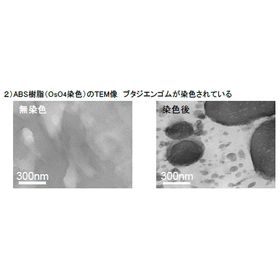
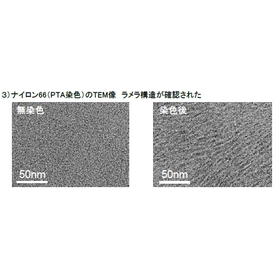
Our website introduces "Observation of Crystal Structure and Morphology of Polymer Alloys using Transmission Electron Microscopy (TEM)." To observe the crystal structure of polymers and the morphology of polymer alloys using TEM, it is necessary to prepare ultra-thin sections. Additionally, staining is required to create differences in electron beam transmission. We provide a table of main staining agents and resins that can be stained, as well as examples of observations, so please take a look. [Contents] ■ Main staining agents and resins that can be stained ■ Observation examples - Crystal structure of HDPE - Observation example of the dispersion structure of polymer alloys *For more details, please refer to the related links or feel free to contact us.

  • Contract Analysis
  • Electron microscope

Added to bookmarks

Bookmarks list

Bookmark has been removed

Bookmarks list

You can't add any more bookmarks

By registering as a member, you can increase the number of bookmarks you can save and organize them with labels.

Free membership registration

TEM observation of CNF (cellulose nanofiber) in ink.

Observing the CNF in the ink solid content of cellulose nanofiber ballpoint pens!

We would like to introduce our observation of cellulose nanofibers (CNF) using transmission electron microscopy (TEM). Utilizing the know-how we have developed in observing resin materials with TEM, we examined the CNF in the ink solids of commercially available cellulose nanofiber ballpoint pens. We observed CNF with a width of approximately 10 nm that appeared to be entangled with ink pigments, and it was found that the ink contains CNF with varying degrees of fibrillation. [Observation Results] - CNF with a width of approximately 10 nm that appeared to be entangled with ink pigments was observed. - Submicron-width CNF was also observed. - Several thin microfibrils, around a few nanometers in diameter, bundle together to form fibers approximately 100 nm thick. - The ink contains CNF with varying degrees of fibrillation. *For more details, please refer to the related links or feel free to contact us.

  • Contract Analysis
  • Electron microscope

Added to bookmarks

Bookmarks list

Bookmark has been removed

Bookmarks list

You can't add any more bookmarks

By registering as a member, you can increase the number of bookmarks you can save and organize them with labels.

Free membership registration

Observation of cellulose nanofibers (CNF) in resin (polyethylene)

Observation of the dispersion state of fine CNF and the lamellar crystals of resin! We also introduce the features of TEM and SEM observations.

Our website introduces "Morphological Observation of Cellulose Nanofiber (CNF) Composites." We have included photos of "TEM Observation Examples of HDPE/CNF" and "SEM Observation Examples of HDPE/CNF." In TEM observation, the dispersion state of fine CNF and the lamellar crystals of the surrounding resin can be observed, while SEM observation allows for the observation of the dispersion state of relatively larger CNF. [Published Photos] ■ TEM Observation Examples of HDPE/CNF ■ SEM Observation Examples of HDPE/CNF *For more details, please refer to the related links or feel free to contact us.

  • Contract Analysis
  • Electron microscope

Added to bookmarks

Bookmarks list

Bookmark has been removed

Bookmarks list

You can't add any more bookmarks

By registering as a member, you can increase the number of bookmarks you can save and organize them with labels.

Free membership registration

Observation of Cellulose Nanofibers (CNF) - Examples of SEM and TEM Observations

Observing the structure of cellulose nanofibers (CNF) using scanning electron microscopy (SEM) and transmission electron microscopy (TEM)!

We would like to introduce the "Cellulose Nanofiber (CNF) Observation" conducted by our company. Utilizing the expertise we have developed in scanning electron microscopy (SEM) and transmission electron microscopy (TEM) observation of resin materials, we observed commercially available cellulose nanofiber (CNF) samples. We were able to clearly view individual CNF microfibrils with thicknesses on the order of nanometers from the surface or cross-section. [Observation Details] ■ Scanning Electron Microscopy (SEM) Observation - More finely dispersed CNF ■ Transmission Electron Microscopy (TEM) Observation - Cross-sectional observation of finely dispersed CNF *For more details, please refer to the related links or feel free to contact us.

  • Contract Analysis
  • Electron microscope

Added to bookmarks

Bookmarks list

Bookmark has been removed

Bookmarks list

You can't add any more bookmarks

By registering as a member, you can increase the number of bookmarks you can save and organize them with labels.

Free membership registration

Analysis of food container packaging: Observation of the layer composition of plastic containers.

With the morphology observation techniques developed through SEM so far, it is possible to observe the layer composition of food container packaging materials!!

The container for solid roux has a multi-layer structure due to the need for food preservation. By observing the cross-section of such food containers with an electron microscope, the layer composition can be clarified. It was found that a commercially available solid roux container has a seven-layer multi-layer structure with a thickness of approximately 3μm to approximately 40μm, as determined by FE-SEM observation. Based on this, further material analysis (*1) was conducted using FT-IR and Raman analysis, allowing us to understand the materials of each layer. Additionally, the preservation properties of the container can also be assessed through measurements of oxygen permeability and water vapor permeability (*2). *For more details, please download the PDF or feel free to contact us.

  • Contract Analysis
  • Electron microscope

Added to bookmarks

Bookmarks list

Bookmark has been removed

Bookmarks list

You can't add any more bookmarks

By registering as a member, you can increase the number of bookmarks you can save and organize them with labels.

Free membership registration

Observation of dispersed structures in plant-derived straw using a field emission scanning electron microscope.

Observe the dispersion state of plastic composite materials from low magnification to high magnification, according to your purpose!

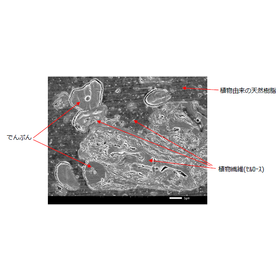
Our company conducts observations of the dispersed structures in plant-derived straw using a field emission scanning electron microscope (FE-SEM). We observe the dispersion of islands of plant fibers (cellulose) in a sea of natural plant-derived resin, with circular starch islands present at the interface. We examine the dispersion state of various plastic composite materials from low magnification (a few hundred times: relatively large aggregated structures) to high magnification (around 100,000 times: fine structures), depending on the purpose. [Features] ■ Observation of the dispersion state of various plastic composite materials from low to high magnification, according to the purpose. *For more details, please download the PDF or feel free to contact us.

  • Contract Analysis
  • Electron microscope

Added to bookmarks

Bookmarks list

Bookmark has been removed

Bookmarks list

You can't add any more bookmarks

By registering as a member, you can increase the number of bookmarks you can save and organize them with labels.

Free membership registration

Dispersion structure of block polypropylene observed by transmission electron microscopy (TEM)

TEM observation of the dispersed structure of block PP! Elastomers and other resins can also be observed.

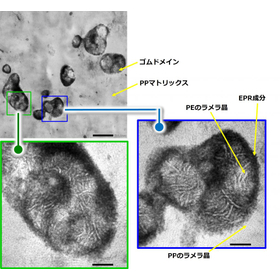
We conduct dispersion structure analysis of block polypropylene using transmission electron microscopy (TEM). The EPR components inside the rubber domain and the lamellar crystals of PE can be clearly observed, as well as the lamellar crystals in the PP matrix. We can also observe composites that include not only block PP alone but also elastomers, other resins, and filler components such as cellulose nanofibers (CNF), so please feel free to contact us. ■ EPR components and lamellar crystals of PE inside the rubber domain can be confirmed ■ Lamellar crystals in the PP matrix can be clearly observed ■ Composites with added filler components can also be observed *For more details, please download the PDF or feel free to contact us.

  • Contract Analysis
  • Electron microscope

Added to bookmarks

Bookmarks list

Bookmark has been removed

Bookmarks list

You can't add any more bookmarks

By registering as a member, you can increase the number of bookmarks you can save and organize them with labels.

Free membership registration

Quantification (image analysis) of transmission electron microscope (TEM) images.

Not only can image analysis be performed from TEM images, but it can also be done from SEM images! Various mechanical property evaluations can also be conducted.

Our company conducts quantification (image analysis) of transmission electron microscope (TEM) images. By analyzing high-resolution TEM and scanning electron microscope (SEM) images, it is possible to quantify the dispersion state of micro-dispersed rubber domains within the resin. Additionally, we can understand how the dispersion state of rubber domains affects the mechanical properties of the resin. 【Features】 ■ By applying binary processing to TEM images, we extract rubber domains and create a histogram of domain diameter (evaluation parameter) based on this, allowing for the evaluation of domain diameter distribution. ■ Other evaluation parameters that can be obtained include the lengths of the major and minor axes of the domains, the number of domains, occupancy area, and area ratio. *For more details, please download the PDF or feel free to contact us.

  • Contract Analysis
  • Image analysis
  • Electron microscope

Added to bookmarks

Bookmarks list

Bookmark has been removed

Bookmarks list

You can't add any more bookmarks

By registering as a member, you can increase the number of bookmarks you can save and organize them with labels.

Free membership registration

Notice of Participation in the "Food Forum Tsukuba Business Exchange Exhibition 2023"

We will introduce our services at the corporate exchange exhibition!

We will be exhibiting at the Food Forum Tsukuba corporate exchange exhibition to be held on November 8, 2023 (Wednesday) at the Tsukuba International Conference Center. This exhibition is an opportunity for companies involved in the food industry to showcase their products and technologies. In addition to displaying equipment and products, we will also conduct demonstrations and distribute samples. At our booth, we will introduce the following services: - Electron microscopy observation of food - Analysis of amino acids and dipeptides We would be grateful if you could visit us when you are in the area. We look forward to seeing you all.

Added to bookmarks

Bookmarks list

Bookmark has been removed

Bookmarks list

You can't add any more bookmarks

By registering as a member, you can increase the number of bookmarks you can save and organize them with labels.

Free membership registration

[Analysis Case] Observation of the Dispersion State of Abrasives in Polishing Slurry

We will introduce an example of visualizing abrasive particles in a grinding slurry.

Materials with fine particles dispersed in liquids, such as dispersions and slurries, are utilized in many fields including batteries, paints, and cosmetics. In these materials, the dispersion of particles significantly affects the performance and quality of the products, making the evaluation of the dispersion state very important. However, in conventional scanning electron microscope (SEM) observations, the process is conducted in a vacuum, which can lead to particle aggregation and structural changes due to drying, making it difficult to accurately assess the original dispersion state in the liquid. This document presents a case study of visualizing abrasive particles in polishing slurries using SEM observations with a liquid cell, which allows for the observation of liquids even in a vacuum. **Analysis Samples** - Diamond slurry - Alumina slurry **Analysis Method** We conducted SEM observations of polishing particles in slurries both with and without the use of a liquid cell. By using a liquid cell, we were able to visualize the dispersion state of fine particles in the liquid without the need for dilution or drying treatment, even for highly viscous slurry materials. SEM observations using a liquid cell enable the observation of the presence of fine particles in dispersions and slurries in their liquid state.

Added to bookmarks

Bookmarks list

Bookmark has been removed

Bookmarks list

You can't add any more bookmarks

By registering as a member, you can increase the number of bookmarks you can save and organize them with labels.

Free membership registration

Analysis services using scanning electron microscopy and energy-dispersive X-ray spectroscopy.

Sample preparation can be performed through resin embedding, cutting, and grinding, allowing for cross-sectional shape observation and elemental analysis.

At Sanko Analysis Center Co., Ltd., we conduct analyses using a scanning electron microscope (SEM) and an energy-dispersive X-ray spectrometer (EDS). With the scanning electron microscope (SEM), we scan the sample with an electron beam and observe the shape of the sample by converting secondary electrons and backscattered electrons emitted from the surface into images. (30x to 300,000x) With the energy-dispersive X-ray spectrometer (EDS), we perform qualitative elemental analysis by detecting characteristic X-rays emitted from the sample when the electron beam is scanned, and we conduct quantitative elemental analysis using the fundamental parameter method by measuring the intensity of the characteristic X-rays. Additionally, we take photographs of the SEM images of the specified areas and report them. Length measurement and 3D imaging are available upon request. *For more details, please download the PDF or feel free to contact us.

  • X-ray fluorescence analyzer
  • Spectroscopic Analysis Equipment
  • Electron microscope

Added to bookmarks

Bookmarks list

Bookmark has been removed

Bookmarks list

You can't add any more bookmarks

By registering as a member, you can increase the number of bookmarks you can save and organize them with labels.

Free membership registration

Technical Data: Low Vacuum SEM

We will introduce a case where the cross-sectional structure of a solar panel was analyzed using only cutting and polishing as a preprocessing step!

Our company is engaged in the analysis solution business. This document presents a case study where the cross-sectional structure of an insulator solar panel composed of organic-inorganic composites was analyzed using low vacuum SEM and FT-IR, with only cutting and polishing as the pretreatment. In low vacuum SEM, coating treatments (pretreatment) such as vacuum deposition are not required for sample preparation. For samples such as insulators, semiconductors, and food, after low vacuum SEM observation without coating treatment, they can be directly used for other analyses. [Contents] ■ Overview ■ Analysis Case ・ Analysis of Solar Panels (Insulators) *For more details, please refer to the PDF document or feel free to contact us.

  • Analytical Equipment and Devices
  • Other services
  • Electron microscope

Added to bookmarks

Bookmarks list

Bookmark has been removed

Bookmarks list

You can't add any more bookmarks

By registering as a member, you can increase the number of bookmarks you can save and organize them with labels.

Free membership registration

"Contract analysis services in a non-contact air environment" *Analysis sample materials provided*

Such as Na, Mg, and Li. Supporting the development of new materials and new products in the fields of automobiles, electronic devices, and machine parts.

Our company offers "analysis services tailored to individual needs." Among these, we provide "analysis services in a non-contact air environment," which allow for the analysis of substances such as lithium, sodium, and potassium that change their surface state when exposed to moisture and oxygen in the air, while keeping them in an active state. We respond to needs in the research and development of new materials and products in the automotive, electronics, chemical, and mechanical parts industries, including the development of new materials and products, discovery of hidden properties, and verification of basic data. ◎ Examples of requests - I want to know if the behavior of thermal decomposition of oil that has dissolved during the manufacturing process differs in an atmosphere of hydrogen, nitrogen, etc. - I want to know if alloys react with atmospheric gases such as hydrogen and nitrogen, and what the reaction temperature is. - I want to know how the data changes when the atmosphere is altered. ◎ Items handled Scanning Electron Microscope (SEM) Thermogravimetric, Differential Thermal, and Temperature-Programmed Desorption Mass Spectrometry (TG-DTA-MS) Powder X-ray Diffraction (XRD) Pressure-Composition Isotherm (PCT) measurement High-Pressure Differential Scanning Calorimetry (DSC) Fourier Transform Infrared Spectroscopy (FT-IR) *Samples for analysis in a non-contact air environment can be viewed via PDF download. Please feel free to contact us for inquiries or analysis requests.

  • Contract Analysis
  • Other microscopes
  • Electron microscope

Added to bookmarks

Bookmarks list

Bookmark has been removed

Bookmarks list

You can't add any more bookmarks

By registering as a member, you can increase the number of bookmarks you can save and organize them with labels.

Free membership registration

NeoScope Tabletop Scanning Electron Microscope

By placing one unit next to the optical microscope, foreign substance analysis and quality control can be performed more quickly and in greater detail.

Japan Electronics Corporation JCM-7000 NeoScope is a tabletop scanning electron microscope with the concept of "anyone can operate SEM/EDS." It features functions such as "Zeromag," which allows observation of SEM images by magnifying optical images, "Live Analysis," which identifies elements in the field of view without starting up the analysis device, and "Live 3D," which enables three-dimensional observation during SEM observation. 〇 Features - Quick and easy observation and analysis without treatment using the tabletop SEM JCM-7000! - Functions designed for "anyone to operate SEM/EDS." *For more details, please download the PDF or feel free to contact us.

  • Optical microscope
  • Electron microscope

Added to bookmarks

Bookmarks list

Bookmark has been removed

Bookmarks list

You can't add any more bookmarks

By registering as a member, you can increase the number of bookmarks you can save and organize them with labels.

Free membership registration

JEM-1400Flash Electron Microscope

New transmission electron microscope

Japan Electronics Co., Ltd. JEM-1400Flash is a new transmission electron microscope with an acceleration voltage of 120kV, featuring a high-sensitivity sCMOS camera, an ultra-wide field montage system, and an enhanced linking function for optical microscope images and electron microscopy. It allows for efficient and high-speed data acquisition. 〇Features - High-sensitivity sCMOS camera Instant Flash camera - New feature Ultra-wide field montage system Limitless Panorama (LLP) - New feature Optical microscope image linking function Picture Overlay - New design Collaboration of pure white color and LED lamp *For more details, please download the PDF or feel free to contact us.

  • Electron microscope
  • Electron microscope

Added to bookmarks

Bookmarks list

Bookmark has been removed

Bookmarks list

You can't add any more bookmarks

By registering as a member, you can increase the number of bookmarks you can save and organize them with labels.

Free membership registration

CRYO ARM 300 II 電界放出形クライオ電子顕微鏡

短時間に、簡単操作で、高コントラスト・高分解能の画像を取得

日本電子株式会社 CRYO ARM300 II は、タンパク質に代表される電子線照射に弱い試料の観察に特化した、クライオ電子顕微鏡です。単粒子構造解析やトモグラフィー、電子線結晶構造解析などの各手法に対応しています。 〇特長 ・顕微鏡の安定性とスループットの更なる向上 ・操作性もよりシンプルに ・サンプルのスクリーニングから画像データ取得までを一体化 ・ユーザーに合わせた運用を可能にする高い自由度 ・簡単な操作で質の高い顕微鏡写真が取得 ※詳細はPDFをダウンロードしていただくか、お気軽にお問い合わせください。

  • Electron microscope
  • Electron microscope

Added to bookmarks

Bookmarks list

Bookmark has been removed

Bookmarks list

You can't add any more bookmarks

By registering as a member, you can increase the number of bookmarks you can save and organize them with labels.

Free membership registration

Introduction of recommended products from Azusa Science.

It can be utilized in various fields such as medicine, biology, metals, semiconductors, and ceramics.

Here, we introduce three products from Japan Electron Optics Laboratory Co., Ltd., recommended by Azusa Science, which are electron microscopes. ■ JSM-IT200 InTouchScope Scanning Electron Microscope The features of this higher-end model have been simplified for easier use. With a user-friendly sample exchange guide, it allows for easy sample setup, finding the field of view, and starting SEM image observation. It integrates software for analytical tasks. ■ JCM-7000 NeoScope Desktop Scanning Electron Microscope With the concept of "Anyone can operate SEM/EDS," it meets the needs for improved work efficiency, ease of operation, and enhanced analysis and measurement performance. Placing one next to an optical microscope allows for faster and more detailed foreign object analysis and quality control. ■ JSM-IT510 InTouchScope Scanning Electron Microscope In quality assurance and manufacturing environments, it is necessary to repeatedly perform the same observation tasks, leading to demands for process efficiency. The JSM-IT510 features a newly added Simple SEM function that allows for "hands-free" repetitive tasks. It has become easier and more efficient to conduct SEM observation tasks.

  • JSM-IT200 InTouchScope? 走査電子顕微鏡.png
  • JSM-IT510 InTouchScope? 走査電子顕微鏡.png
  • Electron microscope
  • Electron microscope

Added to bookmarks

Bookmarks list

Bookmark has been removed

Bookmarks list

You can't add any more bookmarks

By registering as a member, you can increase the number of bookmarks you can save and organize them with labels.

Free membership registration

For research in organic chemistry and materials science, as well as observations at atomic resolution!

Introduction to recommended electron microscopes, polarizing microscopes, and mass spectrometers by Azusa Science.

Here are three recommended products: ◆ JEOL Ltd. JEM-ARM200F NEOARM Atomic Resolution Analytical Electron Microscope Equipped with a cold field emission gun (Cold-FEG) and a new spherical aberration corrector (ASCOR) capable of correcting higher-order aberrations as standard, it enables atomic resolution observation not only at a high acceleration voltage of 200 kV but also at a low acceleration voltage of 30 kV. This makes it easier to observe materials containing light elements with clear contrast. ◆ Nikon Solutions Co., Ltd. Polarized/Dispersion Microscope ECLIPSE LV100ND POL/DS This microscope can measure the properties of asbestos, such as refractive index, birefringence, retardation, extinction angle, pleochroism, and elongation, aiding in the identification of asbestos. It allows for dispersion staining observation at a magnification of 400 times. ◆ JEOL Ltd. JMS-T100LP AccuTOF LC-Express Atmospheric Pressure Ionization Time-of-Flight Mass Spectrometer This high-throughput mass spectrometer aims for high productivity with features such as multi-ionization, robustness, and easy maintenance. It is capable of analyzing a wide range of samples from low polarity to high polarity.

  • JEM-ARM200F.png
  • JMS-T100LP.png
  • ECLIPSE LV100ND POL-DS.png
  • Analytical Equipment and Devices
  • Electron microscope

Added to bookmarks

Bookmarks list

Bookmark has been removed

Bookmarks list

You can't add any more bookmarks

By registering as a member, you can increase the number of bookmarks you can save and organize them with labels.

Free membership registration

Fundamentals and Applications of MicroED Crystal Structure Analysis Part 2 (Held on 10/15)

Free participation! Report on the determination of absolute stereochemistry using MicroED.

We will hold a webinar titled "Fundamentals and Applications of MicroED Crystal Structure Analysis Part 2 - Determining Absolute Stereochemistry Using MicroED." This time, referred to as "Part 2," we will introduce the determination of "absolute stereochemistry" while fully considering the effects of multiple scattering of electrons. This method is an excellent technique that demonstrates remarkable power in determining absolute stereochemistry in molecules composed solely of light elements. As a case study, this webinar will report on the determination of absolute stereochemistry using MicroED for complex natural products and synthetic pharmaceutical raw materials. [Event Overview] ■ Date and Time: October 15, 2024 (Tuesday) 14:00 - 14:45 ■ Participation: Free ■ Venue: Webinar held via Microsoft Teams *For more details, please refer to the related links or feel free to contact us.

  • Structural analysis contract
  • Seminar
  • Electron microscope

Added to bookmarks

Bookmarks list

Bookmark has been removed

Bookmarks list

You can't add any more bookmarks

By registering as a member, you can increase the number of bookmarks you can save and organize them with labels.

Free membership registration

Tabletop scanning electron microscope

Far higher resolution than optical microscopes! Suitable for surface observation and checking surface irregularities at the micro level.

The "Tabletop Scanning Electron Microscope" is a microscope that scans the surface of a sample with a finely focused electron beam in a vacuum, detecting information that comes from the sample and displaying it in an enlarged form. It has a much higher resolution than optical microscopes, making it suitable for surface observation and checking surface irregularities at the micro level. In addition to surface observation, it is also possible to confirm what elements are present on the sample surface and in what quantities through EDS elemental analysis using an X-ray detector. 【Features】 ■ Effective for samples that are difficult to process or that need to be observed as they are ■ Can accommodate samples up to a maximum size of W100mm × D100mm × H40mm on the testing stage ■ By utilizing a user-centric holder, tilting and rotation of the sample is possible ■ Suitable for surface observation and checking surface irregularities at the micro level ■ EDS elemental analysis using an X-ray detector allows for confirmation of what elements are present on the sample surface and in what quantities *For more details, please refer to the PDF document or feel free to contact us.

  • 1.PNG
  • 2.PNG
  • Electron microscope
  • Electron microscope

Added to bookmarks

Bookmarks list

Bookmark has been removed

Bookmarks list

You can't add any more bookmarks

By registering as a member, you can increase the number of bookmarks you can save and organize them with labels.

Free membership registration

[Introduction of Testing Equipment] Multi-Angle Lens VHX-D510

In addition to observations at the atomic level ranging from 0.1nm to 1nm, it is also possible to synthesize images from optical lenses and ultra-depth lenses, enabling the acquisition of detailed images!

We would like to introduce our testing device, the "Multi-Angle Lens VHX-D510." This device irradiates the sample surface with an electron beam and projects the reflected electron beam as an image for observation. The sample chamber is maintained in a vacuum state, and the sample is captured using a super-depth lens (electron beam irradiation). It is possible to synthesize images from both optical lenses and super-depth lenses to obtain detailed images. 【Device Specifications】 ■ Magnification: 30x to 5000x *For more details, please refer to the PDF document or feel free to contact us.

  • 4.PNG
  • Testing Equipment and Devices
  • Electron microscope

Added to bookmarks

Bookmarks list

Bookmark has been removed

Bookmarks list

You can't add any more bookmarks

By registering as a member, you can increase the number of bookmarks you can save and organize them with labels.

Free membership registration

Contracted service for cross-section sample polishing | JTL

We will create cross-section samples for analysis and observation according to your request.

We will carry out the necessary sample preparation processes for observing the cross-sections of solder joints and welds, analyzing the cross-sections of foreign objects, and confirming the interiors of assembly products, including "cutting the target object → resin embedding → polishing." We accept requests for sample preparation alone, as well as comprehensive services that include observation and analysis after preparation. - Polyester resin Used for embedding large products Does not contain chlorine in the resin - Acrylic resin High transparency Resistant to scratches - Epoxy resin Has a low curing shrinkage rate and is less prone to cracking (catalog value 0.5%) Excellent heat, water, chemical, and weather resistance Superior adhesion to non-substrates Contains trace amounts of chlorine in the resin - Polisher Short production time for cross-section samples (fewer steps to mirror polishing) Mainly used for polishing resin materials and steel materials. - Precision polisher Allows for setting polishing pressure and time. Can suppress distortion even when polishing hard materials such as carbide and ceramics.

  • Other services
  • Processing Contract
  • Plastic processing machines (cutting and rolling)
  • Electron microscope

Added to bookmarks

Bookmarks list

Bookmark has been removed

Bookmarks list

You can't add any more bookmarks

By registering as a member, you can increase the number of bookmarks you can save and organize them with labels.

Free membership registration

Analysis of high-performance materials with 'Materials Studio'

Analysis simulation of high-performance materials, as well as material development simulation software compatible with various types of materials.

"Materials Studio" A suite of molecular modeling/simulation tools for next-generation materials development equipped with quantum mechanics (density functional theory), classical mechanics (molecular dynamics calculations), mesoscale (dissipative particle dynamics calculations, etc.), statistics, and analysis/crystallization tools. 【Features】 ■ Simulation software that streamlines materials development Available for use by those engaged in research, development, design, and manufacturing across various industries and fields. ■ Compatible with various types of materials ■ All tasks, including crystal structure creation, calculation condition settings, and calculation result display, can be performed on a single GUI screen. 【Examples】 Tribochemical (lubrication) reactions Analysis of CFRP (carbon-based materials) Research and development of crystal growth, thin film formation, fuel cells, lubricants, etc. Catalysts, polymers and mixtures, metals and alloys, batteries and fuel cells, etc. *For more details, please feel free to contact us.*

  • others
  • Image analysis software
  • Electron microscope

Added to bookmarks

Bookmarks list

Bookmark has been removed

Bookmarks list

You can't add any more bookmarks

By registering as a member, you can increase the number of bookmarks you can save and organize them with labels.

Free membership registration

Accelerating development through "visualization" inside the battery.

Clarifying uncertain phenomena and unknown phenomena in battery development! KRI's one-stop service for secondary batteries.

At our company, battery and system engineers, materials engineers, and analytical engineers collaborate from their respective perspectives to elucidate phenomena and mechanisms. In the fusion technology of operando CT and image analysis (cell thickness and displacement analysis), we acquire three-dimensional images while intermittently and continuously charging and discharging, analyze the images, and evaluate changes. We provide a one-stop solution to clarify uncertain and unknown phenomena in battery development. 【Ultra-high resolution SEM and NMR (partial)】 ■ Potential contrast observation to distinguish materials that are difficult to differentiate through compositional analysis based on differences in conductivity. ■ Observation of sharp fiber shapes without "bulking" due to deposited films. ■ Understanding the bonding state of silane coupling agents chemically bonded to the substrate surface. ■ Observation of intermolecular interactions between phosphine oxide and the substrate. *For more details, please download the PDF or feel free to contact us.

  • Company:KRI
  • Price:Other
  • Technology Development
  • Other analysis and evaluation services
  • Secondary Cells/Batteries
  • Electron microscope

Added to bookmarks

Bookmarks list

Bookmark has been removed

Bookmarks list

You can't add any more bookmarks

By registering as a member, you can increase the number of bookmarks you can save and organize them with labels.

Free membership registration