91~135 item / All 512 items
Displayed results
Filter by category

Added to bookmarks
Bookmarks listBookmark has been removed
Bookmarks listYou can't add any more bookmarks
By registering as a member, you can increase the number of bookmarks you can save and organize them with labels.
Free membership registration
Contact this company
Inquiry Form91~135 item / All 512 items
Filter by category

"I want to reduce the particles (micro-particles) in the chemical solution to the absolute minimum." "I want to shorten the piping cleaning (flushing) time and speed up the startup." "Since we use harsh chemical solutions, we need high durability." In the fields of semiconductor and LCD manufacturing, where nano-level precision processing is required, the specifications demanded for piping tubes are becoming increasingly stringent each year. The "TOMBO No.9003-PFA-HG Naflon PFA-HG tube" from Nichias meets these advanced requirements that are difficult to achieve with standard PFA tubes. We will unravel why it is labeled "HG (High Grade)" and its overwhelming specifications. *For detailed content of the column, please refer to the related link. For more information, please download the PDF or feel free to contact us.*
Added to bookmarks
Bookmarks listBookmark has been removed
Bookmarks listYou can't add any more bookmarks
By registering as a member, you can increase the number of bookmarks you can save and organize them with labels.
Free membership registration
From semiconductor manufacturing equipment to chemical plants and electrical insulation applications. As a reliable piping material in harsh environments, the "TOMBO No.9003 Naflon PTFE Tube" has been chosen for many years. In the latest semiconductor processes, ultra-high-performance grades like "PFA-UG" have also emerged, but for general industrial applications, the balance of cost and performance is still best with this "PTFE Tube." We will thoroughly explain its specifications and reasons for being chosen. *For detailed content of the column, you can view it through the related links. For more information, please download the PDF or feel free to contact us.*
Added to bookmarks
Bookmarks listBookmark has been removed
Bookmarks listYou can't add any more bookmarks
By registering as a member, you can increase the number of bookmarks you can save and organize them with labels.
Free membership registration
"I want to visually confirm whether liquid is flowing through the pipes." "Since there is a gap between the devices, I want to connect them with a single long tube." When selecting a fluoropolymer tube, the solution to these challenges is the "TOMBO No.9003-PFA Naflon PFA Tube." This high-performance tube possesses incredible chemical resistance and heat resistance comparable to PTFE, while also featuring "translucency" and "continuous molding capability (lengthening)" that PTFE does not have. I will explain its capabilities and applications. *For detailed content of the column, you can view it through the related links. For more information, please download the PDF or feel free to contact us.*
Added to bookmarks
Bookmarks listBookmark has been removed
Bookmarks listYou can't add any more bookmarks
By registering as a member, you can increase the number of bookmarks you can save and organize them with labels.
Free membership registration
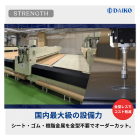
"The rubber melts due to heat," "the cross-section gets charred and hardens," "the material is too large to fit in the machine." In the processing of industrial gaskets and seals, the game-changer that solves these issues all at once is "water jet processing." However, while the technology itself is known, the extent to which it can handle materials of various thicknesses and scales varies greatly from one processing company to another. In this article, we will explain the "core" of the water jet technology and the "overwhelming equipment capability" of Daiko Co., Ltd. that maximizes its potential. *For detailed content of the column, please refer to the related links. For more information, feel free to download the PDF or contact us directly.*
Added to bookmarks
Bookmarks listBookmark has been removed
Bookmarks listYou can't add any more bookmarks
By registering as a member, you can increase the number of bookmarks you can save and organize them with labels.
Free membership registration
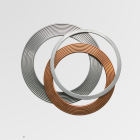
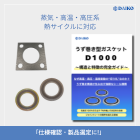
In this document, we thoroughly analyze the core "structure" and "features" of D1000, explaining why it can withstand harsh environments, while comparing it with other types of gaskets. We provide detailed explanations using diagrams and images regarding the robust sealing mechanism, its decisive role, and the special configurations of the product. This is a valuable reference, so please take the time to read it. 【Contents】 ■ Areas that exceed the limits of joint sheets ■ Features of the spiral gasket D1000 ■ The core of D1000 - The robust sealing mechanism created by the "spiral" structure ■ The decisive role of the "inner and outer rings" in maximizing performance ■ The diverse product configurations and special adaptations of D1000 ■ For complex insulation design and product selection, consult the experts at "Daiko" *For more details, please download the PDF or feel free to contact us.
Added to bookmarks
Bookmarks listBookmark has been removed
Bookmarks listYou can't add any more bookmarks
By registering as a member, you can increase the number of bookmarks you can save and organize them with labels.
Free membership registration
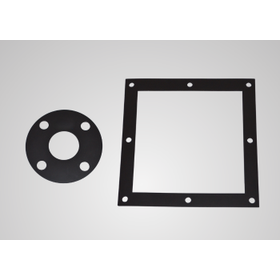
We would like to introduce a processing case where 22 seals were produced from 3mm thick neoprene sponge (Neo-spot) in the size of 148mm × 478mm. Neoprene sponge is a well-balanced rubber sponge material with excellent weather resistance, heat resistance, flame retardancy, and oil resistance. Its closed-cell structure makes it difficult for air and water to pass through, maintaining high airtightness and water resistance. The processing details include four bolt holes with a diameter of 10mm and R30 curved processing on the inner diameter corners. Using our water jet cutting machine, we precisely cut the soft sponge material with sharp edges according to the CAD data without crushing it. 【Case Overview】 ■ Material: Neoprene Sponge 3t ■ Size: 148mm × 478mm ■ Quantity: 22 pieces *For more details, please download the PDF or feel free to contact us.
Added to bookmarks
Bookmarks listBookmark has been removed
Bookmarks listYou can't add any more bookmarks
By registering as a member, you can increase the number of bookmarks you can save and organize them with labels.
Free membership registration
This is a case study of manufacturing block-shaped gaskets measuring 60mm × 95mm from 20mm thick CR rubber (chloroprene rubber). CR rubber is a rubber material that possesses a balanced combination of high weather resistance, heat resistance, oil resistance, and chemical resistance. Compared to other general-purpose rubbers, it has a low flammability characteristic (flame retardant). The processing details include counterboring to sink the heads of bolts and C10 chamfering around the entire product. Using our plotter processing machine (with router function), we minimized the distortion typical of thick rubber and achieved a sharp finish. [Case Overview] ■ Material: CR Rubber 20t ■ Size: 60mm × 95Lmm ■ Processing Details: Counterboring, C10 chamfering around the entire perimeter *For more details, please download the PDF or feel free to contact us.
Added to bookmarks
Bookmarks listBookmark has been removed
Bookmarks listYou can't add any more bookmarks
By registering as a member, you can increase the number of bookmarks you can save and organize them with labels.
Free membership registration
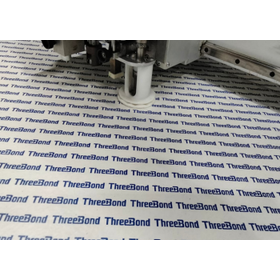
This is an example of producing a framed irregularly shaped gasket measuring 210mm x 355mm from the special sheet gasket "Three Sheet 201S" (thickness 0.1mm) manufactured by Three Bond Co., Ltd. The Three Sheet packing is a special gasket that combines the advantages of both solid sheet gaskets and liquid gaskets. It is impregnated with a unique viscous material in long and strong fibrous materials, providing flexibility and excellent conformity to flange surfaces. The processing includes cutting the outer circumference and applying an R65 curve to the inner diameter. Using our plotter processing machine, we precisely cut the material according to the CAD data without damaging it. 【Case Overview】 ■ Material: Three Sheet 201S (0.1t) ■ Size: 210mm x 355mm ■ Processing Details: Outer circumference cut, R65 curve processing on the inner diameter *For more details, please download the PDF or feel free to contact us.
Added to bookmarks
Bookmarks listBookmark has been removed
Bookmarks listYou can't add any more bookmarks
By registering as a member, you can increase the number of bookmarks you can save and organize them with labels.
Free membership registration
We would like to introduce a processing example of producing mats and partitioning materials measuring 440mm × 1800mm from flexible polyvinyl chloride resin (2mm thick) that excels in flexibility and transparency. Flexible transparent PVC is a type of polyvinyl chloride resin that has been made flexible by adding plasticizers, combining high transparency and toughness. It is stable against acids, alkalis, and fats, making it resistant to degradation even in factory environments. The processing details include eight small diameter holes of φ3mm and specified slit processing. Using our plotter processing machine, we achieved high-precision cuts directly from CAD data without moving the material. 【Case Overview】 ■ Material: Flexible transparent PVC 2mm ■ Size: 440mm × 1800mm ■ Processing Details: Eight φ3mm small diameter holes, slit processing *For more details, please download the PDF or feel free to contact us.
Added to bookmarks
Bookmarks listBookmark has been removed
Bookmarks listYou can't add any more bookmarks
By registering as a member, you can increase the number of bookmarks you can save and organize them with labels.
Free membership registration
In the field of plant maintenance, issues with steam line leaks are never-ending. Many of these problems stem from a "selection mistake" where "joint sheets for general piping (water and oil)" were carelessly used in steam piping. "I thought it would be fine because the catalog said it was heat-resistant up to 150°C." This complacency can be fatal. There are clear physical reasons why only "steam-specific" materials should be used for steam piping. This article will explain the mechanism of "thermal degradation (hardening)" that occurs when the wrong gasket is used, as well as the risks of "re-tightening," which should absolutely be avoided, based on technical materials from Nichias. *For detailed content of the column, please refer to the related links. For more information, you can download the PDF or feel free to contact us.
Added to bookmarks
Bookmarks listBookmark has been removed
Bookmarks listYou can't add any more bookmarks
By registering as a member, you can increase the number of bookmarks you can save and organize them with labels.
Free membership registration
"Even after tightening, it keeps dripping from the gap between the flange and the gasket." "When I reused old piping, even though I put in a new packing, it won't stop." "There is rust and scratches on the flange surface, but there is no budget for replacement." The most frequently encountered trouble in piping maintenance is "Interface Leakage." Unlike "permeation leakage," which passes through the material of the gasket itself, this phenomenon occurs when fluid escapes through the "gap" between the gasket and the flange surface. The key to stopping interface leakage is "familiarity." In this article, we will explain why interface leakage occurs and how to approach rough flanges to stop the leakage. *For more detailed content of the column, please refer to the related link. For more information, feel free to download the PDF or contact us.
Added to bookmarks
Bookmarks listBookmark has been removed
Bookmarks listYou can't add any more bookmarks
By registering as a member, you can increase the number of bookmarks you can save and organize them with labels.
Free membership registration
Have you ever been troubled by such inexplicable minor leaks at the piping site? It may not be "interface leakage" that leaks from the gap between the gasket and the flange, but rather "permeation leakage," which leaks through the material of the gasket itself. In particular, when using "sheet gaskets" such as joint sheets, the risk of this permeation leakage is always present. The most effective countermeasure for this is to "make the gasket thinner." In this article, we will explain the often-overlooked mechanism of "permeation leakage" and the physical reasons why thick gaskets can lead to leaks. *For more detailed information, you can view the related links. For further details, please download the PDF or feel free to contact us.*
Added to bookmarks
Bookmarks listBookmark has been removed
Bookmarks listYou can't add any more bookmarks
By registering as a member, you can increase the number of bookmarks you can save and organize them with labels.
Free membership registration
"A leak occurred from a flange that was supposed to be tightened to the specified torque a few months later." "After performing a re-tightening (hot bolting), the gasket was damaged." Such troubles are not uncommon in the maintenance of plants and piping systems. The main cause cited is the physical phenomenon specific to gaskets known as "stress relaxation." This article will explain the mechanism of stress relaxation, the differences in behavior depending on the material, and appropriate management methods to maintain long-term sealing performance. *For detailed content of the column, you can view it through the related link. For more information, please download the PDF or feel free to contact us.*
Added to bookmarks
Bookmarks listBookmark has been removed
Bookmarks listYou can't add any more bookmarks
By registering as a member, you can increase the number of bookmarks you can save and organize them with labels.
Free membership registration
The "sheet gasket," which is the most familiar sealing material on site, is widely used due to its convenience of being processed with scissors or cutters, such as joint sheets and fluororesin sheets. However, when it comes to its "thickness," are you not deciding it based on a vague feeling? In fact, the belief that "thicker is stronger and safer" for sheet gaskets is a significant misconception. On the contrary, it is not uncommon for overly thick selections of sheet gaskets to cause critical leakage problems precisely because they are sheet gaskets. In this article, we will thoroughly explain why "thin" is recommended for sheet gaskets, as well as the situations where "thick" is necessary, and the criteria for selection. *For detailed content of the column, please refer to the related links. For more information, feel free to download the PDF or contact us.*
Added to bookmarks
Bookmarks listBookmark has been removed
Bookmarks listYou can't add any more bookmarks
By registering as a member, you can increase the number of bookmarks you can save and organize them with labels.
Free membership registration
In the manufacturing fields of food, pharmaceuticals, and cosmetics, achieving a balance between "safety (compliance with the Food Sanitation Act)" and "durability (heat and chemical resistance)" is an eternal challenge. While silicone rubber and EPDM are safe and easy to use, they may not withstand high-temperature oils, certain chemicals, or high-pressure steam. This is where "Food Sanitation Act-compliant fluorine rubber IF-900," proudly offered by Iruma River Rubber Co., Ltd., comes into play. IF-900 is a high-grade product that maintains the inherent heat and oil resistance of fluorine rubber while complying with the Food Sanitation Act (Ministry of Health and Welfare Notification No. 370). In this article, we will provide a detailed explanation of the physical properties and resistance data of IF-900 based on the manufacturer's official catalog. We will also introduce our processing solutions at Daiko Co., Ltd. to procure this expensive material in the necessary shapes and quantities without waste. *For more detailed content of the column, please refer to the related links. For more information, feel free to download the PDF or contact us directly.*
Added to bookmarks
Bookmarks listBookmark has been removed
Bookmarks listYou can't add any more bookmarks
By registering as a member, you can increase the number of bookmarks you can save and organize them with labels.
Free membership registration
In the manufacturing environment of products that enter the human mouth, such as food, beverages, pharmaceuticals, and cosmetics, the safety of "rubber packings" and "gaskets" used in equipment is as important, if not more so, than the safety of the products themselves. If harmful substances were to leach from the rubber and contaminate the products, the trust in the company would collapse instantly. Not an ambiguous "food grade," but truly safe silicone rubber based on "solid evidence" from a public testing organization. That is the "Silicone Rubber Sheet SN-50" from Osaka Rubber Co., Ltd. In this article, we will thoroughly explain why SN-50 has gained absolute trust in the food and medical fields, based on the test report (No. 452-21-A-0055) issued by the Chemical Substance Evaluation and Research Institute (CERI), detailing its legal basis and test results. *For detailed content of the column, please refer to the related links. For more information, please download the PDF or feel free to contact us.
Added to bookmarks
Bookmarks listBookmark has been removed
Bookmarks listYou can't add any more bookmarks
By registering as a member, you can increase the number of bookmarks you can save and organize them with labels.
Free membership registration
In manufacturing environments where "hygiene management" is the top priority, such as in food, beverages, pharmaceuticals, and cosmetics, the selection of rubber components (gaskets, seals) used is extremely important. This is because it is not only about preventing leaks but also about ensuring safety for the human body (compliance with regulations) and significantly reducing the risk of foreign material contamination. A suitable solution to meet such stringent requirements is the "EP-5165-W" developed by Iruma River Rubber Co., Ltd. This is a special grade of white (white) EPDM (ethylene propylene rubber) that is compliant with food hygiene laws and excels in weather resistance and chemical resistance. In this article, we will thoroughly explain why EP-5165-W continues to be chosen in hygiene management settings from the perspectives of "legal compliance," "color advantages," and "basic performance," and we will introduce our solutions at Daiko Co., Ltd., which process and supply this safe material tailored to the shape of our customers' equipment, starting from just one piece. *For detailed content of the column, please refer to the related link. For more information, please download the PDF or feel free to contact us.
Added to bookmarks
Bookmarks listBookmark has been removed
Bookmarks listYou can't add any more bookmarks
By registering as a member, you can increase the number of bookmarks you can save and organize them with labels.
Free membership registration
The challenges of "cutting processing" in manufacturing sites always lie in balancing "cost," "delivery time," and "accuracy." While dedicated mold presses offer high precision, they come with high initial costs and long lead times. On the other hand, hand cutting and cutting plotters have no initial costs, but they tend to have longer takt times during mass production, resulting in higher unit prices. A suitable solution to this dilemma is the long-established technique known as "Thompson processing (die cutting)." This article will thoroughly explain the basics of Thompson processing, why Daiko is committed to "in-house mold production," its technical advantages, and its ability to handle a wide variety of materials such as joint sheets, rubber, sponge, and PTFE. *For detailed content of the column, you can view it through the related links. For more information, please download the PDF or feel free to contact us.
Added to bookmarks
Bookmarks listBookmark has been removed
Bookmarks listYou can't add any more bookmarks
By registering as a member, you can increase the number of bookmarks you can save and organize them with labels.
Free membership registration
In plant and building piping systems, "corrosion" is the greatest risk factor that shortens the lifespan of equipment and can lead to serious accidents. Among these, "galvanic corrosion" (dissimilar metal contact corrosion) that occurs when different metals are connected progresses rapidly and is a phenomenon for which countermeasures are essential. The standard method to prevent this galvanic corrosion is the use of "insulation kits" (insulation bolts and gaskets). Among these, the "insulation lining bolt," which has the bolt shaft coated with fluororesin, is particularly excellent in terms of workability and reliability, and can resolve installation issues on-site (such as interference with gaskets). This article will thoroughly explain the mechanism of why "galvanic corrosion" occurs, why insulation lining bolts are supported on-site, their structural advantages and specifications, and the appropriate selection methods tailored to on-site standards. *For detailed content of the column, please refer to the related links. For more information, feel free to download the PDF or contact us.
Added to bookmarks
Bookmarks listBookmark has been removed
Bookmarks listYou can't add any more bookmarks
By registering as a member, you can increase the number of bookmarks you can save and organize them with labels.
Free membership registration
In selecting waterproof sealants, cushioning materials, and packing materials, there are surprisingly few materials that meet the three elements of "water-stopping ability," "flame resistance," and "weather resistance" at a high level. The reality is that common sponges often have trade-offs, such as "stops water but is flammable" or "flame-resistant but has weak weather resistance." In response to these challenges, the chloroprene rubber (CR) sponge "Gum Sponge C-4305," manufactured by Inoac Corporation, has been chosen as a standard in the industry for many years. In this article, based on the manufacturer's official technical documentation and product characteristics, we will thoroughly explain why C-4305 has gained such trust from many engineers and designers who say, "You can rely on C-4305 for now." We will delve into the secrets of its core performance, including its "closed-cell structure" and "flame-retardant CR formulation," specific applications, and the "processing technology" that allows this material to be shaped flexibly to meet on-site needs. *For detailed content of the column, you can view it through the related links. For more information, please download the PDF or feel free to contact us.*
Added to bookmarks
Bookmarks listBookmark has been removed
Bookmarks listYou can't add any more bookmarks
By registering as a member, you can increase the number of bookmarks you can save and organize them with labels.
Free membership registration
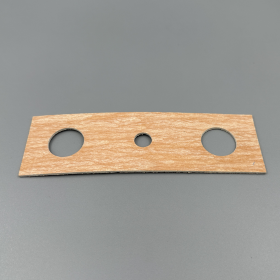
We would like to introduce a case study where we produced 20 pieces of insulation and vibration-damping sheets for water level gauges using the heat-resistant "TOMBO No.6750-S (Vermosal Sheet-S)." "TOMBO No.6750-S" is a non-asbestos heat-resistant sheet made primarily from inorganic minerals and formed through a papermaking process. Compared to conventional asbestos sheets, it has a thermal conductivity that is approximately 30% lower, demonstrating excellent heat retention and insulation effects. The size is 34mm × 340mm (equivalent to 9B size). Using our plotter processing machine, we cut the sheets directly from CAD data to precise dimensions without the need for a die. 【Case Overview】 ■ Material: TOMBO No.6750-S 1.5t ■ Size: 34mm × 340mm (equivalent to 9B size) ■ Quantity: 20 pieces *For more details, please download the PDF or feel free to contact us.
Added to bookmarks
Bookmarks listBookmark has been removed
Bookmarks listYou can't add any more bookmarks
By registering as a member, you can increase the number of bookmarks you can save and organize them with labels.
Free membership registration
This is a case of producing 500 ring gaskets with an outer diameter of φ55mm and an inner diameter of φ43mm from the gasket sheet "TOMBO No.9007-SC," which is compatible with strong alkaline fluids. "TOMBO No.9007-SC" is a special gasket sheet made by blending carbon with PTFE (fluororesin). It exhibits excellent corrosion resistance against strong alkaline fluids such as sodium hydroxide and potassium hydroxide. Using our plotter processing machine, we were able to respond quickly to the production of 500 medium-lot items directly from CAD data without the need to create a die. [Case Overview] ■ Material: TOMBO No.9007-SC 1.5t ■ Size: Outer diameter φ55mm × Inner diameter φ43mm ■ Quantity: 500 pieces *For more details, please download the PDF or feel free to contact us.
Added to bookmarks
Bookmarks listBookmark has been removed
Bookmarks listYou can't add any more bookmarks
By registering as a member, you can increase the number of bookmarks you can save and organize them with labels.
Free membership registration
We would like to introduce a case where a gas seal material with an outer diameter of φ2270mm was produced from laminated boards made by bonding board-shaped insulation materials "TOMBO No.5625" and "TOMBO No.5615." The Fineflex BIO board is a high-temperature insulation material formed into a board shape by adding inorganic and organic binders to biodegradable fibers. It is not subject to RCF regulations and is designed with consideration for the environment and safety. Due to the size exceeding the standard dimensions of the material, it was precisely cut into a four-part shape using our water jet cutting machine. By using CAD data for cutting, the split surfaces fit perfectly together, allowing for installation without gaps. [Case Overview] ■ Material: Bonded BIO board (50t) ■ Size: Outer diameter φ2270mm, four-part processed product *For more details, please download the PDF or feel free to contact us.
Added to bookmarks
Bookmarks listBookmark has been removed
Bookmarks listYou can't add any more bookmarks
By registering as a member, you can increase the number of bookmarks you can save and organize them with labels.
Free membership registration
We would like to introduce a processing case where a large product measuring 310mm × 1466mm was created from a special material made by bonding a PTFE sheet to an EPDM rubber block with a thickness of 55mm. This product is a high-performance composite that combines the elasticity and weather resistance of EPDM rubber with the chemical resistance and slip properties of PTFE. The part in contact with liquids is made of PTFE, which is strong against chemicals, while the main body is made of EPDM, providing a solid elastic sealing function. Using our water jet cutting machine, we achieved high-precision cutting of bonded materials with different hardness levels without delaminating the adhesive surfaces. [Case Overview] ■ Processing Details: Drilling a hole with a diameter of 194mm and chamfering the corners with C15 ■ Material: Laminated product of EPDM (55t) + PTFE (1t) *For more details, please download the PDF or feel free to contact us.
Added to bookmarks
Bookmarks listBookmark has been removed
Bookmarks listYou can't add any more bookmarks
By registering as a member, you can increase the number of bookmarks you can save and organize them with labels.
Free membership registration
■Overview of Processing Example Product Name: Natural Rubber Gasket for Light Valve Dimensions: As per drawing This processing example involves the fabrication of a natural rubber gasket used in light valves. The structure features bolt holes for mounting on the outer perimeter and an arc-shaped opening on the inside, requiring reliable sealing performance while following the opening and closing motion of the valve. The client's industry is related to industrial machinery dealing with valves and piping equipment. This product is a natural rubber gasket used for light valves, designed with an emphasis on compatibility and resilience at the valve seat. Water jet processing was employed for fabrication. Since natural rubber is prone to deformation during cutting, a non-contact processing method was chosen to achieve shape reproduction as per the drawing and stable processing accuracy. This helps minimize positional misalignment during assembly, leading to stable assembly characteristics and reproducibility.
Added to bookmarks
Bookmarks listBookmark has been removed
Bookmarks listYou can't add any more bookmarks
By registering as a member, you can increase the number of bookmarks you can save and organize them with labels.
Free membership registration
Processing Case Overview Product Name: Red Fiber Long Hole Processed Part Dimensions: 45W × 70L Material: Red Fiber 1t This case involves the production of a part made from rectangular-shaped red fiber material, featuring a combination of round holes and long holes, using laser processing. It includes a long hole shape designed for adjustment of the mounting position, accommodating mounting conditions that cannot be met with standard holes.
Added to bookmarks
Bookmarks listBookmark has been removed
Bookmarks listYou can't add any more bookmarks
By registering as a member, you can increase the number of bookmarks you can save and organize them with labels.
Free membership registration
■Overview of Processing Example Product Name: Fluororubber Frame-Shaped Gasket Dimensions: 188W × 748L (Frame Width 38W) This processing example involves the fabrication of a frame-shaped gasket made from fluororubber material. The long, elongated outer perimeter is equipped with multiple mounting holes, and the interior features an opening, creating a frame structure with specified R-shaped inner corners. To avoid stress concentration during assembly, the product requires shape reproducibility and precision of the inner R. The client's industry is related to thermal equipment and industrial devices. The characteristics of this product include its use of fluororubber for chemical and heat-resistant applications, and the design that incorporates an R shape on the inside of the frame, which takes into account the sealing area's fit and durability. The processing method employed is water jet cutting. Since fluororubber tends to show edge irregularities with blade processing, non-contact processing is used to fabricate the inner R shape according to the specifications, thereby stabilizing shape accuracy and reproducibility.
Added to bookmarks
Bookmarks listBookmark has been removed
Bookmarks listYou can't add any more bookmarks
By registering as a member, you can increase the number of bookmarks you can save and organize them with labels.
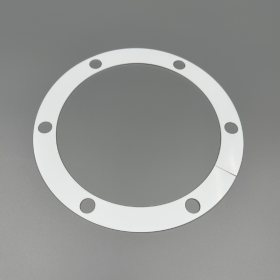
Free membership registrationProcessing Case Overview Product Name: Circular Multi-Hole Gasket Dimensions: Outer Diameter φ300 / Inner Diameter φ228 Material: PTFE 1t This case involves the processing of a circular gasket made of PTFE material, featuring multiple bolt holes arranged with an uneven pitch. The material was specified with a focus on chemical resistance, and the non-standard hole arrangement was addressed using water jet cutting. Product Features PTFE PTFE (polytetrafluoroethylene) is a high-performance material with exceptional heat and chemical resistance. It withstands almost all acids and alkalis, and has minimal leaching of impurities, making it widely used in industries that require contamination-free materials, such as food, pharmaceuticals, and chemical plants. It also possesses non-stick and insulating properties, providing reliable performance even in harsh environments. Processing Method (Water Jet Cutting) Water jet cutting is a method that uses high-pressure water to cut materials. It processes by spraying high-pressure water. The injection nozzle can be changed according to the processing material, allowing for the production of high-quality products in a short time. Additionally, the dimensional tolerances achieved through traditional manual processing are significantly improved, resulting in stable processing accuracy. The taper of the cut surface from press processing can also be improved with water jet cutting.
Added to bookmarks
Bookmarks listBookmark has been removed
Bookmarks listYou can't add any more bookmarks
By registering as a member, you can increase the number of bookmarks you can save and organize them with labels.
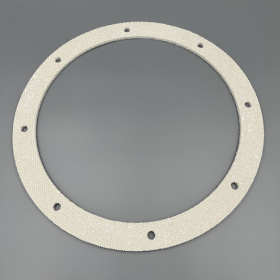
Free membership registrationOverview of Processing Example Product Name: R-shaped Irregular Gasket Dimensions: 479 × 753 (Reference) Material: No.6500 0.8t This case involves the production of a gasket with an irregular outer shape that includes an R shape and a multi-hole configuration, made from No.6500 joint sheet using water jet processing. For this project, which required precision in the outer shape including curved sections and accuracy in hole positioning, stable shape reproduction was achieved through data processing.
Added to bookmarks
Bookmarks listBookmark has been removed
Bookmarks listYou can't add any more bookmarks
By registering as a member, you can increase the number of bookmarks you can save and organize them with labels.
Free membership registration
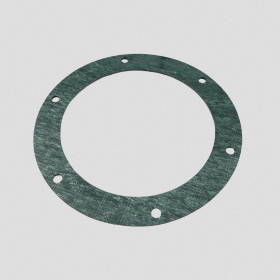
We would like to introduce a case where we produced two frame-shaped gaskets measuring 230mm x 340mm from a non-asbestos joint sheet "D6000" with a thickness of 2mm, based on the customer's drawing. The processing involved drilling 14 holes with a diameter of 10mm. Using our water jet cutting machine, we cut directly from the CAD data with high precision. Water jet cutting is suitable for processing joint sheets with complex shapes, as it cuts using a high-pressure water stream. 【Processing Features】 - No need for dies, resulting in low cost and short delivery time - Direct processing from drawings - Easy repeat orders with data storage *For more details, please download the PDF or feel free to contact us.
Added to bookmarks
Bookmarks listBookmark has been removed
Bookmarks listYou can't add any more bookmarks
By registering as a member, you can increase the number of bookmarks you can save and organize them with labels.
Free membership registration
Based on the customer's drawing, we produced four plates measuring 25mm x 150mm from food-grade silicone rubber (5mm thick). The processing details include drilling two holes with a diameter of 5.5mm and further performing counterboring on those holes. Using our plotter processing machine (with router functionality), we combined cutting with blades and machining with the router to produce the plates without the need for molds. 【Processing Features (with Router Functionality)】 ■ Cost reduction without the need for die cutting ■ Support for counterboring ■ Capable of small lot production from a single piece ■ Easy repeat orders with data storage *For more details, please download the PDF or feel free to contact us.
Added to bookmarks
Bookmarks listBookmark has been removed
Bookmarks listYou can't add any more bookmarks
By registering as a member, you can increase the number of bookmarks you can save and organize them with labels.
Free membership registration
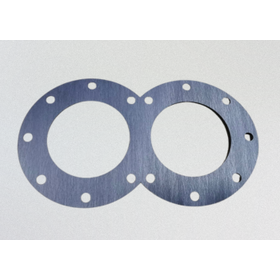
Based on the customer's drawing, we have produced one gasket for a heat exchanger from the standard grade joint sheet "TOMBO No.1995" with a thickness of 2mm. The shape is a "2-pass" gasket for a heat exchanger, in the form of a ring with a center branch, measuring φ532mm × φ445mm. Using our water jet cutting machine, we cut it directly from CAD data with high precision. Water jet cutting is suitable for processing gaskets with complex shapes, such as those used in heat exchangers, as it cuts with a high-pressure water stream. 【Processing Features】 ■ No need for molds, resulting in low cost and short lead times ■ Direct processing from drawings ■ High-quality cutting with no thermal effects ■ Easy repeat orders with data storage *For more details, please download the PDF or feel free to contact us.
Added to bookmarks
Bookmarks listBookmark has been removed
Bookmarks listYou can't add any more bookmarks
By registering as a member, you can increase the number of bookmarks you can save and organize them with labels.
Free membership registration
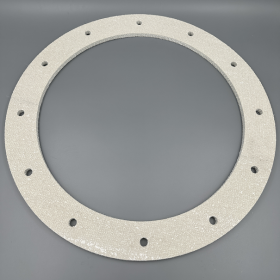
We would like to introduce a case where we manufactured six large-diameter flange gaskets with an outer diameter of φ580mm and an inner diameter of φ482mm from a fluororubber (FKM) sheet (thickness 3mm) based on the customer's drawing, which has excellent chemical resistance. The processing involved drilling 16 bolt holes of φ12mm on a P.C.D. of 536mm. Using our water jet cutting machine, we directly cut from CAD data with high precision. Water jet cutting is suitable for processing elastic materials like rubber because it cuts with a high-pressure water stream. 【Processing Features】 - No need for molds, resulting in low cost and short delivery times - Direct processing from drawings - High-quality cutting with no thermal impact - Easy repeat orders with data storage *For more details, please download the PDF or feel free to contact us.
Added to bookmarks
Bookmarks listBookmark has been removed
Bookmarks listYou can't add any more bookmarks
By registering as a member, you can increase the number of bookmarks you can save and organize them with labels.
Free membership registration
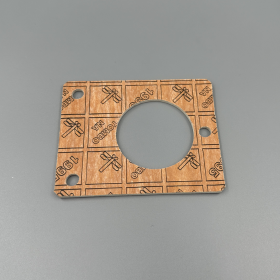
We would like to introduce a case where we produced 50 gaskets for a manifold, measuring 60mm x 128mm, from a heat-resistant joint sheet "TOMBO No.1120" with a thickness of 1.5mm, based on the customer's drawing. The processing involved drilling holes with diameters of φ41mm and φ13mm. Using our plotter processing machine (with router functionality), we processed the material directly and precisely from CAD data. Since no die cutting was required, we were able to respond quickly to requests for medium lots of 50 pieces with a clean finish and no burrs. 【Processing Features】 ■ Cost reduction without the need for die cutting ■ Support for small lot production starting from one piece ■ Clean finish with no burrs ■ Easy repeat ordering with data storage *For more details, please download the PDF or feel free to contact us.
Added to bookmarks
Bookmarks listBookmark has been removed
Bookmarks listYou can't add any more bookmarks
By registering as a member, you can increase the number of bookmarks you can save and organize them with labels.
Free membership registration
"Insulation materials do not fit well on the curved surfaces of large boiler furnace walls and tanks." "We are having trouble with insulation boards that have shifted or fallen off due to plant vibrations." "We want to 'thicken' the insulation on existing piping, but installation is difficult." "Reliable non-combustible insulation materials are needed in high-temperature areas exceeding 600°C." To meet the heavy-duty demands of industrial equipment for "high-performance insulation," "adaptability to complex equipment shapes," and "mechanical strength to withstand vibrations and self-weight," Nichias Corporation has developed the metal-reinforced roll-type insulation material "MG Wired Blanket." This article thoroughly explains why the MG Wired Blanket is trusted as an absolute insulation solution for large, high-temperature equipment such as plants, from the secrets of its structure to its reliable performance based on JIS standards. *For detailed content of the column, please refer to the related link. For more information, please download the PDF or feel free to contact us.*
Added to bookmarks
Bookmarks listBookmark has been removed
Bookmarks listYou can't add any more bookmarks
By registering as a member, you can increase the number of bookmarks you can save and organize them with labels.
Free membership registration
"The fireproof covering of the kitchen exhaust duct in apartment buildings, particularly where it penetrates fire compartments, is a source of concern. With conventional 50mm thick rock wool, the space in the ceiling is compromised, leading to reduced design flexibility. Is there a fireproof material that is easy to install and highly reliable?" In architectural design for apartments and mixed-use buildings, fire prevention measures for kitchen exhaust ducts are an extremely important issue that cannot be overlooked in order to comply with building codes and fire prevention regulations. The revolutionary product "Ceracover S" developed by Nichias Corporation solves the conflicting challenges of "reliable fire resistance" and "space-saving" with its unique technology. This article will thoroughly explain why Ceracover S can achieve the astonishing performance of being "equivalent to or better than 50mm thick rock wool with a thickness of only 20mm," including the secrets of its structure, outstanding performance, and the correct selection method. *For detailed content of the column, please refer to the related links. For more information, please download the PDF or feel free to contact us.*
Added to bookmarks
Bookmarks listBookmark has been removed
Bookmarks listYou can't add any more bookmarks
By registering as a member, you can increase the number of bookmarks you can save and organize them with labels.
Free membership registration
"Heat dissipation from the plant's steam and hot water piping is putting pressure on energy costs." "Condensation is occurring in the chilled water piping of the air conditioning system, causing problems with mold and rust." "The traditional work of wrapping blanket material around pipes is time-consuming and leads to inconsistencies in construction quality." In response to the challenge of achieving both "standardization and efficiency in installation" and "high insulation performance" in pipe insulation, Nichias Corporation has long provided the perfect answer: the "MG Mighty Cover." This article thoroughly explains why the MG Mighty Cover has gained overwhelming trust as the "de facto standard" for pipe insulation tubes in various sites, from the core of its structure and performance to the correct selection method. *For detailed content of the column, please refer to the related link. For more information, please download the PDF or feel free to contact us.
Added to bookmarks
Bookmarks listBookmark has been removed
Bookmarks listYou can't add any more bookmarks
By registering as a member, you can increase the number of bookmarks you can save and organize them with labels.
Free membership registration
"I want to efficiently insulate and prevent condensation in a large area of air conditioning ducts." "I want to use safe and easy-to-install insulation and sound-absorbing materials on the ceilings and walls of the factory." "I want roll-type insulation material, but I also want to ensure surface strength and moisture resistance." In response to these demands, one of the standard and high-efficiency solutions provided by Nichias Corporation is the roll-type high-performance rock wool insulation material "MG Mighty Roll." This article thoroughly explains why MG Mighty Roll is trusted and widely adopted across such a broad range of fields, focusing on the core of its performance, which is the combination of "rock wool felt" and "high-performance surface materials," the selection methods according to applications, and the "processing technology" that maximizes its excellent material performance to meet on-site needs. *For detailed content of the column, please refer to the related links. For more information, please download the PDF or feel free to contact us.
Added to bookmarks
Bookmarks listBookmark has been removed
Bookmarks listYou can't add any more bookmarks
By registering as a member, you can increase the number of bookmarks you can save and organize them with labels.
Free membership registration
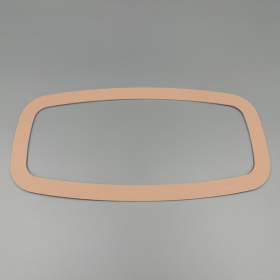
■Overview of Processing Example Product Name: Truck Oval Gasket Dimensions: 3t × 160W × 410L Material: EPDM Rubber Processing Method: Water Jet Cutting This case involves the production of an EPDM rubber gasket based on an oval shape (truck oval), featuring multiple through holes arranged at the inner opening and outer circumference, using water jet cutting. Due to the multi-hole configuration and curved shape, the project required dimensional accuracy and assembly compatibility that standard products could not meet, but stable shape reproduction was achieved through data processing.
Added to bookmarks
Bookmarks listBookmark has been removed
Bookmarks listYou can't add any more bookmarks
By registering as a member, you can increase the number of bookmarks you can save and organize them with labels.
Free membership registration
This document is a basic guide for new personnel on the arrangement of "gaskets and packing." It clearly introduces the main types and structures of sealing materials, including non-metallic gaskets (soft gaskets), rubber gaskets, PTFE gaskets, high-performance sheets, and ring joint gaskets. Additionally, it includes a "checklist for material personnel," making it a useful resource. Please feel free to download it and make use of it. [Contents (partial)] ■ What are "gaskets" and "packing" in the first place? ■ The importance of selection: "P-T-F" that must be confirmed on-site ■ [Important] Main types and structures of sealing materials ■ How to arrange standard products (how to communicate the "4 elements" to prevent mistakes) ■ How to arrange O-rings *For more details, please download the PDF or feel free to contact us.
Added to bookmarks
Bookmarks listBookmark has been removed
Bookmarks listYou can't add any more bookmarks
By registering as a member, you can increase the number of bookmarks you can save and organize them with labels.
Free membership registration
We would like to introduce a case where we produced 63 pieces of L-shaped products using natural rubber as protective material for L-shaped angles, based on the customer's request. The dimensions are L-shaped with 20mm and 40mm sides, and a length of 1050mm. While integrated molding (extrusion) would require a mold, this time we used a water jet cutting machine to cut the material to the specified size and joined the cross-sections with strong adhesive processing, achieving the L-shaped form without the need for a mold. By combining cutting from the material and adhesive bonding, we create three-dimensional products without using molds. 【Processing Features (Water Jet + Adhesive)】 ■ Achieves L-shaped form without molds ■ Precision cutting with water jet ■ Easy repeat arrangements with data storage *For more details, please download the PDF or feel free to contact us.
Added to bookmarks
Bookmarks listBookmark has been removed
Bookmarks listYou can't add any more bookmarks
By registering as a member, you can increase the number of bookmarks you can save and organize them with labels.
Free membership registration
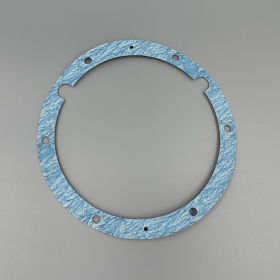
We would like to introduce a case where we manufactured a "10K-25A" size gasket using Vulcan No. 6502 (Black Super) based on the customer's drawing. The features include a "tabbed" shape that is convenient for alignment and verification during installation, and the processing and installation of "metal mesh" in the inner diameter section. The main body of the gasket is precisely cut using a water jet cutting machine, while the mesh part is formed and integrated using pressing or laser processing. 【Processing Features】 ■ No mold required with water jet cutting ■ Flexibility in mesh processing ■ Easy repeat ordering with data storage *For more details, please download the PDF or feel free to contact us.
Added to bookmarks
Bookmarks listBookmark has been removed
Bookmarks listYou can't add any more bookmarks
By registering as a member, you can increase the number of bookmarks you can save and organize them with labels.
Free membership registration
We would like to introduce a case where we produced a large-diameter product with an outer diameter of φ1500mm from a 10mm thick natural rubber sheet based on the customer's drawing. The main feature is the multi-hole processing, which involves drilling a total of 320 holes with a diameter of φ24mm. Using our water jet cutting machine, we were able to cut accurately and efficiently according to the CAD data, even for the numerous holes that would be difficult to achieve with manual or press processing. The chemical structure of natural rubber is polyisoprene, which embodies the fundamental "flexibility and toughness" of rubber material at a very high level. 【Processing Features】 ■ Accurate processing of 320 holes ■ Cost reduction without the need for a die ■ Easy repeat ordering with data storage *For more details, please download the PDF or feel free to contact us.
Added to bookmarks
Bookmarks listBookmark has been removed
Bookmarks listYou can't add any more bookmarks
By registering as a member, you can increase the number of bookmarks you can save and organize them with labels.
Free membership registration
We would like to introduce a case where we manufactured four small-sized parts measuring 26mm x 42mm from a 0.5mm thick ultra-thin EPDM rubber sheet based on the customer's drawing. The processing involved precision work, creating one hole with a diameter of 12mm and four holes with a diameter of 5mm. Using our water jet cutting machine, we minimized the unique "escape" and "distortion" of thin rubber, achieving high precision cutting according to the CAD data. EPDM is a synthetic rubber that excels in weather resistance, heat resistance, ozone resistance, and cold resistance. Due to its saturated structure without double bonds in the main chain, it has properties that make it resistant to degradation even in harsh environments outdoors or where ozone is present. 【Processing Features】 ■ High precision for thin and small sizes ■ No need for die cutting, resulting in low cost and short lead times ■ Direct processing from drawings ■ Easy repeat orders with data storage *For more details, please download the PDF or feel free to contact us.
Added to bookmarks
Bookmarks listBookmark has been removed
Bookmarks listYou can't add any more bookmarks
By registering as a member, you can increase the number of bookmarks you can save and organize them with labels.
Free membership registration
"I can't wait for custom gaskets with complex shapes that take time to deliver." "I want to use it on a rough sealing surface or a slightly uneven corroded flange surface." "It's a line for corrosive fluids, but I want a reliable sealing material while keeping costs down." In plant maintenance, emergency repairs, or prototype development at job sites, the issues of gasket "shape" and "delivery time" are always challenging problems. Especially in the case of non-standard dimensions or complex shapes, expensive molds and specialized processing are required, leading to increased time and costs. A groundbreaking product that solves these on-site troubles all at once is the "Mushseal," developed by Sumitomo Electric Fine Polymer Co., Ltd. This article thoroughly explains why Mushseal is valued on-site as a "universal repair material," based on the official product information from Sumitomo Electric Fine Polymer Co., Ltd., detailing its incredible performance, cost advantages, and construction know-how to avoid failures. *For detailed content of the column, you can view it through the related links. For more information, please download the PDF or feel free to contact us.
Added to bookmarks
Bookmarks listBookmark has been removed
Bookmarks listYou can't add any more bookmarks
By registering as a member, you can increase the number of bookmarks you can save and organize them with labels.
Free membership registration