1~45 item / All 524 items
Displayed results
Filter by category

Added to bookmarks
Bookmarks listBookmark has been removed
Bookmarks listYou can't add any more bookmarks
By registering as a member, you can increase the number of bookmarks you can save and organize them with labels.
Free membership registration
Contact this company
Inquiry Form1~45 item / All 524 items
Filter by category

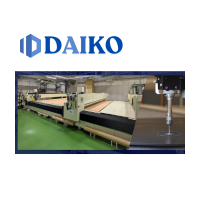
In the field of semiconductor manufacturing equipment, maintaining a vacuum environment is directly linked to product quality and yield, making gaskets and seals with high precision sealing performance essential. Minute foreign matter contamination or leaks can have serious impacts on the manufacturing process. Therefore, to ensure stable operation and reliability of the equipment, it is necessary to select optimal sealing materials that meet the required specifications and to perform precise processing. Daiko Co., Ltd. solves these challenges as an expert in industrial sealing materials. We can provide optimal proposals tailored to the lot and shape, from data cutting that does not require a die to dedicated die press processing. ## Application Scenarios * Sealing of vacuum chambers * Sealing of vacuum pumps * Sealing of vacuum transport equipment * Vacuum sealing of various piping ## Benefits of Implementation * Improved yield through high vacuum maintenance * Stable operation of equipment and reduced maintenance costs * Reduced risk of minute foreign matter contamination * Increased flexibility in production planning due to short lead times for parts supply * Shortened prototyping and development periods through drawing-less support
Added to bookmarks
Bookmarks listBookmark has been removed
Bookmarks listYou can't add any more bookmarks
By registering as a member, you can increase the number of bookmarks you can save and organize them with labels.
Free membership registration
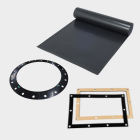
The operating environment of construction machinery is exposed to extremely harsh conditions such as dust, vibration, and temperature changes. In such environments, gaskets and seals with high durability and reliability are essential for maintaining equipment performance and longevity. Inappropriate sealing materials can lead to premature deterioration or damage, resulting in increased equipment downtime and maintenance costs. Daiko Co., Ltd. offers gasket and seal processing that meets the harsh usage conditions of construction machinery as experts in industrial sealing materials. 【Usage Scenarios】 - Around the engine of construction machinery - Sealing parts of hydraulic equipment - Use under extreme temperature and pressure - Prevention of dust and moisture intrusion 【Benefits of Implementation】 - Improved equipment durability - Reduced maintenance costs - Stable operation over a long period - Assurance of reliable sealing performance
Added to bookmarks
Bookmarks listBookmark has been removed
Bookmarks listYou can't add any more bookmarks
By registering as a member, you can increase the number of bookmarks you can save and organize them with labels.
Free membership registration
In the energy industry, high durability and reliability are required to withstand harsh environments such as high temperatures and high pressures. Gaskets and seals with excellent sealing performance are essential for ensuring stable operation of equipment and safety. Inappropriate materials or products with low processing precision can lead to leaks and premature deterioration, increasing the risk of serious accidents and production stoppages. Our company provides optimal gasket and sealing processing solutions to address these specific challenges in the energy sector. 【Application Scenarios】 - High-temperature and high-pressure piping in plant equipment - Sealing for various equipment within power plants - Reaction devices in oil and chemical plants - Renewable energy facilities 【Benefits of Implementation】 - High durability and extended lifespan under harsh conditions - Stable operation of equipment and reduction in maintenance costs - Improved safety through reduced leak risks - Flexible processing to meet diverse needs
Added to bookmarks
Bookmarks listBookmark has been removed
Bookmarks listYou can't add any more bookmarks
By registering as a member, you can increase the number of bookmarks you can save and organize them with labels.
Free membership registration
In the measurement equipment industry, precise sealing materials with high airtightness and durability are required to maintain fine measurement accuracy. In particular, sealing performance that allows for no gaps is essential to block the influence of the external environment and protect the internal precision mechanisms. The use of inappropriate sealing materials can lead to measurement errors, equipment malfunctions, and reduced lifespan. As experts in industrial sealing materials, we propose the optimal gasket and packing processing for your measurement equipment. 【Application Scenarios】 - Maintaining airtightness in precision measuring devices - Sealing sample chambers in analytical instruments - Sealed structures in environmental testing equipment - Protection of sensor housings 【Benefits of Implementation】 - Maintenance and improvement of measurement accuracy - Increased reliability of equipment - Protection from external environments - Durability for long-term use
Added to bookmarks
Bookmarks listBookmark has been removed
Bookmarks listYou can't add any more bookmarks
By registering as a member, you can increase the number of bookmarks you can save and organize them with labels.
Free membership registration
In the food manufacturing industry, strict compliance with hygiene standards is required to ensure product safety. In particular, gaskets and seals used in the manufacturing line are crucial in terms of material selection and design to prevent foreign matter contamination and ensure cleanability. Inappropriate materials or designs can increase the risk of reduced hygiene management and product contamination. At Daiko, we offer gaskets and seals tailored to our customers' needs, from material selection that meets food manufacturing hygiene standards to processing complex shapes. 【Usage Scenarios】 - Pipe connections in manufacturing lines - Sealing parts of various equipment - Areas requiring designs that facilitate easy cleaning and sterilization 【Benefits of Implementation】 - Improved hygiene management - Reduced risk of foreign matter contamination - Compliance with regulations
Added to bookmarks
Bookmarks listBookmark has been removed
Bookmarks listYou can't add any more bookmarks
By registering as a member, you can increase the number of bookmarks you can save and organize them with labels.
Free membership registration
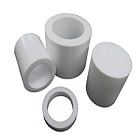
In chemical plant equipment, gaskets and seals with high chemical resistance are essential due to the handling of various chemicals. Inappropriate materials or processing deficiencies increase the risk of accidents from leaks, equipment downtime, and product contamination. Our custom processing of gaskets and seals provides optimal solutions to these unique challenges faced by chemical plants. We also have extensive experience in processing materials with excellent chemical resistance, such as PTFE. 【Usage Scenarios】 - Piping connections in chemical manufacturing lines - Flange seals for reaction vessels and storage tanks - Areas around pumps and valves handling corrosive fluids - Operating environments under high temperature and high pressure 【Benefits of Implementation】 - Reduced risk of chemical leaks - Stable operation of equipment and increased lifespan - Maintenance and improvement of product quality - Reduction of maintenance costs
Added to bookmarks
Bookmarks listBookmark has been removed
Bookmarks listYou can't add any more bookmarks
By registering as a member, you can increase the number of bookmarks you can save and organize them with labels.
Free membership registration
"I want to quickly prototype a complex-shaped gasket." "I want to create a packing for old equipment without drawings from the actual item." "I want to place a large order in the tens of thousands at a short lead time and low cost." These concerns will be resolved by Daiko Co., Ltd., a company specializing in industrial sealing materials. From data cutting that requires no die to press processing with dedicated molds, we propose the "optimal solution" tailored to your lot and shape. **Three Reasons to Choose Daiko** 1. "Immediate Delivery" with an overwhelming inventory of materials. We always stock joint sheets, various rubbers, PTFE, and more at our bases in Osaka and Tokyo. 2. "Production Capability" that meets all lot sizes. We have our own equipment, from water jets to large presses for mass production, allowing seamless transition from a single prototype to mass production of tens of thousands. 3. "Drawing-less Production" for old equipment. Even without drawings, our professionals can measure and digitize from the actual item or template paper to produce new products. **Main Processing Achievements** - Joint Sheets: Gear-shaped protrusions, T-shaped branches, large diameters over 3000Φ, etc. - Various Rubbers: Large diameter multi-holes, complex irregular shapes and three-dimensional forms, double-sided tape bonding, etc. - Resins and Metals: Special dimensions like PTFE, router cutting, metal nameplates, etc.
Added to bookmarks
Bookmarks listBookmark has been removed
Bookmarks listYou can't add any more bookmarks
By registering as a member, you can increase the number of bookmarks you can save and organize them with labels.
Free membership registration
In the food manufacturing industry, strict hygiene management is required to ensure product safety and quality maintenance. In particular, gaskets and nameplates used on the production line need reliable information display to reduce the risk of foreign matter contamination and ensure traceability. Traditional seals and ink printing face challenges such as peeling, wear, and degradation due to cleaning, which can raise hygiene management concerns. Amid the wave of digitalization (DX) and the need to respond to harsh on-site environments, Daiko Co., Ltd. introduces the new machine "Keyence MD-U1000C" and proposes a new management method to address these challenges. 【Usage Scenarios】 - Printing manufacturing lot information and expiration dates on gaskets on the production line - Engraving serial numbers and manufacturing dates on product nameplates - Printing on areas that require durability in environments with high cleaning frequency 【Benefits of Implementation】 - Reduction of the risk of foreign matter contamination due to ink or seal peeling and wear - Improved long-term information retention and traceability due to high durability - Realization of efficient production management and quality assurance in line with digitalization
Added to bookmarks
Bookmarks listBookmark has been removed
Bookmarks listYou can't add any more bookmarks
By registering as a member, you can increase the number of bookmarks you can save and organize them with labels.
Free membership registration
In the chemical plant industry, equipment management under harsh conditions and ensuring product traceability are highly valued. Traditional seals and ink printing can pose challenges in terms of chemical resistance and durability. To respond to the wave of digitalization (DX) and solve on-site issues, Daiko Co., Ltd. has introduced the advanced machine "Keyence MD-U1000C" and proposes a new management method. 【Usage Scenarios】 - Marking on gaskets that require chemical resistance - Printing on nameplates in harsh environments - Improvement of product traceability 【Effects of Implementation】 - Durable marking as an alternative to ink printing and seals - Efficient equipment and product management compatible with digitalization - Providing significant added value that contributes to solving on-site challenges
Added to bookmarks
Bookmarks listBookmark has been removed
Bookmarks listYou can't add any more bookmarks
By registering as a member, you can increase the number of bookmarks you can save and organize them with labels.
Free membership registration
In the medical device industry, strict traceability is required to ensure the safety and reliability of products. In particular, accurately recording manufacturing processes and usage history, and enabling rapid response in case of emergencies, is extremely important for protecting patient safety. Traditional seals and ink printing have faced challenges regarding durability in harsh environments and the permanence of information. To respond to the wave of digitalization (DX) and solve these issues, Daiko Co., Ltd. has introduced the advanced machine "Keyence MD-U1000C" and proposes a new management method. 【Usage Scenarios】 - Engraving manufacturing lot information and serial numbers on medical device nameplates - Permanent marking that can withstand sterilization and cleaning processes - Ensuring traceability throughout the entire product lifecycle 【Effects of Implementation】 - Improved product reliability and strengthened quality control - Prevention of counterfeiting and suppression of illicit distribution - Streamlined recall response and risk management efficiency
Added to bookmarks
Bookmarks listBookmark has been removed
Bookmarks listYou can't add any more bookmarks
By registering as a member, you can increase the number of bookmarks you can save and organize them with labels.
Free membership registration
FRP (Fiber Reinforced Plastics) has become an essential high-performance material in modern industries, ranging from chemical plants, residential equipment, automobiles, aerospace, to precision machinery. It possesses outstanding advantages such as "lightweight yet as strong as metal" and "rust-resistant with excellent chemical resistance," leading to a shift from traditional metal components and general-purpose plastics. However, FRP is not a single resin; it is a composite material that combines a base "matrix resin" with "reinforcing fibers," which means that the physical properties and suitable applications can vary significantly depending on the combinations used. This article will provide a detailed explanation of the basic structure of FRP resins, the main types (GFRP, CFRP, AFRP), their advantages and disadvantages, differences from other industrial materials, and important considerations for selection to prevent accidents, incorporating insights from Daiko Co., Ltd., a specialized processing manufacturer. *For more detailed content of the column, please refer to the related links. For further inquiries, feel free to contact us.*


Added to bookmarks
Bookmarks listBookmark has been removed
Bookmarks listYou can't add any more bookmarks
By registering as a member, you can increase the number of bookmarks you can save and organize them with labels.
Free membership registration
We would like to introduce a processing example of the "EPDM large-diameter gasket with R-shaped protrusions," which has been adopted for large connection flanges of water treatment equipment and various tanks and ducts. This special specification is based on a flat gasket with an outer diameter of φ710mm and a thickness of 5mm, with rubber protrusions (ribs) in an R5 shape (semi-circular) bonded to both sides along the central circumference of the sealing surface. By combining water jet cutting and advanced manual bonding techniques, we achieved short lead times and reduced initial costs without the need to create expensive large-diameter molding molds. [Case Overview] ■ Challenges - Gaskets with ribbed molded shapes require molds costing several million yen. ■ Key Processing Points - High sealing achieved through bonding technology between the flat plate and R protrusions. *For more details, please refer to the related links or feel free to contact us.
Added to bookmarks
Bookmarks listBookmark has been removed
Bookmarks listYou can't add any more bookmarks
By registering as a member, you can increase the number of bookmarks you can save and organize them with labels.
Free membership registration
In the piping connections of semiconductor manufacturing equipment, high-purity chemical lines, oxygen, hydrogen, and ultra-pure water lines, as well as high vacuum equipment, the requirements for "cleanliness" regarding gaskets and seals are at an extremely high level. Residual machining oils, greases, and release agents on surfaces and cutting edges during the manufacturing and punching processes of sealing materials are direct causes of contamination of process fluids and fire risks. To accurately prevent such oil contamination, Daiko Co., Ltd., a specialized manufacturer of industrial sealing materials and insulating materials, has introduced a high-precision "ultrasonic cleaner with heating elements" as part of its own facilities, establishing a precise degreasing cleaning system. By combining ultrasonic cleaning with simply room temperature water and "hot water management using heating elements" that allows for appropriate temperature control, the cleaning effect is enhanced and achieved more reliably. This article explains the technical mechanism of ultrasonic degreasing cleaning using hot water and its benefits. *For detailed content of the column, please refer to the related link. For more information, feel free to contact us.
Added to bookmarks
Bookmarks listBookmark has been removed
Bookmarks listYou can't add any more bookmarks
By registering as a member, you can increase the number of bookmarks you can save and organize them with labels.
Free membership registration
PTFE (polytetrafluoroethylene) resin is a type of fluoropolymer that boasts top-class chemical resistance and heat resistance among industrial materials. There are reasons why it is selected in environments that require extremely high reliability, ranging from piping in chemical plants to semiconductor manufacturing equipment using ultra-pure water and medical devices. In this article, we will explain in detail why PTFE resin has excellent resistance to many chemicals, its mechanisms, specific selection considerations, and comparisons with other resins (such as PE, PP, POM, PVC), incorporating insights from Daiko Co., Ltd., a specialized processing manufacturer. *For detailed content of the column, please refer to the related links. For more information, feel free to contact us.*
Added to bookmarks
Bookmarks listBookmark has been removed
Bookmarks listYou can't add any more bookmarks
By registering as a member, you can increase the number of bookmarks you can save and organize them with labels.
Free membership registration
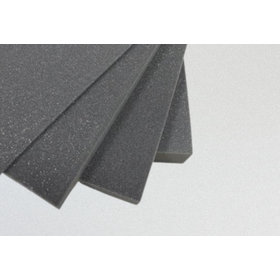
We introduce a case study of a custom cushioning inner tray (90t) made of PE Light A-8 (gray) that protects precision devices and measuring instruments from shocks during transportation. Traditionally, there was a limit to the thickness of polyethylene foam raw material forming, usually around 30 to 50mm. However, we adopted a lamination bonding technique to ensure thickness. By managing high-precision pressing with heat or special adhesives, we formed a uniform 90t block that does not peel or warp over time. This was then precisely cut to a depth of 90mm with a beautiful vertical cross-section, maintaining no distortion, using a water jet cutting machine that operates at high water pressure without crushing. Prototyping and small lot production from a single piece can also be accommodated at low cost and with short lead times. *For more details, please refer to the related links or feel free to contact us.
Added to bookmarks
Bookmarks listBookmark has been removed
Bookmarks listYou can't add any more bookmarks
By registering as a member, you can increase the number of bookmarks you can save and organize them with labels.
Free membership registration
In the design of plant equipment, precision instruments, and automotive devices, the "heat resistance temperature" of rubber materials used for sealants and gaskets is an extremely important selection factor that influences the reliability of the system. Incorrect selection in relation to the temperature of the operating environment can lead to early deterioration or hardening of the rubber, a decrease in sealing performance, and serious leakage issues. Among the various rubber elastomers, silicone rubber (Q/VMQ) is known for its top-class heat and cold resistance. However, it is essential to correctly understand the specific temperature limits it can withstand and how it differs from other rubber materials for appropriate component design. This article will focus on the concept of heat resistance temperature of silicone rubber, the chemical mechanisms of thermal resistance, the differences compared to other representative rubber materials (such as fluorine rubber, NBR, EPDM, etc.), and the key selection points to keep in mind in actual design settings, incorporating insights from Daiko Co., Ltd., a specialized processing manufacturer. *For detailed content of the column, please refer to the related links. For more information, feel free to contact us.*
Added to bookmarks
Bookmarks listBookmark has been removed
Bookmarks listYou can't add any more bookmarks
By registering as a member, you can increase the number of bookmarks you can save and organize them with labels.
Free membership registration
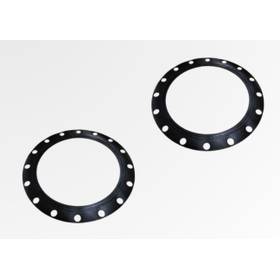
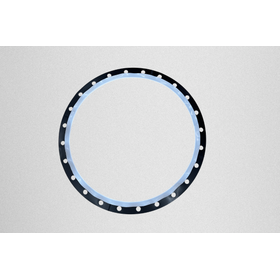
We would like to introduce a processing case of a massive "fabric-reinforced NBR gasket" with an outer diameter of φ1156, which was implemented at the connection flange of plant piping and large containers. Due to its large diameter size, which greatly exceeds the standard width of rubber sheets, it is physically impossible to cut it out as a single piece from the material. Therefore, our company adopted a "bonded joint processing" method, where we used a water jet cutting machine to accurately cut the material into four arc-shaped pieces, which were then finished into a ring shape through precise bonding by skilled craftsmen. This dramatically reduced material loss while stably achieving the production of 28 pieces in a medium lot size with no deviation in the position pitch of P1073 and 20 bolt holes of φ23. [Case Overview] ■Challenge - It is physically impossible to cut it out as a single piece from the material. ■Processing Points - "Four-part bonded (joint) processing" that exceeds standard size limits. *For more details, please refer to the related links or feel free to contact us.
Added to bookmarks
Bookmarks listBookmark has been removed
Bookmarks listYou can't add any more bookmarks
By registering as a member, you can increase the number of bookmarks you can save and organize them with labels.
Free membership registration
In the piping connections for semiconductors, precision chemicals, oxygen, hydrogen, ultrapure water lines, and high vacuum equipment, what is required of gaskets and seals is not just dimensional accuracy. In fact, even trace amounts of residual "cutting oil," "grease," and "release agents" on the surface or cut edges of sealing materials can cause system troubles after operation. To address this issue, Daiko Co., Ltd., a specialized manufacturer of industrial sealing materials and insulating materials, has introduced a high-precision "ultrasonic cleaner" as part of its own equipment, establishing a precise degreasing and cleaning system for gaskets and seals. This article technically explains the importance of degreasing and cleaning for gaskets, the risks posed by oil residues, and Daiko's comprehensive degreasing and cleaning solutions. *For detailed content of the column, please refer to the related links. For more information, feel free to contact us.*
Added to bookmarks
Bookmarks listBookmark has been removed
Bookmarks listYou can't add any more bookmarks
By registering as a member, you can increase the number of bookmarks you can save and organize them with labels.
Free membership registration
We would like to introduce a processing example of "storage tanks and gaskets for heat exchangers" used in hot water lines for buildings and factories, as well as district heating systems. It features a special partition (branch HE11 shape) integrated with an outer ring, designed to fit the internal partition walls of heat exchangers with multiple passes (multiple back-and-forth flow paths). The material selected is TOMBO No. 1120, which has excellent flexibility and high heat and steam resistance. High-precision integral cutting was achieved using water jet processing from a 3.0mm thick sheet that is prone to deformation. 【Case Overview】 ■ Challenge - To completely prevent fluid from leaking by short-circuiting to adjacent flow paths, it is necessary to cut it out as a "complete one-piece" without seams. ■ Processing Points - Seamless integral cut of the "branch HE11 shape." *For more details, please refer to the related links or feel free to contact us.
Added to bookmarks
Bookmarks listBookmark has been removed
Bookmarks listYou can't add any more bookmarks
By registering as a member, you can increase the number of bookmarks you can save and organize them with labels.
Free membership registration
The requirements for "cleanliness" of gaskets and packing in semiconductor manufacturing equipment, high-purity chemical lines, pharmaceutical and food processes, and precision machinery piping connections are becoming increasingly stringent year by year. In the manufacturing and punching processes of sealing materials, even the slightest residual fine particles, machining oils, and adhered dust on the surface can mix into fluids after the line starts operating, leading to significant product defects and contamination of the entire system. The decisive solution to this challenge is "ultrasonic cleaning." This article will explain the advanced technical mechanisms and benefits of ultrasonic cleaning, as well as introduce the implementation solutions of in-house ultrasonic cleaning equipment at Daiko Co., Ltd., a specialized manufacturer of industrial sealing materials and insulating materials. *For more detailed information, please refer to the related links. Feel free to contact us for further inquiries.
Added to bookmarks
Bookmarks listBookmark has been removed
Bookmarks listYou can't add any more bookmarks
By registering as a member, you can increase the number of bookmarks you can save and organize them with labels.
Free membership registration
■Overview of Processing Example Product Name: TOMBO No.1120 Oval Gasket / Dimensions: Thickness 3t × Inner Dimensions 300W × 400L / This processing example features a large oval gasket made from expanded graphite joint sheet. It was manufactured for steam lines and exhaust systems in high-temperature environments. The oval shape is cut with high precision using water jet processing, achieving a uniform width sealing surface. ■Product Features TOMBO No.1120 is a joint sheet primarily composed of expanded graphite, with aramid fibers and NBR added. It excels in heat resistance, steam resistance, and corrosion resistance, and is characterized by its flexibility and scratch resistance. It is suitable for water, steam, oil, exhaust gases, etc., and is widely used in relatively high-temperature flanges and valves in petroleum refining, chemical plants, power plants, and more.
Added to bookmarks
Bookmarks listBookmark has been removed
Bookmarks listYou can't add any more bookmarks
By registering as a member, you can increase the number of bookmarks you can save and organize them with labels.
Free membership registration
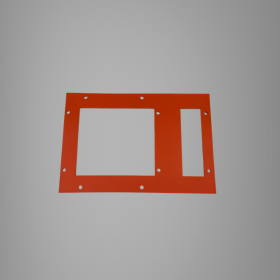
■Overview of Processing Example Product Name: Silicone Sponge Packing / Dimensions: 208W × 305L × 5t, Hole Diameter φ7 × 10 Locations / This processing example features a packing made from silicone sponge (SSR930N). It has a special shape with two openings and ten bolt holes arranged around the outer perimeter. The water jet cutting process allowed for precise dimensional accuracy without compromising the unique flexibility of the sponge material. Silicone sponge is excellent in heat resistance and cold resistance, making it suitable for sealing applications in equipment. ■Product Features Silicone rubber (Si) is a special rubber with silicon as its main framework. It exhibits exceptional heat resistance (up to 200°C) and cold resistance (down to -70°C), maintaining stable performance over a wide temperature range. It also has high weather resistance, electrical insulation properties, and safety for human contact, making it widely used as a sealing material in the food and medical fields, as well as in high-temperature environments, although it has lower mechanical strength.
Added to bookmarks
Bookmarks listBookmark has been removed
Bookmarks listYou can't add any more bookmarks
By registering as a member, you can increase the number of bookmarks you can save and organize them with labels.
Free membership registration
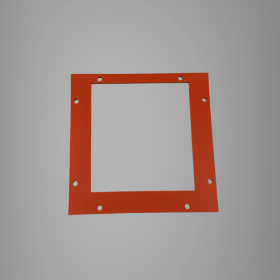
■Overview of Processing Example Product Name: Square Gasket Made of Silicone Sponge / Dimensions: 204□×29.5×14W Groove Edge, Thickness 5t, φ7 Holes × 8 Locations / This processing example features a square gasket made from silicone sponge SSR930N. It was manufactured for applications requiring stable sealing performance over a wide temperature range. The water jet processing has achieved high precision for the 8 bolt holes, despite the material being sponge. ■Product Features Silicone sponge is a material made by foaming silicone rubber, offering excellent heat resistance (up to 200°C) and cold resistance (down to -50°C). Its independent bubble structure provides outstanding sealing and thermal insulation properties, making it lightweight and highly flexible, widely used as packing and insulation material for equipment. It also exhibits excellent weather resistance and ozone resistance, maintaining stable performance even in outdoor environments.
Added to bookmarks
Bookmarks listBookmark has been removed
Bookmarks listYou can't add any more bookmarks
By registering as a member, you can increase the number of bookmarks you can save and organize them with labels.
Free membership registration
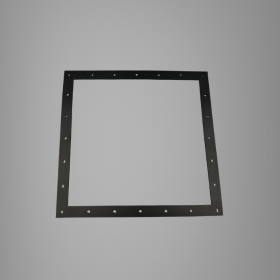
■Overview of Processing Example Product Name: NBR Rubber Square Packing (with Bolt Holes) / Dimensions: 290W × 300L × 3t, Hole Diameter φ4 × 24 Locations, Inner Dimensions 20W Square Cutout / This processing example is a sealing packing for industrial machinery. It features 24 evenly spaced bolt holes along the outer circumference, allowing for secure attachment to flanges. The water jet processing maintains high positional accuracy for the holes despite being made of rubber, achieving a smooth cutting surface without burrs. ■Product Features NBR (Nitrile Rubber) has excellent oil resistance, making it an ideal synthetic rubber for seals in fuel oils and lubricating oils. It also boasts high mechanical strength and wear resistance, and is widely used in O-rings, packings, hoses, and more. However, it has low weather resistance and ozone resistance, making it unsuitable for outdoor use, and it primarily excels in indoor hydraulic and pneumatic equipment.
Added to bookmarks
Bookmarks listBookmark has been removed
Bookmarks listYou can't add any more bookmarks
By registering as a member, you can increase the number of bookmarks you can save and organize them with labels.
Free membership registration
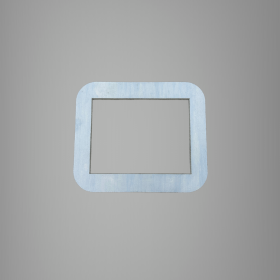
■Overview of Processing Example Product Name: D6000 Square Gasket / Dimensions: 107W × 126L × 3t, Outer R20-4, Different Width Square Hole / This processing example features a square gasket made from the general-purpose joint sheet D6000. The outer corners have been beveled with an R20 radius, and a square hole has been created in the center, all processed using a water jet. This processing method allows for the high-precision cutting of complex contours and inner holes in a single operation, achieving dimensional accuracy and cutting surface quality that are difficult to attain with manual processing. ■Product Features D6000 is a general-purpose joint sheet primarily composed of non-asbestos fibers and synthetic rubber. It excels in processability and flexibility, and it meets the JIS standards for plumbing fixtures. It can be used as a gasket for general piping and equipment for water, oil, and gas; however, it is not suitable for steam lines and is recommended for use at temperatures below 150°C.
Added to bookmarks
Bookmarks listBookmark has been removed
Bookmarks listYou can't add any more bookmarks
By registering as a member, you can increase the number of bookmarks you can save and organize them with labels.
Free membership registration
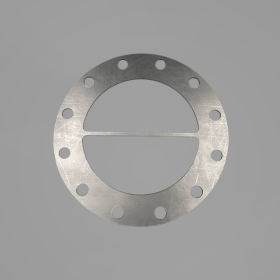
■Overview of Processing Example Product Name: D4000 Manufactured Flange Gasket (with Partition Shape) / Dimensions: Outer Diameter 400φ × Inner Diameter 270φ × Thickness 2t, Bolt Holes 25φ × 12 Locations (P355), with Partition Ribs in the Inner Diameter Section (R10-4) / This processing example features a special flange gasket with a partition shape in the inner diameter section. In addition to the standard annular shape, a partition rib that divides the inner diameter into two parts is machined as a single piece. Thanks to plotter processing, such complex cut-out shapes can be handled with high precision without the need for molds. ■Product Features D4000 is a joint sheet primarily composed of expanded graphite. It has excellent heat resistance and chemical resistance, making it suitable for high-temperature steam and various chemical substances. Its flexibility and superior conformability to flange surfaces allow it to be used for sealing in a wide range of industrial piping and valves.
Added to bookmarks
Bookmarks listBookmark has been removed
Bookmarks listYou can't add any more bookmarks
By registering as a member, you can increase the number of bookmarks you can save and organize them with labels.
Free membership registration
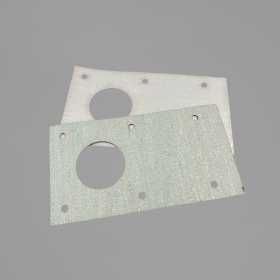
■Overview of Processing Example Product Name: D5800 Tape-Backed Gasket / Dimensions: 185mm × 341mm × 2t, Bolt Holes φ12 × 6 Locations, Center Hole φ90 / This processing example involves the laser processing of the D5800 gasket for high-temperature ducts. The tape-backed specification allows for easy temporary fixing to flanges, improving workability. Laser processing enables high-precision cutting of bolt holes and center holes, while also maintaining dimensional tolerances for complex outer shapes. ■Product Features Used for duct flanges and manhole gaskets for exhaust gases, combustion gases, and hot air. It utilizes bio-soluble fiber cloth that complies with RCF regulations. There are processing methods such as sewing, and large diameter processing is possible. It is used for high-temperature duct sealing.
Added to bookmarks
Bookmarks listBookmark has been removed
Bookmarks listYou can't add any more bookmarks
By registering as a member, you can increase the number of bookmarks you can save and organize them with labels.
Free membership registration
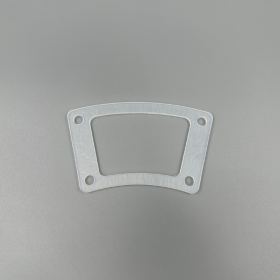
■Overview of Processing Example Product Name: Fan-Shaped Gasket / Dimensions: R178×R117, Thickness 3mm, φ7 holes at 4 locations, with inner and outer radii / This processing example features a fan-shaped gasket made from silicone rubber. It was manufactured for mounting on a leveling plate. The gasket has a complex fan shape with different curvatures on the inside and outside, and requires machining of four bolt holes, so water jet processing was selected. The non-contact cutting with high-pressure water prevents thermal effects and deformation on the rubber material, resulting in smooth curves. ■Product Features Silicone rubber (Si) is a special rubber with a silicon-based main framework. It has excellent heat resistance (up to 200°C) and cold resistance (down to -70°C), demonstrating stable performance over a wide temperature range. It also has high weather resistance, electrical insulation properties, and safety for human contact, making it widely used as a sealing material in the food and medical fields, as well as in high-temperature environments, although its mechanical strength is relatively low.
Added to bookmarks
Bookmarks listBookmark has been removed
Bookmarks listYou can't add any more bookmarks
By registering as a member, you can increase the number of bookmarks you can save and organize them with labels.
Free membership registration
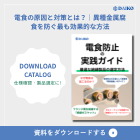
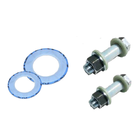
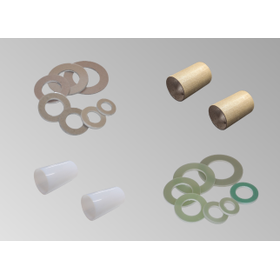
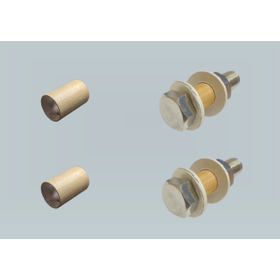
In the longevity of plant equipment and various industrial machinery, preventing dissimilar metal contact corrosion (galvanic corrosion) that occurs at piping flanges and joints of different metals is an extremely important technical challenge. In this article, the term "electrolytic corrosion" primarily refers to this dissimilar metal contact corrosion (galvanic corrosion). It is necessary to ensure sufficient insulation resistance throughout the entire system. In the flange insulation (isolation) of this bolted connection, the core component that physically prevents contact (electrical conduction) between the bolt shaft and the inner wall of the flange is the insulated bolt sleeve (insulation bushing). In this article, our company, a specialized processing manufacturer of industrial sealing materials and insulating materials, will thoroughly compare the material characteristics of the two representative materials: "insulated mica sleeve" and "insulated PTFE sleeve." *For detailed content of the column, please refer to the related link. For more information, please download the PDF or feel free to contact us.
Added to bookmarks
Bookmarks listBookmark has been removed
Bookmarks listYou can't add any more bookmarks
By registering as a member, you can increase the number of bookmarks you can save and organize them with labels.
Free membership registration
In the design and maintenance of plant piping and industrial machinery, preventing "electrolysis (dissimilar metal contact corrosion, galvanic corrosion)" that occurs at points where different metals come into contact is an extremely important technical challenge to ensure the longevity and safe operation of equipment. To block the weak current (corrosion current) generated by the potential difference between metals, it is necessary to completely electrically insulate the flange fastening parts (bolts, nuts, and seating surfaces). Conventional fluororesin (PTFE) sleeves are prone to deformation due to creep (stress relaxation) in high-temperature environments, which may require consideration of reduced tightening axial force and insulation performance. In this article, our company, a specialist manufacturer of industrial sealing materials and insulating materials, will explain the material characteristics of "mica," which is suitable for high-temperature environments, the selection criteria for specific fastening parts (insulating sleeves and mica washers), strict adherence rules during installation, and the total coordination of high-temperature insulating gaskets that should be used in conjunction. *For detailed content of the column, please refer to the related link. For more information, please download the PDF or feel free to contact us.
Added to bookmarks
Bookmarks listBookmark has been removed
Bookmarks listYou can't add any more bookmarks
By registering as a member, you can increase the number of bookmarks you can save and organize them with labels.
Free membership registration
Boilers and pressure vessels are essential energy sources in factories and plants, as well as in various process lines. While they are extremely convenient facilities, they also carry the risk of causing serious labor accidents (major incidents) that can endanger lives, such as massive explosions or the eruption of high-temperature fluids if something goes wrong. Therefore, based on Japan's Industrial Safety and Health Act, boilers and pressure vessels are strictly categorized according to their size, capacity, and pressure. From manufacturing to installation, operation, and eventual decommissioning, a very strict inspection and certification system, along with personnel qualification requirements, are mandated by law. In this article, Daiko Co., Ltd., a specialized manufacturer of industrial sealing materials, will explain the overall picture of "safety regulations for boilers and pressure vessels, statutory inspections (lifecycle regulations), and qualification requirements." *For detailed content of the column, please refer to the related links. For more information, feel free to download the PDF or contact us.
Added to bookmarks
Bookmarks listBookmark has been removed
Bookmarks listYou can't add any more bookmarks
By registering as a member, you can increase the number of bookmarks you can save and organize them with labels.
Free membership registration
Blowers, blowers, and fans operate as the "heart" of various industries, handling exhaust from industrial plants, factory air conditioning systems, and even flue gas treatment from incineration facilities and drying ovens. The "sealing materials (gaskets and packing)" used at flange and casing split surfaces (casing packing) fundamentally support the performance and safety of equipment in the manufacturing and maintenance of these devices. Blowers vary widely in their internal fluids and operating environments depending on their applications, ranging from standard sirocco fans that deliver clean air at room temperature to turbo blowers that handle high-temperature exhaust gases or combustion gases at several hundred degrees, and corrosion-resistant fans that exhaust corrosive gases. *For detailed content of the column, please refer to the related links. For more information, feel free to download the PDF or contact us.
Added to bookmarks
Bookmarks listBookmark has been removed
Bookmarks listYou can't add any more bookmarks
By registering as a member, you can increase the number of bookmarks you can save and organize them with labels.
Free membership registration
Are you having trouble determining whether the bolt threads that fit 150LB (Class 150) or 300LB (Class 300) flanges in the maintenance of overseas plant equipment or in the construction of piping lines designed for oil refining and chemical plants are in metric standards or unified standards (inches)? Do you want to know the exact length of the stud bolts? In domestic plants, the JPI-7S-15 (Flanges for Petroleum Industry) standard, which is based on ASME B16.5, is widely used. While the basic dimensional system is based on ASME B16.5, there are also differences tailored to domestic operations, so it is necessary to confirm the actual specifications. Since these differ from the familiar JIS standards (10K/20K, etc.) in terms of outer diameter, P.C.D (the diameter of the circle connecting the centers of the bolt holes), and the number of bolts, if you do not confirm the exact specifications and arrange accordingly, it could lead to nonconformities on-site or leakage risks due to poor fastening. *For detailed content of the column, you can view it through the related link. For more information, please download the PDF or feel free to contact us.*
Added to bookmarks
Bookmarks listBookmark has been removed
Bookmarks listYou can't add any more bookmarks
By registering as a member, you can increase the number of bookmarks you can save and organize them with labels.
Free membership registration
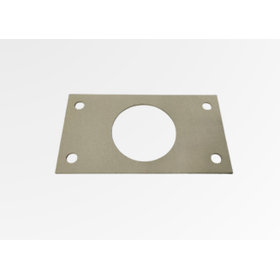
We would like to introduce a processing case of Nichias' vermiculite-based heat-resistant and insulating board "Vermosal Sheet No. 6750-P," adopted for electric furnaces and heat treatment equipment. The specifications include a board measuring 138W × 250L with a large center hole of φ100 and four φ15 bolt holes for fastening. Hard boards containing minerals, like Vermosal Sheet, tend to have brittle edges that can easily chip when cut with rough tools such as saws. However, by utilizing our high-precision plotter processing, we minimized burrs and chipping to an extreme degree, successfully completing the mass production of 120 pieces with high precision. [Case Overview] ■ Product Name: Vermosal Sheet High Heat-Resistant Insulating Gasket ■ Dimensions: 3.0t × 138W × 250L (Center φ100 × 1, Corner Bolt Holes φ15 × 4) ■ Material/Processing Method: Vermosal Sheet No. 6750-P (manufactured by Nichias) / Plotter Processing ■ Quantity/Application: 120 pieces / Insulating and electrical insulating gaskets for industrial furnaces, drying ovens, etc. *For more detailed information about the case, please refer to the related link. For further details, you can download the PDF or feel free to contact us.
Added to bookmarks
Bookmarks listBookmark has been removed
Bookmarks listYou can't add any more bookmarks
By registering as a member, you can increase the number of bookmarks you can save and organize them with labels.
Free membership registration
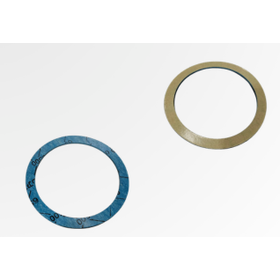
We would like to introduce an example of a round ring gasket using "Vulcan No. 6500," which is widely used for piping connections and sealing parts of various industrial devices. The size of φ145×φ119 is easy to handle, and a major feature is that one side is processed with adhesive tape (double-sided tape). This dramatically facilitates temporary fixing and positioning in high places, vertical flanges, or narrow areas that are difficult to reach, preventing the gasket from shifting or falling during screw tightening work. It shortens construction time on-site and significantly improves the reliability of assembly work. 【Case Overview】 ■ Product Name: Vulcan No. 6500 Round Ring Gasket with Double-Sided Tape ■ Dimensions: 2.0t×φ145 (outer diameter)×φ119 (inner diameter) ■ Material/Specification: Vulcan No. 6500 (general-purpose non-asbestos joint sheet) / bonded with adhesive tape on one side (for temporary fixing) ■ Processing Method/Quantity: Plotter processing / 30 pieces *For detailed information about the case, please refer to the related link. For more details, please download the PDF or feel free to contact us.
Added to bookmarks
Bookmarks listBookmark has been removed
Bookmarks listYou can't add any more bookmarks
By registering as a member, you can increase the number of bookmarks you can save and organize them with labels.
Free membership registration
In industrial gas and high-pressure gas environments, such as filling lines for plant equipment and gas cylinders, do you have questions like "Which packing should be used for piping that carries ultra-low temperature liquid nitrogen?" or "What is 'Daiflon,' which is often specified for high-pressure gas valve seats?" In the industrial gas industry, including oxygen, nitrogen, and argon, various materials are used for pipe joints and internal valve components. Among them, "Daiflon (PCTFE)" is a representative resin material widely adopted in industrial gas facilities. In this article, our company, a specialized manufacturer of industrial sealing materials with extensive delivery experience in the industrial gas sector, will clearly explain the reasons why Daiflon is frequently used in the industrial gas and high-pressure gas industry. *For detailed content of the column, please refer to the related link. For more information, feel free to download the PDF or contact us directly.*
Added to bookmarks
Bookmarks listBookmark has been removed
Bookmarks listYou can't add any more bookmarks
By registering as a member, you can increase the number of bookmarks you can save and organize them with labels.
Free membership registration
In the design, manufacturing, and maintenance of water treatment plants, industrial filtration equipment, or semiconductor manufacturing equipment, the selection of sealing materials (gaskets and packing) for piping connections is a crucial factor that affects the reliability of the equipment. In particular, when fastening "PVC piping (plastic flanges)" or "plastic lined flanges," which have limitations on tightening torque, standard sheet gaskets are prone to leakage due to insufficient surface pressure. Conversely, if tightened too much in an attempt to stop the leak, there is a risk that the flange itself may crack. A widely used sealing material that addresses these specific challenges of plastic flanges is the "D packing (EPDM molded packing)," which reliably stops fluids even at low surface pressures. *For more detailed information, please refer to the related links. For further details, you can download the PDF or feel free to contact us.*
Added to bookmarks
Bookmarks listBookmark has been removed
Bookmarks listYou can't add any more bookmarks
By registering as a member, you can increase the number of bookmarks you can save and organize them with labels.
Free membership registration
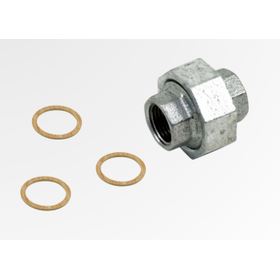
The "union joint" and its internal sealing component, the "union gasket," play a modest yet crucial role in the maintenance of piping and the installation of equipment. Have you ever faced issues on-site such as "water leaking from the union," "not knowing the size of the union packing for old equipment," or "using a special chemical that dissolves standard rubber products"? Due to its threaded structure, the union joint requires the selection of gaskets with appropriate thickness and material; otherwise, it can lead to insufficient tightening or excessive compression, resulting in damage and leaks. In this article, Daiko Co., Ltd., a manufacturer specializing in industrial sealing materials, will thoroughly explain the "union gasket dimension quick reference table," which is immediately useful on-site, the correct material selection based on fluid type, and key points for prompt arrangements to avoid halting operations. *For detailed content of the column, please refer to the related links. For more information, feel free to download the PDF or contact us directly.*
Added to bookmarks
Bookmarks listBookmark has been removed
Bookmarks listYou can't add any more bookmarks
By registering as a member, you can increase the number of bookmarks you can save and organize them with labels.
Free membership registration
In regular repairs (scheduled maintenance) and unexpected maintenance of plants and factories, what troubles on-site personnel are the "limited short construction periods" and the "uncertainty of not knowing the exact dimensions until disassembly." What if the valve manufacturer has been discontinued, or if there are no drawings for overseas products? Delays in procurement directly lead to extended line stoppages. In this article, we will thoroughly explain how Daiko Co., Ltd., a specialized manufacturer of industrial sealing materials, addresses the challenges of component procurement in valve maintenance and dramatically smooths operations for the following fiscal years. *For detailed content of the column, you can view it through the related links. For more information, please download the PDF or feel free to contact us.*
Added to bookmarks
Bookmarks listBookmark has been removed
Bookmarks listYou can't add any more bookmarks
By registering as a member, you can increase the number of bookmarks you can save and organize them with labels.
Free membership registration
Here is an example of the "EPDM white packing" used in large flange parts of food and beverage machinery. We performed circular machining with a diameter of φ600 on a rubber material with a thickness of 10mm. Thick rubber tends to have distorted cross-sections (tapering) when processed with standard cutting methods, but our water jet cutting technology achieves vertical and beautiful cutting surfaces. We use safe materials that comply with the Food Sanitation Act, and we consistently accept requests for accompanying documents such as conformity certificates as needed. 【Case Overview】 ■ Product Name: EPDM White Food Sanitation Act Compliant Packing ■ Dimensions: t10×φ600 (outer diameter)×φ550 (inner diameter) ■ Material/Specifications: EPDM White / Compliant with Food Sanitation Act, documents available ■ Processing Method: Water Jet Cutting *For more detailed information about the case, you can view it through the related links. For further details, please download the PDF or feel free to contact us.
Added to bookmarks
Bookmarks listBookmark has been removed
Bookmarks listYou can't add any more bookmarks
By registering as a member, you can increase the number of bookmarks you can save and organize them with labels.
Free membership registration
In factories, hydraulic equipment, piping systems, and various industrial machines, "oil leaks (due to oil seal failure)" are a critical issue that can lead to serious equipment troubles, fires, and production line stoppages. To address these leaks, the key to sealing is the use of sealing components such as gaskets and packing made from "oil-resistant rubber." In this article, our company, a specialized trading firm and processing manufacturer of industrial sealing materials, will thoroughly explain the mechanism by which rubber deteriorates in oil, compare the characteristics of representative oil-resistant rubbers (such as NBR, FKM, and silicone), and provide guidance on the correct selection based on different environments. *For detailed content of the column, please refer to the related links. For more information, feel free to download the PDF or contact us.
Added to bookmarks
Bookmarks listBookmark has been removed
Bookmarks listYou can't add any more bookmarks
By registering as a member, you can increase the number of bookmarks you can save and organize them with labels.
Free membership registration
In the design and maintenance of factory equipment, essential applications include wanting to "prevent drafts and water leaks" and needing "cushioning materials to protect precision instruments from shocks," which makes "sponge materials" indispensable. However, if one chooses a random sponge just because "it's soft for now," it can lead to failures such as water seeping in and causing leaks, or degrading due to oil and becoming worn out. In this article, Daiko Co., Ltd., a specialized manufacturer of industrial sealing materials, will thoroughly explain the differences between sponge and foam, how to distinguish between "continuous bubbles and independent bubbles" that must not be confused, and compare representative materials (such as rubber sponge, urethane, PE, etc.). *For detailed content of the column, please refer to the related links. For more information, feel free to download the PDF or contact us.
Added to bookmarks
Bookmarks listBookmark has been removed
Bookmarks listYou can't add any more bookmarks
By registering as a member, you can increase the number of bookmarks you can save and organize them with labels.
Free membership registration
"I want to create original design educational toys using sponge, but the mold costs are too high." "I would like to custom order a single store logo sign or interior decoration made of acrylic or wood." "I want to process dedicated urethane cushioning material for an attaché case to carry precision equipment." In the development of new products and the production of custom items, many designers and creators are troubled by not knowing where to request processing or by the initial costs being a barrier to product realization. In fact, our industrial cutting equipment, which manufactures gaskets and packing to prevent pipe leaks, is widely utilized in creating products across various industries such as construction, interior design, education, and advertising displays, due to its overwhelming precision and versatility. *For more details on the column, please refer to the related link. For more information, feel free to download the PDF or contact us.
Added to bookmarks
Bookmarks listBookmark has been removed
Bookmarks listYou can't add any more bookmarks
By registering as a member, you can increase the number of bookmarks you can save and organize them with labels.
Free membership registration
We would like to introduce a case study of the "fluororesin cushion packing" used in large flanged parts of industrial equipment. For a massive ring shape exceeding an outer diameter of 900A, it was necessary to precisely arrange numerous bolt holes. We adopted water jet processing, which allows for high-precision cutting while minimizing thermal effects on the composite material, the fluororesin cushion material. With uniform hole position accuracy and excellent shape reproducibility, we achieved ease of assembly on-site and stable sealing performance. 【Case Overview】 ■ Product Name: Fluororesin Cushion Packing (Core CR) ■ Dimensions: Equivalent to 5K-900A large diameter ring (with multiple bolt holes) ■ Material/Structure: PTFE (coating layer) + CR rubber (core material) ■ Processing Method: Water Jet Processing *For detailed information about the case, please refer to the related link. For more information, feel free to download the PDF or contact us.
Added to bookmarks
Bookmarks listBookmark has been removed
Bookmarks listYou can't add any more bookmarks
By registering as a member, you can increase the number of bookmarks you can save and organize them with labels.
Free membership registration
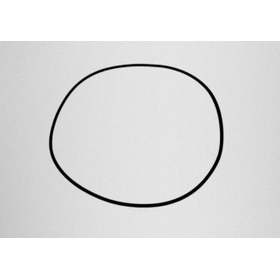
We would like to introduce a case study of the production of oversized O-rings used in the sealing parts of large equipment. In response to the challenge that the curing adhesion process (using molds) takes several weeks and does not meet the timeline for site restoration, we proposed our round cord adhesive processing. A 10mm diameter NBR round cord was bias cut (diagonally cut) to match the circumference length, and skilled craftsmen manually bonded it. By maximizing the adhesive surface area, we secured sufficient strength for practical use and achieved delivery in an overwhelmingly short time frame. 【Case Overview】 ■ Product Name: NBR Round Cord Adhesive O-Ring ■ Dimensions: Wire diameter 10φ × Inner diameter (ID) 621 ■ Material/Processing Method: NBR (Nitrile Rubber) / Bias cut and manual adhesive bonding ■ Application: Emergency maintenance of large equipment / Large tank sealing *For more detailed information about the case, please refer to the related links. For further details, please download the PDF or feel free to contact us.
Added to bookmarks
Bookmarks listBookmark has been removed
Bookmarks listYou can't add any more bookmarks
By registering as a member, you can increase the number of bookmarks you can save and organize them with labels.
Free membership registration