- Publication year : 2026
1~6 item / All 6 items
Displayed results

Added to bookmarks
Bookmarks listBookmark has been removed
Bookmarks listYou can't add any more bookmarks
By registering as a member, you can increase the number of bookmarks you can save and organize them with labels.
Free membership registration
Contact this company
Inquiry FormBefore making an inquiry
Download Profile1~6 item / All 6 items
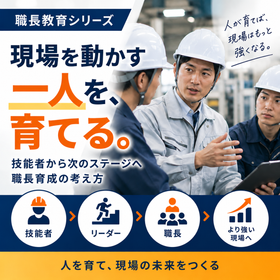
In the manufacturing field, it is essential to have not only skilled personnel but also a "foreman" who can manage safety, quality, and progress while overseeing the entire site and motivating people. However, just because someone is an excellent skilled worker does not mean they will automatically become an excellent foreman. Foremen are required to possess abilities that differ from technical skills, such as instruction and communication, personnel development, risk management, and decision-making on-site. That is why it is important to view foremen not as something that naturally arises from experience, but to intentionally cultivate future foreman candidates from an early stage. This article provides a detailed explanation of the mindset needed to expand one's career from skilled worker to leader and foreman, as well as the roles and development methods required of foremen. For more detailed content, please check out the Technical Farm's note!
Added to bookmarks
Bookmarks listBookmark has been removed
Bookmarks listYou can't add any more bookmarks
By registering as a member, you can increase the number of bookmarks you can save and organize them with labels.
Free membership registration
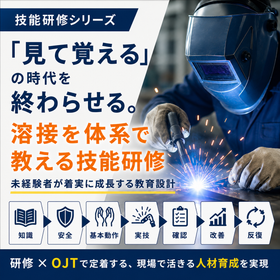
In manufacturing sites, education through "watching and learning from seniors" is still widely practiced. However, for inexperienced individuals, it can be unclear what to observe, why certain actions are taken, and how proficient they need to be, which can lead to a personalized approach to training. Therefore, it is important to shift the skill acquisition process from "learning by watching" to "learning in a structured manner." By breaking down the process into steps such as knowledge, safety, basic actions, practical skills, verification, improvement, and repetition, both learners and instructors can clarify the skill acquisition process. This article uses welding skills as an example to explain the concept of systematic skill education and the development of human resources through a combination of training and on-the-job training (OJT) in detail. For more detailed information, please check out the Technical Farm's note!
Added to bookmarks
Bookmarks listBookmark has been removed
Bookmarks listYou can't add any more bookmarks
By registering as a member, you can increase the number of bookmarks you can save and organize them with labels.
Free membership registration
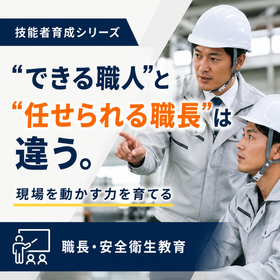
In the manufacturing field, even if there are highly skilled "capable craftsmen," it does not necessarily mean they can become "trustworthy supervisors" right away. Supervisors are required to have not only work skills but also the ability to manage safety and quality, provide instructions and communication to workers, oversee progress, develop talent, and make decisions on-site, which are essential for driving the entire team. This article organizes the differences between "capable craftsmen" and "trustworthy supervisors," and explains the six essential skills needed for supervisors, as well as the role of supervisor and safety and health education. It is recommended for companies facing challenges in workforce development in the manufacturing industry, such as "there are skilled workers, but not enough personnel to manage the site" or "we want to develop the next candidates for supervisors." For detailed content of the article, please check out the Technical Farm's note!
Added to bookmarks
Bookmarks listBookmark has been removed
Bookmarks listYou can't add any more bookmarks
By registering as a member, you can increase the number of bookmarks you can save and organize them with labels.
Free membership registration
In the manufacturing industry, addressing the shortage of human resources and skill transfer has become an important management issue. Particularly in welding and assembly processes, there is a demand for early effectiveness and improved retention rates after assignment. This time, we would like to introduce a case study of pre-assignment training implemented by a construction machinery manufacturer. The company faced challenges with early turnover of personnel assigned to welding and assembly processes, as well as an increase in the educational burden on-site. To address this, they introduced the "Semi-Automatic Welding Practical Training (10 days, 80 hours)" from Technical Farm. Practical training was conducted using actual equipment, allowing participants to gradually acquire knowledge and skills in welding from the basics to practical application. As a result, in addition to early effectiveness after assignment and a reduction in OJT burden, it also contributed to a decrease in turnover rates. Currently, it is being utilized as part of human resource development with an eye toward full-time employment. This case study provides detailed information on the background of the introduction, the training content, and the results achieved. Companies considering a review of pre-assignment education or skill training are encouraged to take a look at the materials.
Added to bookmarks
Bookmarks listBookmark has been removed
Bookmarks listYou can't add any more bookmarks
By registering as a member, you can increase the number of bookmarks you can save and organize them with labels.
Free membership registration
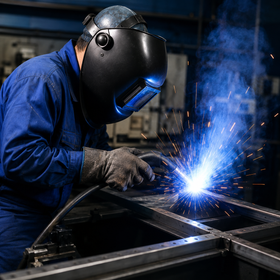
In the manufacturing industry, many companies face challenges in human resource development, such as a shortage of skilled workers, skill transfer, and securing educational systems. Particularly in welding and machining, it is not uncommon for temporary employees to start with tacking and grinding tasks and take time to be able to handle advanced operations like full welding. To address this issue, our company utilizes the training facility "Technical Farm" to provide practical education in welding and machining. We not only train inexperienced individuals to reach a "quasi-experienced level," but also offer reskilling for seniors and those with gaps in their employment history. By acquiring basic skills before assignment, we not only accelerate their effectiveness on-site but also help reduce the educational burden on companies and promote skill transfer. If you are struggling with human resource development, skill transfer, or reducing educational burdens, please feel free to consult us. We will propose human resource development and utilization methods tailored to your company's challenges. ▼ For more details, please check the URL. *This information is introduced on the official note of G Factory, a group company of ours.
Added to bookmarks
Bookmarks listBookmark has been removed
Bookmarks listYou can't add any more bookmarks
By registering as a member, you can increase the number of bookmarks you can save and organize them with labels.
Free membership registration
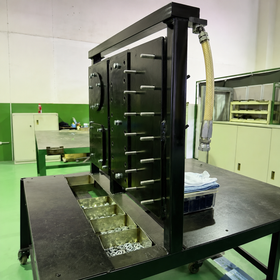
At Technical Farm, we conduct practical training related to assembly work in addition to welding and machining. Although the task of tightening bolts and nuts may seem simple at first glance, it is important to acquire the proper use of tools, work posture, and highly reproducible work procedures to ensure quality stability. Our training focuses not just on repetitive practice, but on understanding "why that task is necessary" while acquiring skills. Additionally, in training using a cuboid assembly kit, participants deepen their understanding of the assembly process by assembling components while reading drawings. We emphasize cultivating "fundamental skills that can be applied in any workplace" rather than teaching specific tasks. By acquiring basic knowledge such as tool usage and inventory management, we support the early development of inexperienced workers and their integration into the workplace! If you are considering human resource development or training in a manufacturing environment, please feel free to contact us. ▼ For more details, please visit the URL below *Details of the training content are introduced on the official note of our group company, G Factory Co., Ltd.
Added to bookmarks
Bookmarks listBookmark has been removed
Bookmarks listYou can't add any more bookmarks
By registering as a member, you can increase the number of bookmarks you can save and organize them with labels.
Free membership registration