We have compiled a list of manufacturers, distributors, product information, reference prices, and rankings for movie.
ipros is IPROS GMS IPROS One of the largest technical database sites in Japan that collects information on.

movie Product List and Ranking from 54 Manufacturers, Suppliers and Companies

Last Updated: Aggregation Period:Dec 24, 2025~Jan 20, 2026
This ranking is based on the number of page views on our site.

movie Manufacturer, Suppliers and Company Rankings

Last Updated: Aggregation Period:Dec 24, 2025~Jan 20, 2026
This ranking is based on the number of page views on our site.

  1. LinkStudio Fukuoka//Educational and Research Institutions
  2. 松井製作所 Osaka//Ferrous/Non-ferrous metals
  3. ベンカン機工 Gunma//Ferrous/Non-ferrous metals
  4. 4 リナック 日本支社 Kanagawa//Machine elements and parts
  5. 5 エスユーエス 京都本社 Kyoto//IT/Telecommunications

movie Product ranking

Last Updated: Aggregation Period:Dec 24, 2025~Jan 20, 2026
This ranking is based on the number of page views on our site.

  1. Reasons and solutions for employees not following safety rules. LinkStudio
  2. Visualizing the reasons for the continued "labeling mistakes." LinkStudio
  3. A thorough explanation of the self-holding power and brakes of electric cylinders in a video! リナック 日本支社
  4. A story about how the new employee's slow work improved after reevaluating the training. LinkStudio
  5. 4 A video that explains the mandrel manufacturing process. ベンカン機工

movie Product List

196~210 item / All 502 items

Displayed results

After the new employee training, accidents occurred one after another; the story of how changing the training method led to improvement.

[Manufacturing Industry New Employee Training] [Safety Education Video] "Practical × Video Training" to Improve Retention Rates! Introducing Effective Training Points to Prevent Accidents.

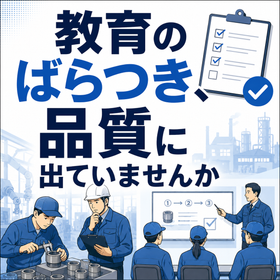
Have you ever faced the concern that 'despite conducting training for new employees, accidents are not decreasing'? In the manufacturing industry, it is often observed that even after implementing training for new employees, accidents continue to occur. ■ While awareness is high immediately after training, many new employees forget the rules within 1 to 2 months (over 50% in an internal survey were unclear about the training content) ■ Training focused mainly on classroom instruction leads to a significant gap with actual work ■ Over-reliance on on-the-job training results in inconsistencies in educational content Many companies face such challenges. *For more details, please feel free to contact us.

  • Distance learning/E-learning
  • Distance learning/E-learning

Added to bookmarks

Bookmarks list

Bookmark has been removed

Bookmarks list

You can't add any more bookmarks

By registering as a member, you can increase the number of bookmarks you can save and organize them with labels.

Free membership registration

Case of Successful Skill Transfer through Video Training in a Site Dependent on Veteran Workers

Manufacturing Industry New Employee Training: Challenges of 'Skill Inheritance' Advancing in the Manufacturing Field! We will also introduce key points for successfully achieving skill inheritance.

In the manufacturing industry, the inheritance of know-how and skills from veteran workers with many years of experience has become an important issue. However, if skill transfer does not proceed smoothly, it can lead to decreased productivity and variations in quality, which are factors that reduce a company's competitiveness. The main reasons why skill transfer is difficult include the following points: - The "intuitive techniques" of veteran workers are not verbalized. - Different instructors have varying teaching methods, making it difficult to provide consistent training for newcomers. - Education is primarily focused on on-the-job training (OJT), resulting in low learning efficiency. - Acquiring skills takes time, and there is significant individual variation in proficiency. To address these issues, many companies are implementing skill transfer programs that utilize video training. *For more details, please feel free to contact us.*

  • Distance learning/E-learning
  • Distance learning/E-learning

Added to bookmarks

Bookmarks list

Bookmark has been removed

Bookmarks list

You can't add any more bookmarks

By registering as a member, you can increase the number of bookmarks you can save and organize them with labels.

Free membership registration

Successful case of improving retention rates through video training in a high turnover rate environment.

[Training Video] What are the Causes of High Turnover Rates in the Manufacturing Industry? We will also introduce cases where turnover rates have been significantly reduced.

In the manufacturing industry, the high turnover rate of new employees and young workers has become a significant issue. In particular, the early resignation of inexperienced employees is seen as problematic because it leads to increased hiring and training costs, as well as decreased production efficiency. The main factors contributing to the high turnover rate include the following: - Insufficient training, making it difficult to adapt to the job - Tasks being challenging, resulting in a heavy burden until mastery is achieved - Dissatisfaction with the work environment and guidance methods - Lack of clarity regarding the significance of the job and career paths To address these issues, an increasing number of companies are implementing training programs that utilize video training. *For more details, please feel free to contact us.*

  • Distance learning/E-learning
  • Distance learning/E-learning

Added to bookmarks

Bookmarks list

Bookmark has been removed

Bookmarks list

You can't add any more bookmarks

By registering as a member, you can increase the number of bookmarks you can save and organize them with labels.

Free membership registration

What problems arise from variations in work procedures?

[Training Video] Introducing the main issues caused by variations in work procedures and successful examples of standardized video education!

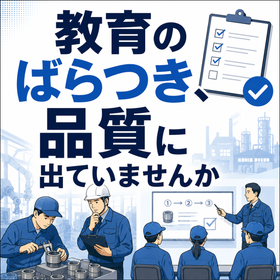
In the manufacturing industry, there is a frequent issue where, despite employees performing the same tasks, the procedures differ from one employee to another. Such non-standardized work procedures lead to the following risks: Main challenges due to variations in work procedures: ■ Instability in quality ■ Decreased work efficiency ■ Personalization of training ■ Increase in mistakes and defective products According to the Ministry of Health, Labour and Welfare's "Survey on Work Standardization in the Manufacturing Industry" (2023), over 60% of manufacturing companies responded that "variations in work procedures are a challenge for quality control," highlighting the growing need for standardization. To address this issue, the standardization of work procedures using video education is gaining attention as an effective measure. *For more details, please feel free to contact us.

  • Distance learning/E-learning
  • Distance learning/E-learning

Added to bookmarks

Bookmarks list

Bookmark has been removed

Bookmarks list

You can't add any more bookmarks

By registering as a member, you can increase the number of bookmarks you can save and organize them with labels.

Free membership registration

No more forklift accidents! Examples of safety education in practice.

【Safety Education Video】About the turning points in forklift safety education and real examples of reducing accidents!

In the manufacturing industry, forklifts are essential transportation tools. However, improper operation and human error can lead to significant causes of workplace accidents. In fact, forklift-related accidents can result in fatalities, making it a critical issue that cannot be overlooked for ensuring safety on site. *For more details, please feel free to contact us.*

  • Distance learning/E-learning
  • Distance learning/E-learning

Added to bookmarks

Bookmarks list

Bookmark has been removed

Bookmarks list

You can't add any more bookmarks

By registering as a member, you can increase the number of bookmarks you can save and organize them with labels.

Free membership registration

What is the method that succeeded in establishing habits through video training?

[Manufacturing Industry New Employee Training] [Safety Education Video] Implementing safety education that is understood and adhered to.

In the manufacturing industry, pointing and confirming is a fundamental safety measure. However, this habit often becomes a mere formality in daily operations, leading to many cases where confirmation is done superficially. As a result, workers' attention levels decline, increasing the risk of accidents and near misses. This is particularly true for new or less experienced workers, who have few opportunities to fully understand the importance of pointing and confirming, often perceiving instructions from supervisors as just a "rule." Therefore, there is a need for education that strongly emphasizes the significance of pointing and confirming. *For more details, please feel free to contact us.*

  • Distance learning/E-learning
  • Distance learning/E-learning

Added to bookmarks

Bookmarks list

Bookmark has been removed

Bookmarks list

You can't add any more bookmarks

By registering as a member, you can increase the number of bookmarks you can save and organize them with labels.

Free membership registration

The 'craftsmanship' on site is disappearing; a way to preserve skills for the future through video.

[Training Video] Points on leaving technology for the future through video and the first steps to introducing training!

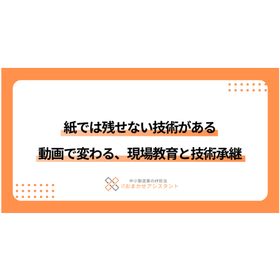
In the manufacturing industry, the craftsmanship possessed by skilled technicians is a crucial element that supports a company's competitiveness. However, the issue of insufficient technology transfer due to aging and labor shortages is becoming increasingly serious. Main factors making it difficult to pass on craftsmanship: ■ Many techniques are hard to verbalize → "Intuition" and "sensory skills" developed over many years of experience are difficult to convey in writing or verbally. ■ The burden on instructors is significant → Relying on on-the-job training for technology transfer increases the burden on educators. ■ Lack of successors → The retention rate of young employees is low, making long-term development challenging. ■ Standardization of techniques is not progressing → Different skilled workers have different methods, making unified education impossible. To address this issue, the use of videos for technology transfer is gaining attention as an effective means. *For more details, please feel free to contact us.

  • Distance learning/E-learning
  • Distance learning/E-learning

Added to bookmarks

Bookmarks list

Bookmark has been removed

Bookmarks list

You can't add any more bookmarks

By registering as a member, you can increase the number of bookmarks you can save and organize them with labels.

Free membership registration

Short on personnel and unable to focus on training? How to streamline with video training.

[Manufacturing Industry New Employee Training] [Training Efficiency] Minimize "Teaching Time" with Video Training! We will also introduce Company A's success story.

I want to train new employees, but the on-site work is so demanding that I can't allocate time for education. For example, there are workplaces where more than 80% of the daily working hours are spent on actual tasks, leaving almost no time for training. Many companies face such concerns. Particularly in the manufacturing industry, while veteran employees are retiring, securing resources for training new hires has become increasingly difficult. ■ There is no time for OJT (on-the-job training) ■ The burden on veterans is too great, hindering education ■ New employees struggle to become productive and end up leaving In a labor shortage, even though there is a need to "properly teach," excessive educational burdens can potentially undermine on-site productivity. So, how can we efficiently advance training within limited resources? *For more details, please feel free to contact us.

  • Distance learning/E-learning
  • Distance learning/E-learning

Added to bookmarks

Bookmarks list

Bookmark has been removed

Bookmarks list

You can't add any more bookmarks

By registering as a member, you can increase the number of bookmarks you can save and organize them with labels.

Free membership registration

Standardizing tasks that were done based on "intuition"! The effects brought by video training.

Manufacturing Industry New Employee Training: Video training that visualizes and standardizes the sense of 'efficiency'! We will also introduce a success story from Company B.

Even when told, "Learn by watching the veterans," it can be difficult for inexperienced newcomers to understand what is important and accurately replicate the work. In fact, a survey in the manufacturing industry revealed that newcomers take more than twice the time to become proficient compared to veterans, and personalized teaching methods tend to decrease the efficiency of skill transfer. ■ Veterans say, "Remember this feeling," but there is no concrete guidance. ■ Although they are supposed to be doing the same work, there is a difference in the results between newcomers and veterans. ■ Different people have different methods, and it is unclear which method is correct. In workplaces facing these challenges, not only does the standardization of skills not progress, but the training speed of newcomers also slows down, hindering productivity improvements. *For more details, please feel free to contact us.

  • Distance learning/E-learning
  • Distance learning/E-learning

Added to bookmarks

Bookmarks list

Bookmark has been removed

Bookmarks list

You can't add any more bookmarks

By registering as a member, you can increase the number of bookmarks you can save and organize them with labels.

Free membership registration

What are the new methods to reduce the burden on educators who become exhausted with each training session?

[Manufacturing Industry New Employee Training] [Training Efficiency Improvement] Significantly reduce educational burden with video training! Accelerate immediate effectiveness in the field.

It is common in many companies for educators to be overwhelmed with training new employees, making it difficult to balance with regular duties. According to a survey, about 60% of educators in the manufacturing industry reported that "the time spent on training is interfering with their work," indicating that the burden of training has become a significant issue. ■ Repeating the same instructions every time a new employee joins ■ Being unable to focus on their primary duties due to the time taken for training ■ The burden on educators increases with each training session, leading to decreased motivation Such problems cannot be solved simply by "trying harder." There is a need to adopt efficient training methods and create systems that alleviate the burden of education. *For more details, please feel free to contact us.

  • Distance learning/E-learning
  • Distance learning/E-learning

Added to bookmarks

Bookmarks list

Bookmark has been removed

Bookmarks list

You can't add any more bookmarks

By registering as a member, you can increase the number of bookmarks you can save and organize them with labels.

Free membership registration

Training costs can be reduced even further! A revolution in education utilizing videos.

[Manufacturing Industry New Employee Training] [Training Efficiency] "Are you facing the issue of 'training costs being too high'? Reduce training costs with video training.

The cost of training is one of the significant burdens for companies. This is especially true in the manufacturing industry, where regular training sessions such as onboarding, safety education, and technical training are conducted, leading to annual training expenses for a single company reaching several million yen. According to a survey, about 70% of manufacturing companies responded that "reducing training costs is a challenge," indicating a demand for the introduction of more efficient training methods. - Inviting instructors for each training session increases costs. - The time taken by the education staff disrupts their primary duties. - On-the-job training (OJT) is central, placing a heavy burden on the trainers. However, these challenges can be significantly mitigated by "changing the training system," allowing for substantial cost reductions. For example, switching from traditional face-to-face training to video training can reduce instructor dispatch costs and alleviate the burden of OJT. *For more details, please feel free to contact us.*

  • Distance learning/E-learning
  • Distance learning/E-learning

Added to bookmarks

Bookmarks list

Bookmark has been removed

Bookmarks list

You can't add any more bookmarks

By registering as a member, you can increase the number of bookmarks you can save and organize them with labels.

Free membership registration

Is the time spent on OJT going to waste? Tips for efficiency.

[Training Video] It is possible to significantly improve the efficiency of OJT, allowing for an intuitive understanding of the workflow!

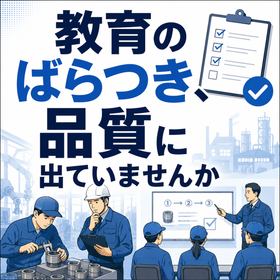
On-the-Job Training (OJT) is an effective educational method that allows learning through practice, but many companies face challenges with it. In fact, a survey revealed that about 65% of companies implementing OJT responded that "variability in guidance and inefficient training are reducing productivity," indicating that it affects the quality of work and the speed of skill acquisition. ■ The burden on instructors is significant ■ The quality of guidance varies, leading to different learning speeds ■ An inefficient situation where the same explanation is repeated multiple times If such challenges are left unaddressed, the burdens on both instructors and learners will increase, making effective education unattainable. *For more details, please feel free to contact us.

  • Distance learning/E-learning
  • Distance learning/E-learning

Added to bookmarks

Bookmarks list

Bookmark has been removed

Bookmarks list

You can't add any more bookmarks

By registering as a member, you can increase the number of bookmarks you can save and organize them with labels.

Free membership registration

The cost of inviting instructors for each training session could be reduced by ○○ thousand yen annually if we use videos?

[Manufacturing Industry New Employee Training] [Training Efficiency] "Are you facing the concern of having to arrange instructors for each training session, resulting in excessive costs?"

In the manufacturing industry, training for new employees and safety education are essential, but inviting external instructors each time incurs costs, becoming a significant burden over the year. - Each training incurs costs for external instructors, increasing expenses (according to surveys, the training costs for external instructors in manufacturing companies reach an average of 4 million yen annually, making cost reduction a major challenge). - Coordinating the schedules of instructors is difficult, limiting the timing of training. - One training session may not cover everything, necessitating additional training. To address these challenges, many companies have adopted "video training," achieving reductions in training costs and improving the efficiency of education. *For more details, please feel free to contact us.*

  • Distance learning/E-learning
  • Distance learning/E-learning

Added to bookmarks

Bookmarks list

Bookmark has been removed

Bookmarks list

You can't add any more bookmarks

By registering as a member, you can increase the number of bookmarks you can save and organize them with labels.

Free membership registration

There are too many falls and pinch accidents! An educational method that was extremely effective in the manufacturing site.

[Manufacturing Industry New Employee Training] [Safety Education Video] The reality of accidents in the manufacturing field! Utilizing video training to enhance safety awareness and prevent accidents.

In the manufacturing industry, falls and being caught in machinery accidents occur frequently and are significant factors in labor-related injuries. In particular, it has been pointed out that the risk of accidents significantly increases in environments where workspace is insufficient and safety measures are not thoroughly implemented. According to a survey by the Ministry of Health, Labor and Welfare, in 2022, falls accounted for about 25% of all labor accidents, while being caught in machinery accidents made up about 15%, with these percentages being particularly high in the manufacturing sector. The main causes of such accidents include the following points: 1. Workers have a low awareness of danger and unconsciously engage in risky behaviors. 2. Safety rules have become mere formalities and are not practiced in daily operations. 3. There is a lack of safety education for new and foreign workers. In fact, statistics from the Ministry of Health, Labor and Welfare indicate that falls account for about 25% of labor accidents, many of which are attributed to inadequate safety measures. To address these issues, more companies are introducing safety education using video training. *For more details, please feel free to contact us.*

  • Distance learning/E-learning
  • Distance learning/E-learning

Added to bookmarks

Bookmarks list

Bookmark has been removed

Bookmarks list

You can't add any more bookmarks

By registering as a member, you can increase the number of bookmarks you can save and organize them with labels.

Free membership registration

"Are you using the machine correctly?" A success story of preventing misuse through video training.

[Manufacturing Industry New Employee Training] [Safety Education Video] Utilizing live-action footage! A video training that clearly explains the correct operating procedures step by step.

In the manufacturing industry, it is required that workers use machines correctly. However, cases of malfunctions and accidents due to misuse still occur frequently, posing a serious challenge for companies. According to a survey by the Ministry of Health, Labour and Welfare, about 30% of labor accidents in the manufacturing sector are related to machine misuse, with a significant number of incidents involving new employees and foreign workers. In particular, it has been pointed out that frequent misuse is caused by a lack of education and inconsistencies in on-site guidance, leading to decreased productivity and increased safety risks. The main causes of misuse include the following points: 1. Operating machines in a self-taught manner without reading the manual. 2. Training relying on verbal instruction without systematic training. 3. New and foreign workers being unfamiliar with machine handling, leading to frequent errors. 4. Not knowing the procedures for responding to troubles, resulting in inadequate responses. To address these issues, the use of video training for machine operation education is gaining attention. *For more details, please feel free to contact us.*

  • Distance learning/E-learning
  • Distance learning/E-learning

Added to bookmarks

Bookmarks list

Bookmark has been removed

Bookmarks list

You can't add any more bookmarks

By registering as a member, you can increase the number of bookmarks you can save and organize them with labels.

Free membership registration