We have compiled a list of manufacturers, distributors, product information, reference prices, and rankings for process.
ipros is IPROS GMS IPROS One of the largest technical database sites in Japan that collects information on.

process Product List and Ranking from 81 Manufacturers, Suppliers and Companies | IPROS GMS

Last Updated: Aggregation Period:Feb 04, 2026~Mar 03, 2026
This ranking is based on the number of page views on our site.

process Manufacturer, Suppliers and Company Rankings

Last Updated: Aggregation Period:Feb 04, 2026~Mar 03, 2026
This ranking is based on the number of page views on our site.

  1. 奥野製薬工業 大阪・放出、東京、名古屋など Osaka//Chemical
  2. 矢崎エナジーシステム Tokyo//Energy
  3. Siconnex Japan(サイコネックス ジャパン) Tokyo//Industrial Machinery
  4. 4 null/null
  5. 5 ネツレン 高周波熱錬株式会社 Tokyo//Machine elements and parts

process Product ranking

Last Updated: Aggregation Period:Feb 04, 2026~Mar 03, 2026
This ranking is based on the number of page views on our site.

  1. The process of creating "cold water" from "heat." 矢崎エナジーシステム
  2. Electroless copper plating process for glass substrates for TGV surface treatment 奥野製薬工業 大阪・放出、東京、名古屋など
  3. Chitose Research Institute Co., Ltd.
  4. Mild carburizing process ネツレン 高周波熱錬株式会社
  5. 4 Ozone-based resist stripping process "SicOzone Strip" Siconnex Japan(サイコネックス ジャパン)

process Product List

31~60 item / All 141 items

Displayed results

ASAL process (drainage treatment using TERRAST)

Reduce running costs! Can be easily installed in existing processing equipment.

The "ASAL Process" can treat most inorganic suspensions such as heavy metals, silica, and fluoride. It allows for low concentration treatment without a decrease in coagulation ability, making it possible to handle low concentrations. It can also be easily installed in existing treatment facilities. It can be utilized for boron treatment, as well as antimony and fluoride treatment. 【Features】 ■ Capable of treating most inorganic suspensions such as heavy metals, silica, and fluoride ■ Allows for low concentration treatment (coagulation ability does not decrease even at low concentrations) ■ Easy installation in existing treatment facilities (reducing initial costs) ■ TERRAST is replaced every six months (reducing running costs) *For more details, please refer to the PDF document or feel free to contact us.

  • Wastewater/wastewater treatment equipment
  • Water treatment equipment
  • process

Added to bookmarks

Bookmarks list

Bookmark has been removed

Bookmarks list

You can't add any more bookmarks

By registering as a member, you can increase the number of bookmarks you can save and organize them with labels.

Free membership registration

JCU proposal process in SAP, MSAP, and any-layer processes.

Etching process suitable for hydrogen peroxide/sulfuric acid etching equipment.

We propose a "Copper Pressure Adjustment Etching Process" aimed at thinning copper pressure and flattening the uneven surface of copper. This process suppresses pitting corrosion (etching pits) that occurs during the etching treatment of filling plated products. Additionally, it is compatible with hydrogen peroxide/sulfuric acid-based etching equipment. 【Features】 - Optimal etching speed for copper pressure adjustment (3-7 μm/min) - Compatible with hydrogen peroxide/sulfuric acid-based etching equipment - Stable management of operating bath component concentration through quantitative replenishment using a sheet counter *For more details, please download the PDF or feel free to contact us.

  • Surface treatment contract service
  • Other surface treatment equipment
  • process

Added to bookmarks

Bookmarks list

Bookmark has been removed

Bookmarks list

You can't add any more bookmarks

By registering as a member, you can increase the number of bookmarks you can save and organize them with labels.

Free membership registration

Dry plating process "Chrome PVD"

Achieving both the appearance of metallic design and radio wave permeability/insulation! An environmentally friendly film formation process that does not use hexavalent chromium.

Metal films with radio wave permeability and insulation properties use "indium vapor deposition" technology. However, the high cost due to being a rare metal and the color tone differences compared to wet chrome plating products are challenges. Our company has established a technology for film formation with radio wave permeability and insulation using 'chrome PVD', which is inexpensive and does not require a coloring process. 【Features】 ■ Insulation of over 1 MΩ ■ Color tone equivalent to wet chrome plating ■ Good adhesion (thermal cycle test) ■ Millimeter wave transmission attenuation lower than indium vapor deposition films ■ Environmentally friendly film formation process that does not use hexavalent chromium *For more details, please refer to the PDF document or feel free to contact us.

  • Other surface treatment equipment
  • process

Added to bookmarks

Bookmarks list

Bookmark has been removed

Bookmarks list

You can't add any more bookmarks

By registering as a member, you can increase the number of bookmarks you can save and organize them with labels.

Free membership registration

[Yamanashi Factory] Self-Hardening Line Process

Casting of various mechanical parts, with numerous achievements!!

Introduction to Our Yamanashi Factory's Self-Hardening Line At our Yamanashi factory, we have a self-hardening casting line that uses wooden patterns, primarily producing castings for injection molding machines, as well as castings for machine tools and various industrial machinery. The main products include hydraulic components used in critical parts of machinery. - Molding sand: Hardened using phenolic resin. - Materials: FC, FCD. - Product weight: From several tens of kilograms to 2.8 tons. - Quality assurance: UT (ultrasonic testing) Other various inspection equipment available. We have built trust and a proven track record. Please feel free to contact us first!

  • Other machine tools
  • process

Added to bookmarks

Bookmarks list

Bookmark has been removed

Bookmarks list

You can't add any more bookmarks

By registering as a member, you can increase the number of bookmarks you can save and organize them with labels.

Free membership registration

Multi-night process (gas nitriding treatment)

Improving wear resistance and fatigue resistance! It is also possible to nitride difficult-to-nitride materials that cannot be treated with gas nitriding.

The "Multi-Night Process (Gas Sulfurizing Nitriding Treatment)" is a technology that allows for the separate and flexible control of nitrogen and sulfur concentrations. It enables the nitriding of difficult-to-nitridize materials that cannot be treated with gas nitriding, improving seizure resistance and galling resistance, while the sulfurized layer (FeS, Fe-Xs) formed on the surface acts as a solid lubricant. Please use it for applications such as shims, thrust washers, engine timing gears, and the balls in ballpoint pens. 【Features】 ■ Separate and flexible control of nitrogen and sulfur concentrations ■ Improved seizure resistance and galling resistance ■ Enhanced wear resistance ■ Increased fatigue resistance ■ Improved pitching resistance *For more details, please refer to the PDF document or feel free to contact us.

Added to bookmarks

Bookmarks list

Bookmark has been removed

Bookmarks list

You can't add any more bookmarks

By registering as a member, you can increase the number of bookmarks you can save and organize them with labels.

Free membership registration

ISC thick plate processing manufacturing process

We can provide materials that are unbreakable and have good elongation rates! Let us introduce the ISC thick plate processing manufacturing process.

We would like to introduce our "Thick Plate Processing Manufacturing Process." Our company collaborates with material manufacturers to research materials suitable for thick plate cold forging processing, providing materials that do not crack and have good elongation properties. We also possess equipment such as the "High-Frequency Partial Annealing Device," which can perform partial annealing treatment, and the "Shot Bonding Treatment Device," which enables unmanned integrated line manufacturing. 【Manufacturing Process】 ■ Blanking Processing ■ High-Frequency Partial Annealing ■ Shot Bonding Processing ■ Cold Forging Forming Processing *For more details, please refer to the PDF document or feel free to contact us.

  • Processing Contract
  • process

Added to bookmarks

Bookmarks list

Bookmark has been removed

Bookmarks list

You can't add any more bookmarks

By registering as a member, you can increase the number of bookmarks you can save and organize them with labels.

Free membership registration

Photoresist Etching Process

We are a photoresist etching manufacturer.

Our photo-resist etching process enables circuits and functions such as light shielding to be incorporated into glass and films. The substrates produced by this process are used in various applications, including organic EL displays, organic EL lighting, optical components, solar cells, and MEMS components.

  • Organic EL
  • lens
  • Other electronic parts
  • process

Added to bookmarks

Bookmarks list

Bookmark has been removed

Bookmarks list

You can't add any more bookmarks

By registering as a member, you can increase the number of bookmarks you can save and organize them with labels.

Free membership registration

Water Treatment Process "Free Series"

Applicable to wastewater from a wide range of processes! A chemical treatment process that improves the issues of conventional methods.

The "Free Series" is a self-developed chemical treatment process that improves the issues of conventional methods for the treatment of nitrogen, COD, fluoride, etc., aimed at water recovery, recycling, and regulatory compliance. It can be applied to wastewater from various processes such as metal pickling, metal chemical products, semiconductor manufacturing processes, plating processes, catalyst manufacturing processes, and precious metal manufacturing processes. We propose appropriate solutions by combining the distinctive elemental technologies of the "Free Series" with metal separation and purification technology. 【Elemental Technologies】 ■ Nitrate Nitrogen Treatment N-Free N ■ Ammoniacal Nitrogen/COD Treatment N-Free A ■ Fluoride Treatment F-Free ■ Boron Fluoride Treatment B-Free F ■ Nitrate/Ammonia Electrolytic Treatment N-Free AN ■ Heavy Metal Treatment, etc. *For more details, please download the PDF or feel free to contact us.

  • Water treatment equipment
  • process

Added to bookmarks

Bookmarks list

Bookmark has been removed

Bookmarks list

You can't add any more bookmarks

By registering as a member, you can increase the number of bookmarks you can save and organize them with labels.

Free membership registration

MAAG Corporation Granulation Temperature Optimization Process【OTP】

A new process technology for resin pellets with high softening and glass transition temperatures that enables void-free spherical pellets.

For example, when high softening point resins such as COC, PMMA, and polycarbonate resin are pelletized using an underwater cutter, will hollow (void) pellets be produced? Immediately after being cut by the underwater cutter, the pellets are cooled by the transport water; however, even if the cooling water is around 90°C, the softening point temperature of polycarbonate resin is around 130°C-160°C, leading to rapid cooling. As a result, the outer shell solidifies due to the sudden cooling, creating a vacuum (void) in the center. MAAG's OTP eliminates the rapid cooling immediately after cutting by enabling the use of cooling water at temperatures above 100°C, resulting in the production of void-free round pellets. Additionally, in conventional underwater cutters, the large ΔT between the cooling water temperature and the resin melting temperature can cause the resin in the die plate holes to solidify and block, which is also resolved.

Added to bookmarks

Bookmarks list

Bookmark has been removed

Bookmarks list

You can't add any more bookmarks

By registering as a member, you can increase the number of bookmarks you can save and organize them with labels.

Free membership registration

Plasma Spray Process

The thermal spray coating is extremely dense! All materials, including high melting point tungsten and ceramics, can be thermally sprayed.

Introducing the thermal spraying process "Plasma Spray." All materials, including high melting point tungsten carbide ceramics, can be thermally sprayed. Since the plasma flame itself is inert, even low melting point metals like aluminum and copper can achieve a pure and low-oxidation coating. Similar to metalizing, it is possible to perform build-up thermal spraying at low temperatures around 100°C, preventing thermal effects and distortion on the base material. 【Features】 ■ Capable of thermal spraying high melting point materials ■ The thermal spray coating is extremely dense ■ A hard and dense coating equivalent to or better than hard plating can be obtained ■ Minimal thermal impact on the base material *For more details, please refer to the PDF document or feel free to contact us.

  • Processing Contract
  • process

Added to bookmarks

Bookmarks list

Bookmark has been removed

Bookmarks list

You can't add any more bookmarks

By registering as a member, you can increase the number of bookmarks you can save and organize them with labels.

Free membership registration

[Blog] The Four Processes of Information Processing

From "data" to "information"! Introducing the reasons why responses differ even when the value of information is recognized.

In this blog, we break down the topic of "how to determine whether 'information' is valuable to oneself" into the thought processes of impression, recognition, evaluation, and influence. There are various indicators that shape impressions, such as whether something is trustworthy or not, stylish or uncool, wonderful or tacky, but many of these are dominated by "appearance." Therefore, in websites, the design in the narrow sense (visual design) that influences the impression when first seen is emphasized for this reason. 【Overview】 ■ From "data" to "information" - Impression - Recognition - Evaluation - Influence *For more details about the blog, you can view it through the related links. Please feel free to contact us for more information.

  • Other information systems
  • Other network tools
  • Other analyses
  • process

Added to bookmarks

Bookmarks list

Bookmark has been removed

Bookmarks list

You can't add any more bookmarks

By registering as a member, you can increase the number of bookmarks you can save and organize them with labels.

Free membership registration

The process of creating "cold water" from "heat."

Reusing "unused" heat! We will explain the specific process of generating "cold water" from "heat."

First, a low-temperature, low-pressure gas-liquid mixed refrigerant (water and water vapor) enters the evaporator. Inside the evaporator, the pressure is almost at a vacuum state, so the boiling point of water at 100°C is reduced to about 7-10°C. By absorbing heat from relatively warm water in the chilled water piping, the refrigerant (water) boils and turns into water vapor. The water vapor is drawn into the absorber, similar to the suction side of the compressor in a vapor compression refrigeration cycle. The water vapor is absorbed by the absorbent liquid "lithium bromide" and is pumped into the regenerator. In the regenerator, the mixture of refrigerant and absorbent liquid is heated and separated back into the original water vapor and absorbent liquid. The absorbent liquid returns to the absorber, while the water vapor is sent to the condenser. There are methods for adding heat in the regenerator, such as combustion using fuels like gas or oil, or using steam or hot water. The refrigerant, which has returned to water after losing heat in the condenser, is depressurized in the expansion device and flows back to the evaporator, repeating the cycle.

  • Heat exchanger
  • process

Added to bookmarks

Bookmarks list

Bookmark has been removed

Bookmarks list

You can't add any more bookmarks

By registering as a member, you can increase the number of bookmarks you can save and organize them with labels.

Free membership registration

Demand planning using Molex's integrated digital approach to the supply chain.

Through our commitment to smart planning, we are establishing a system to effectively meet customer needs in a consistent manner and strengthen our relationships with customers.

In today's rapidly changing environment, ensuring the predictability of the supply chain is essential. Intelligent demand planning, which combines advanced data insights with a robust collaboration framework, provides the resilience and agility that modern supply chains require. Based on seven years of experience since officially starting demand planning operations, Molex embarked on a large-scale reform of the process about three years ago. This reform focused on advanced demand sensing and tighter integration of S&OP and S&OE, as well as building a more cohesive and advanced system. The use of AI and advanced analytics is extremely important. The demand planning team at Molex quickly adopted these technologies, resulting in approximately a 20% improvement in forecast accuracy compared to previous methods. Molex is dedicated to an advanced demand planning process that integrates diverse functions and data sources, along with technologies like AI, to deliver visible results. *For more details, please feel free to contact us.*

  • others
  • process

Added to bookmarks

Bookmarks list

Bookmark has been removed

Bookmarks list

You can't add any more bookmarks

By registering as a member, you can increase the number of bookmarks you can save and organize them with labels.

Free membership registration

What are the benefits of reusing factory wastewater? The system and process.

What is factory wastewater reuse? A detailed explanation of its benefits and basic mechanisms!

The reuse of factory wastewater has been attracting increasing attention in recent years as an important initiative towards achieving a sustainable society. Against the backdrop of severe water resource constraints, strengthened environmental regulations, and the growing need for cost reduction, many companies are actively advancing the sophistication of wastewater treatment technologies and the introduction of reuse systems. In this article, we will explain in detail what factory wastewater reuse is, its benefits, and the basic mechanisms involved. Now is the time to explore the possibilities of reuse for the sustainable use of water resources. *For more detailed information, please refer to the related links. Feel free to contact us for more details.*

  • Water treatment equipment
  • Water treatment equipment and technology
  • Wastewater/wastewater treatment equipment
  • process

Added to bookmarks

Bookmarks list

Bookmark has been removed

Bookmarks list

You can't add any more bookmarks

By registering as a member, you can increase the number of bookmarks you can save and organize them with labels.

Free membership registration

HV1000 Super Carburizing NN Process

Increased strength, wear resistance, and fatigue resistance. Heat treatment of over Hv1000 is possible with low-temperature carburizing (850°C).

We handle the "HV1000 Super Carburizing NN Process." Our newly developed technology, the N・N Process, solves the problem of poor carburizing properties through a special gas reaction, making it possible to achieve hardness above Hv1000 even in sulfur-resistant steel (SUN). Additionally, we offer immediate services for direct vacuum carburizing, marquenching distortion-resistant quenching, fine grain life extension, vacuum pressure quenching, cooling rate conversion, multi-nitriding, and heat treatment of stainless steel (SUS). 【Equipment】 ■ Vacuum furnace ■ Vacuum cleaning device ■ Multi-nitriding sulfurizing furnace ■ Gas flow tempering device ■ Micro Vickers hardness tester, etc. *For more details, please download the PDF or feel free to contact us.

  • Processing Contract
  • process

Added to bookmarks

Bookmarks list

Bookmark has been removed

Bookmarks list

You can't add any more bookmarks

By registering as a member, you can increase the number of bookmarks you can save and organize them with labels.

Free membership registration

How to achieve the FDA's five-stage goals and bring medical devices to market.

While looking at examples of various medical devices, let's review the stage objectives and the statistical techniques commonly used within each stage!

From bandages to heart pacemakers, medical devices have one primary purpose: to enhance the quality of life. Medical device manufacturers must be responsible for the safety and efficacy of their products throughout the entire product development cycle. In the United States, the FDA recommends five stages for medical device development. These stages require rigorous pre-market testing and post-market surveillance to monitor the performance of medical devices, ensuring their safety and efficacy throughout the entire product development cycle. As scientists invent, improve, and test medical devices, many of these steps may overlap with one another. *For more detailed information, please refer to the PDF. Feel free to contact us for more details.*

  • Business Intelligence and Data Analysis
  • process

Added to bookmarks

Bookmarks list

Bookmark has been removed

Bookmarks list

You can't add any more bookmarks

By registering as a member, you can increase the number of bookmarks you can save and organize them with labels.

Free membership registration

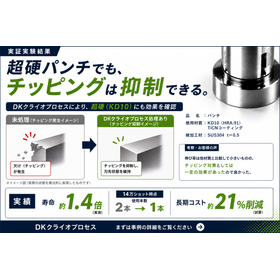
DK Cryo Process <Significant Reduction in Chipping>

Through numerous demonstrations, a long life extension of up to 7 times! Dimensional changes are suppressed within a tolerance range of ±0.01mm.

The "DK Cryo Process" solves your company's challenges without the need to change tools or molds. It is compatible with parts that have been tempered, are in use, or are coated, offering flexibility that does not depend on the timing of processing. Through numerous demonstrations, we have achieved up to 7 times longer life. 【Features】 ■ Compatible with tempered, in-use, and coated parts ■ Significant extension of lifespan ■ High precision dimensional support *For more details, please download the PDF or feel free to contact us.

  • Processing Contract
  • Other contract services
  • process

Added to bookmarks

Bookmarks list

Bookmark has been removed

Bookmarks list

You can't add any more bookmarks

By registering as a member, you can increase the number of bookmarks you can save and organize them with labels.

Free membership registration

Surface treatment - Wet process

For machine tools, guides, rails, and press molds!

In cases where more reliable hardness and durability are required, wet processes such as plating may be more effective than fluoropolymer coatings. Additionally, gold and silver plating may be applied not only for functional purposes but also for decorative purposes. Yoshida SKT accommodates various plating processes. *For more details, please refer to the catalog or contact us directly.*

  • Surface treatment contract service
  • process

Added to bookmarks

Bookmarks list

Bookmark has been removed

Bookmarks list

You can't add any more bookmarks

By registering as a member, you can increase the number of bookmarks you can save and organize them with labels.

Free membership registration

What are the advantages of the vacuum lamination process using infrared heaters?

After adoption, standby control that requires preheating of up to about 30% is no longer necessary!

The car doors, center consoles, and dashboards are made of plastic, with a foil applied on top. This is typically done by applying adhesive to the wheels and carrier parts and then vacuum laminating them. 3CON develops and manufactures innovative tools and machinery for producing door panels, instrument panels, and many other automotive interior components. As a company operating internationally with technical trends, we supply products to all major OEMs and Tier 1 automotive suppliers. *For more details, please refer to the PDF materials or feel free to contact us.

Added to bookmarks

Bookmarks list

Bookmark has been removed

Bookmarks list

You can't add any more bookmarks

By registering as a member, you can increase the number of bookmarks you can save and organize them with labels.

Free membership registration

High-temperature and high-speed heating process of metals using infrared heaters.

High-speed heating to 900°C within tens of seconds! High energy density can also be achieved.

In recent years, materials such as high-strength steel sheets (high-tensile) and aluminum have been used in the automotive industry as measures to reduce environmental impact. These materials are being increasingly adopted for vehicle bodies due to their excellent combination of lightweight properties and safety. The "water-cooled high-output infrared unit" can accommodate a wide range of metals, from thin sheets to heavy metals. It can heat in an open environment, and the ability to finely control the heating according to individual materials is a characteristic of infrared technology. 【Features of the High-Output Infrared System】 - Capable of heating steel sheets (t=0.8mm) to 900°C in under 15 seconds - Adopts a staggered pitch arrangement of infrared heaters, enabling uniform heating and preventing temperature variations - Allows heating processes in open spaces without dependence on ambient temperature - By using a fast-starting infrared heater system, it is possible to shorten process times - Can reduce installation space *For more details, please refer to the related links or feel free to contact us.

  • Other heaters
  • Heating device
  • Electric furnace
  • process

Added to bookmarks

Bookmarks list

Bookmark has been removed

Bookmarks list

You can't add any more bookmarks

By registering as a member, you can increase the number of bookmarks you can save and organize them with labels.

Free membership registration

Molding heating process of carbon fiber reinforced plastic (CFRP) using infrared radiation.

Can be precisely adjusted according to the customer's products and processes! We are proposing solutions using infrared technology.

Carbon fiber composite materials use various materials depending on their purpose. For example, short fiber reinforced thermosetting plastics are used for large body parts, while long fiber reinforced thermoplastics are used for high-strength structural components. Infrared heating cures thermosetting plastics, preheats thermoplastics before welding or molding, and can be precisely adjusted according to the customer's products and processes. Advanced numerical methods such as ray tracing and computational fluid dynamics help achieve uniform heating even over large surfaces. [Reasons for proposing infrared heaters in the CFRP molding process] - Rapid heating - Energy-efficient system - Uniform temperature within the material - Temperature difference between the front and back (temperature difference with the material interior) - Prevention of resin surface degradation due to overheating *For more details, please refer to the related links or feel free to contact us.

  • Heating device
  • Other heaters
  • process

Added to bookmarks

Bookmarks list

Bookmark has been removed

Bookmarks list

You can't add any more bookmarks

By registering as a member, you can increase the number of bookmarks you can save and organize them with labels.

Free membership registration

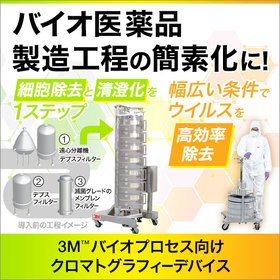
Biopharmaceuticals: Innovative Manufacturing Processes

Achieves high purity, high yield, and high efficiency processing with a single-use chromatography device. It also contributes to cost reduction.

We would like to introduce solutions for bioprocesses using chromatography devices. As products that help simplify processes in biopharmaceutical manufacturing, we offer "3M(TM) Harvest RC," which allows for cell removal and clarification in one step, as well as "3M(TM) Polisher ST," which enables stable virus removal under a wide range of conditions. These are compact, easy-to-handle single-use designs. Scaling up from lab to production grade can also be done easily. 【Features of "3M(TM) Harvest RC"】 ■ Minimizes cell disruption ■ Eliminates the need for centrifugation and depth filtration ■ Efficiently removes soluble and insoluble impurities ■ High antibody recovery rate ▽ Here is the homepage for 3M(TM) Harvest RC https://www.3mcompany.jp/3M/ja_JP/bioprocessing-jp/products-solutions/harvest/ * You can view the product catalog from "PDF Download." Please feel free to contact us with any inquiries.

Added to bookmarks

Bookmarks list

Bookmark has been removed

Bookmarks list

You can't add any more bookmarks

By registering as a member, you can increase the number of bookmarks you can save and organize them with labels.

Free membership registration

Electrocoat AMG Process

Electrodeposition paint with excellent coating properties for edge areas, suitable for electrical insulation applications.

For electrical insulation applications, there is also a heat-resistant polyimide electrocoating paint called "Electcoat PI."

  • paint
  • process

Added to bookmarks

Bookmarks list

Bookmark has been removed

Bookmarks list

You can't add any more bookmarks

By registering as a member, you can increase the number of bookmarks you can save and organize them with labels.

Free membership registration

Electrocoating Process 'E-Coat'

Electrophoretic painting process

Elekote is a surface treatment technology that uses an electrodeposition coating method, which can be considered ideal compared to spray painting, electrostatic painting, and powder coating.

  • Other consumables
  • process

Added to bookmarks

Bookmarks list

Bookmark has been removed

Bookmarks list

You can't add any more bookmarks

By registering as a member, you can increase the number of bookmarks you can save and organize them with labels.

Free membership registration

Alternative processes as alternative technologies for anodizing treatment.

We propose coloring using electrocote as an alternative technology to anodizing treatment.

What is the electrocoat process (electrodeposition coating method)? It is a water-soluble paint that carries a positive or negative charge, allowing for quick painting by applying an electric current. The painted areas become insulators, making it easier for the electric current to reach the unpainted areas, resulting in a uniform coating formation. *For more details, please download the catalog or contact us.

  • Chemicals
  • process

Added to bookmarks

Bookmarks list

Bookmark has been removed

Bookmarks list

You can't add any more bookmarks

By registering as a member, you can increase the number of bookmarks you can save and organize them with labels.

Free membership registration

Seamless Aluminum Pipe Manufacturing Process 'SheathEx'

Adopting the SheathExTM process! Continuously extruding seamless aluminum tubes.

The "SheathEx Machine" is equipment that extrudes seamless aluminum pipes (with a maximum outer diameter of 165mm) continuously from two aluminum rod materials with an outer diameter of 12mm, placed over the core of high-pressure cables. It incorporates a large-diameter die necessary for the cable sheath within a large crosshead. The aluminum sheath is finished seamlessly, without weld seams or beads. Using a wheel with two grooves in the extrusion wheel and a twin-groove operating mode, the aluminum sheath allows for products without thickness variation. 【Specifications】 ■ Cable diameter: 50mm to 165mm ■ Wall thickness: 2mm to 4mm ■ Output: Up to 1000kg/hr of aluminum *For more details, please refer to the external link page or feel free to contact us.

Added to bookmarks

Bookmarks list

Bookmark has been removed

Bookmarks list

You can't add any more bookmarks

By registering as a member, you can increase the number of bookmarks you can save and organize them with labels.

Free membership registration