
List of Solder products
- classification:Solder
121~180 item / All 386 items


Reduce the workload from handling heavy objects! Here are five case studies that solved customer challenges! We are also accepting free consultations and tests tailored to your work!

- Other conveying machines


Presentation of explanatory materials on JIS and ISO standards. We propose suitable safety barriers from a rich product series! Free rental of demo kits.


- Other safety and hygiene products


Good finish even with rapid laser heating, compatible with printing methods.
- Solder

Compliant with the J-STD-709 halogen-free standard, enabling low-temperature mounting with low-melting-point solder alloys.
- Solder

Achieves excellent cleaning performance, compliant with the halogen-free standard J-STD-709.
- Solder

Supports rapid heating by laser, specialized for the implementation of micro components.
- Solder

Excellent wettability, abundant in-vehicle track record.
- Solder

Uses fluorine-based special surfactants, providing strong wettability while being compatible with no-rinse applications.
- Solder


High-intensity solder for laser applications type BH63G3228G-HR
- Solder


I will introduce the void in the implementation with solder paste.
- Solder
![[Soldering Defects] Wet defects, br...](https://image.mono.ipros.com/public/product/image/8a8/2000660812/IPROS95170335891658259157.jpeg?w=280&h=280)
I will introduce you to wet defects, bridges, and horns (solder with flux).
- Solder

I will introduce you to residue cracking (solder with flux, solder paste).
- Solder

Halogen-free standard compliant! Significantly reduced scattering, enabling high-quality mounting! Demonstrates sufficient wettability even at low output, reducing damage to mounted components due to ...
- Solder

We introduce solder and solder paste containing flux that is compatible with low Ag and no Ag.
- Solder


We will introduce the applications of low melting point solder.
- Solder

We will introduce examples of products suitable for special applications such as ultra-fine solder.
- Solder

Reduce residue volume, compatible with ICT testing, good wettability and high assembly quality.
- Solder

Achieving excellent cleaning performance, good wettability, and high mounting quality.
- Solder

All halogen-free, compatible with laser heating methods.
- Solder

Supports terminal processing of aluminum wire, achieving high joint reliability.
- Solder

Dip soldering to aluminum wire is possible; no cleaning is required after soldering.
- Solder

Rich in in-vehicle experience, lineup according to construction methods.
- Solder

High melting point alloy compatible type "B280P3202J"
- Solder


![[Special Use Case] Measures Against...](https://image.mono.ipros.com/public/product/image/046/2000660638/IPROS25197355021438279102.jpeg?w=280&h=280)
We will introduce measures against copper and fine wire corrosion.
- Solder


We will introduce flux dispersion and solder balls (solder with resin).
- Solder

I will introduce you to flux dispersion (solder paste).
- Solder

I will introduce the issue of printing defects (solder paste).
- Solder

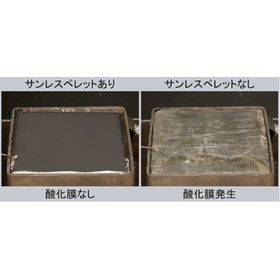
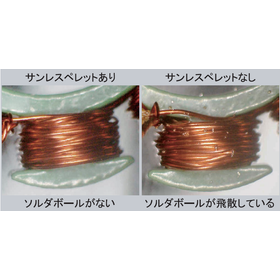
Reduced occurrence of dross due to the action of oxidation-inhibiting elements! A solder pot oxidation inhibitor that exhibits stable oxidation prevention effects.
- Solder

Completely halogen-free compatible! Demonstrates wettability equivalent to halogen-containing products, and is compatible with difficult materials such as nickel and brass!
- Solder


Acidic type high-speed indium plating solution
- Non-ferrous metals
- Chemicals
- Solder


Three types of Pb-free soldered products were subjected to reliability testing! We will introduce the main objectives of each test and the results of cross-sectional observations.
- Solder

Cross-sectional observation of substrate-mounted components (1) to (6)
We would like to introduce an example of cross-sectional observation of mounted components conducted by our company. Using commercially available computer circuit boards, we observed the solder joints of mounted components and the internal structure of the components with a metal microscope. The observation modes of the metal microscope include bright field observation, dark field observation, and polarized light observation, among others. Additionally, there are observations using transmitted light, and the observation mode is selected according to the sample. By conducting cross-sectional observations before and after reliability testing, we can evaluate the reliability of the product. When observing, it is important to select an appropriate "observation mode" to clearly capture the condition of the solder joint interface and defects such as cracks.