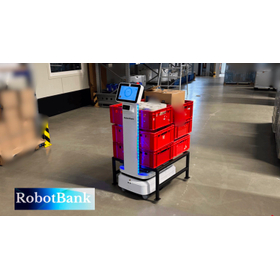
Introduction of Exhibiting Companies at Robot Festa Fukushima 2025
Kanaden Corporation
Robot (AGV), MI, FA solutions, Early Observer/ME
- Company:福島県 次世代産業課
- Price:Other
Last Updated: Aggregation Period:Apr 22, 2026~May 19, 2026
This ranking is based on the number of page views on our site.
Last Updated: Aggregation Period:Apr 22, 2026~May 19, 2026
This ranking is based on the number of page views on our site.
Last Updated: Aggregation Period:Apr 22, 2026~May 19, 2026
This ranking is based on the number of page views on our site.
3721~3736 item / All 3736 items
Kanaden Corporation
Robot (AGV), MI, FA solutions, Early Observer/ME
Kana LABO Co., Ltd.
No description available.
Sunnohashi Co., Ltd.
Bolt Calimote System
Tokyo Kyuei Co., Ltd.
Aerial Triad by Robots and Drones
Tokyo Power Technology Co., Ltd. and Hakusan Industry Co., Ltd. HERO
Introduction and demonstration of the robot.
Fukushima Prefectural Inventors Association (INPIT Fukushima Intellectual Property Comprehensive Support Window)
No description available.
Fukushima National College of Technology / Tokyo Power Technology Fukushima National College of Technology
Introduction of research project content and establishment of a contact point.
Fukushima International Research and Education Organization (F-REI)
Introducing a mobile robot designed for use in operations at the Fukushima Daiichi Nuclear Power Plant.
Fukushima Souma Reconstruction Promotion Organization
Exhibition of disaster response robots. Additionally, a robot operation experience will be held for children. Introduction of FREI.
Fukushima University - VIC
Overview of the research to be conducted.
Fukushima Robot Test Field
Introduction to the overview and activities of the Fukushima Robot Test Field.
Mabuchi Motor Microtech Co., Ltd.
Fiber Control Rover, GPS/GPS/GLIDAR-SLAM Rover, GPS Drone
Living Robotics Co., Ltd.
Robot (walking), programming Mechatro WeGo
A case where manufacturing tact time was shortened by approximately 20% and manufacturing costs were reduced by 13%!
We would like to introduce a case of implementing a "servo gun robot-based automatic spot welding line" that utilizes the manufacturing subsidy to automate the spot welding assembly of complex parts, achieving cost reduction and labor saving. The decision to implement this system was made because it was difficult to manufacture complex parts that require spot welding at 25 locations by combining five sheet metal components using the conventional stationary system. As a result of the implementation, it became possible to weld and assemble complex parts, allowing us to receive orders for components that support our management. [Case Overview] ■ Background of Implementation - It was difficult to manufacture complex parts requiring spot welding at 25 locations using the conventional stationary system. ■ Results of Implementation - Manufacturing takt time was reduced by approximately 20% compared to the conventional type, and manufacturing costs were reduced by 13%. *For more details, please download the PDF or feel free to contact us.
Overwhelming speed and cost competitiveness. The trend of hardware implementation accelerating exponentially.
One of the global trends in physical AI is the incredible speed of hardware mass production in China and the introduction of implementation examples. In China, the commercialization of humanoid robots is accelerating, with production numbers increasing exponentially from 1,000 units to 10,000 units in just a few months. The phase of skill verification has now ended, and we have moved to a stage of scalable value provision. With low-cost and mass production as their weapons, there are many lessons that Japanese manufacturing can learn from the strategies of Chinese companies that are rapidly advancing social implementation. Details of China's leading robot implementation trends are available in the downloadable materials.