1~45 item / All 578 items
Displayed results
Filter by category

Added to bookmarks
Bookmarks listBookmark has been removed
Bookmarks listYou can't add any more bookmarks
By registering as a member, you can increase the number of bookmarks you can save and organize them with labels.
Free membership registration
Contact this company
Inquiry FormBefore making an inquiry
Download Profile1~45 item / All 578 items
Filter by category

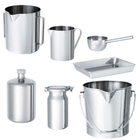
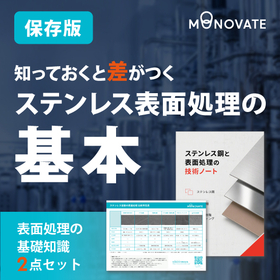
How to choose the surface treatment for stainless steel containers - This is a practical document that consolidates the decision-making materials into one. MONOVATE, a stainless steel specialist manufacturer, explains the basics of stainless steel and surface treatments, including the differences between buff polishing, electropolishing, and fluoropolymer coating.
Added to bookmarks
Bookmarks listBookmark has been removed
Bookmarks listYou can't add any more bookmarks
By registering as a member, you can increase the number of bookmarks you can save and organize them with labels.
Free membership registration
In the manufacturing site of slurries (raw materials where powders and particles are dispersed in a liquid), challenges such as "the powder settles or floats even when stirred," "high viscosity prevents it from being removed from the container," and "filtration takes a long time" repeatedly occur. This document is a collection of case studies summarizing data obtained from actual equipment verification using real raw materials before implementation, along with the directions for solutions identified from that data. The content is structured into three main parts: 1. The foundational column explains how to choose stirrers and mixing devices that are resistant to sedimentation and settling, as well as customization proposals for slurry tanks (seven cases including dispersion, liquid transfer, cooling, explosion-proofing, and filtration). 2. The verification report presents three examples: "stirring a 150L cosmetic slurry with a powder ratio of about 50%," "discharging a high-viscosity slurry with a viscosity of about 150,000 cP (rat hole countermeasures)," and "vacuum filtration of carbon dispersion slurry," including conditions, values, and customer feedback. 3. Information useful for considering implementation is also provided. This is recommended for those in charge of design, production technology, and quality assurance who want to consider not only "what to mix with" but also "how to input and output" the equipment. We offer customized solutions for each unit, ranging from small volumes for trial use (4L and up) to production use (around 1000L).
Added to bookmarks
Bookmarks listBookmark has been removed
Bookmarks listYou can't add any more bookmarks
By registering as a member, you can increase the number of bookmarks you can save and organize them with labels.
Free membership registration
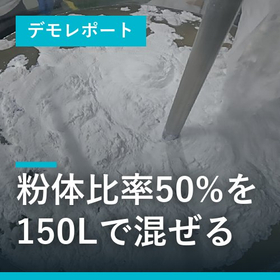
We want to be able to produce cosmetics that are currently manufactured as OEM in-house. To facilitate better product development, we aim to create an environment where we can conduct our own tests. In response to this request from cosmetic manufacturers, we conducted a stirring test to verify the feasibility of in-house production. The test involved dispersing powdered raw materials in multiple types of oils to produce a slurry with a total volume of 150L. The key point was whether we could achieve a homogeneous dispersion without any clumping under conditions where the liquid and powder were nearly equal in quantity. The results showed that after 120 minutes of stirring, the undissolved particles were dispersed to an acceptable level visually. We have summarized the configuration of the stirring machine used, the progress of the stirring process, and three key points observed on-site.
Added to bookmarks
Bookmarks listBookmark has been removed
Bookmarks listYou can't add any more bookmarks
By registering as a member, you can increase the number of bookmarks you can save and organize them with labels.
Free membership registration
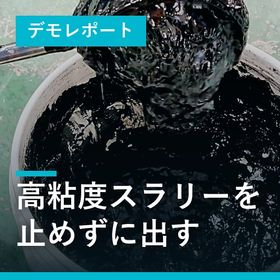
This is a report on a demonstration conducted in collaboration with an ink manufacturer to explore the feasibility and specifications for discharging high-viscosity slurries, as they want to discharge high-viscosity materials quickly but find it difficult to select the right equipment. They also want to know methods for automatic discharge without human intervention. The slurry tested had a viscosity of approximately 150,000 cP, which does not easily fall even when scooped with a ladle and turned upside down. We recreated the current situation where suction creates a rat hole and stops the supply, and then we gradually tested approaches such as using a drop lid and adding pressure conditions. Remaining issues are also included.
Added to bookmarks
Bookmarks listBookmark has been removed
Bookmarks listYou can't add any more bookmarks
By registering as a member, you can increase the number of bookmarks you can save and organize them with labels.
Free membership registration
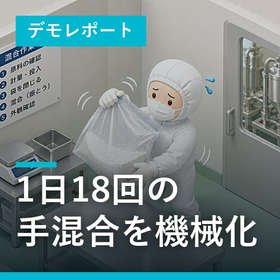
Can the preliminary mixing of pharmaceutical raw materials be switched from manual labor to mechanization using a rotary drum mixer? This is a report on a practical test conducted in response to inquiries from pharmaceutical manufacturers. Raw materials for a batch of 28 kg are divided into 2 to 3 bags and mixed by hand for each bag. In this setting, the task of lifting and shaking 10 kg rice bags occurs 18 times a day. The test confirmed whether the particle size distribution of the 28 kg batch could be uniformly mixed, while also addressing safety measures and space requirements for installation. Three key points to consider before advancing to mechanization are also included.
Added to bookmarks
Bookmarks listBookmark has been removed
Bookmarks listYou can't add any more bookmarks
By registering as a member, you can increase the number of bookmarks you can save and organize them with labels.
Free membership registration
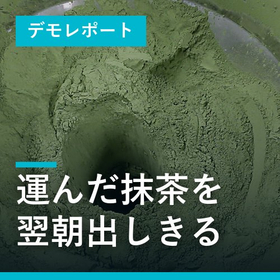
This is a report on a test conducted following the consultation about wanting to automatically transport matcha unmanned at night. In this main section, we will introduce the verification of whether the matcha transported at night can be discharged from the hopper the next morning. The final point that determines the success or failure of unmanned transportation at night is whether the transported matcha "comes out." We compared the discharge behavior with and without aeration, and included the installation of a vibrator as a precaution. The results of the verification to ensure the discharge of powder that does not flow under its own weight are summarized.
Added to bookmarks
Bookmarks listBookmark has been removed
Bookmarks listYou can't add any more bookmarks
By registering as a member, you can increase the number of bookmarks you can save and organize them with labels.
Free membership registration
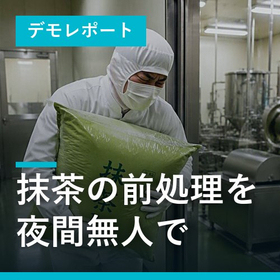
This is a report on a test conducted in response to the inquiry, "I want to automate the transportation of matcha at night without personnel." In this main section, we will convey the results of verifying the stability of transportation using air transport and measures to prevent adhesion to the equipment. We want to complete the preprocessing at night and focus on high-value-added tasks during the day. However, there are unique concerns associated with the unmanned transportation of fine powders like matcha. If the powder gets clogged during transportation, no one will notice, and if it adheres to the equipment, the yield the next morning may not be sufficient. We clarified that the issue is not the transportation volume but the losses due to adhesion, and we delved into verification of countermeasures through surface treatment.
Added to bookmarks
Bookmarks listBookmark has been removed
Bookmarks listYou can't add any more bookmarks
By registering as a member, you can increase the number of bookmarks you can save and organize them with labels.
Free membership registration
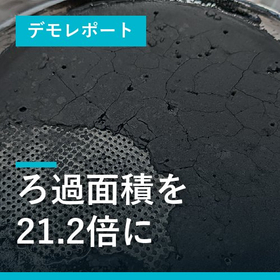
"The catalog specifications alone do not guarantee that it will work well under our conditions," and "The most frightening thing is to realize after implementation that it is different from what we expected." — This is a report on a demonstration conducted with an electronic components manufacturer to confirm the performance of a filtration device and determine the direction of specifications. We prepared 1L of carbon dispersion slurry that closely resembles the actual raw materials and tested three conditions: suction filtration, pressure filtration, and suction filtration with an expanded filtration area. The report summarizes the process of developing specifications that can be realized within the constraints of being accurate but time-consuming, or fast but lacking the necessary equipment.
Added to bookmarks
Bookmarks listBookmark has been removed
Bookmarks listYou can't add any more bookmarks
By registering as a member, you can increase the number of bookmarks you can save and organize them with labels.
Free membership registration
"Even when the valve is opened, the powder does not come out" — especially lightweight and fluffy fine powders may not start moving within the hopper, causing discharge to stop. In this report, we conducted experiments using silica with a bulk density of 0.16 kg/L to see if we could truly improve discharge with an aeration hopper. The results showed that silica, which had "almost zero discharge" when the valve was simply opened, achieved "almost complete discharge" with the aeration hopper. We also discuss why it did not come out despite being "flowable," along with symptoms worth testing.
Added to bookmarks
Bookmarks listBookmark has been removed
Bookmarks listYou can't add any more bookmarks
By registering as a member, you can increase the number of bookmarks you can save and organize them with labels.
Free membership registration
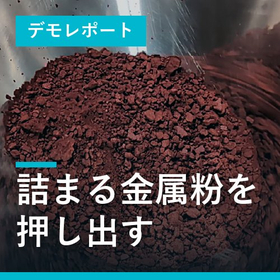
This is an example of a demo verification conducted with a customer who faced the issue of metal powder clogging in the hopper, making it difficult to supply to the next process. While common clogging countermeasures such as knockers and vibrators were also considered, the customer wanted to verify whether the aeration hopper they saw at the exhibition would be effective for metal powder, leading to the test. We compared the discharge behavior with and without aeration and transparently communicated the conditions under which no effect was observed.
Added to bookmarks
Bookmarks listBookmark has been removed
Bookmarks listYou can't add any more bookmarks
By registering as a member, you can increase the number of bookmarks you can save and organize them with labels.
Free membership registration
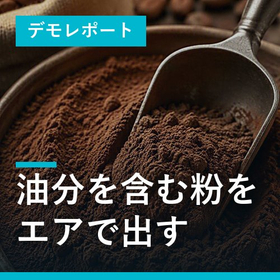
Powders containing moisture and oil are among the materials that are difficult to handle for hoppers and conveying equipment. Many may have experienced situations where, even after opening a valve, the powder cannot be supplied, or clumps remain in the container. This report examines how discharge characteristics change using the method of "injecting air" with cocoa and whole milk powder as subjects. It includes both conditions where the powder began to break down within seconds and those where it was fluidized over time, discussing from the perspective of "devices that work under the right conditions" rather than just "usable devices."
Added to bookmarks
Bookmarks listBookmark has been removed
Bookmarks listYou can't add any more bookmarks
By registering as a member, you can increase the number of bookmarks you can save and organize them with labels.
Free membership registration
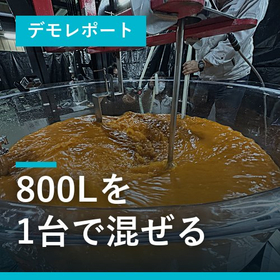
We received an inquiry from a food manufacturer regarding the mixing of seasoning liquids, and we conducted a practical test on a scale of 800 liters. The materials included "sinking grated vegetables," "floating sesame seeds," and "separating oil," creating challenging conditions for mixing. The purpose of the test was to determine whether a single mixer could appropriately mix raw materials with different physical properties. We conducted three tests, changing the conditions for each raw material, to explore viable configurations. We have summarized the progress of the tests and the key points for equipment consideration that emerged from them.
Added to bookmarks
Bookmarks listBookmark has been removed
Bookmarks listYou can't add any more bookmarks
By registering as a member, you can increase the number of bookmarks you can save and organize them with labels.
Free membership registration
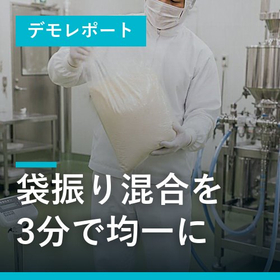
This is a report on the mixing tests conducted in response to inquiries such as, 'Every time, the workers are shaking the bags to mix, and I'm concerned about the burden,' and 'But it's not enough to introduce a large powder mixer.' We tested the mixing performance of a rotary drum mixer using wheat flour and bran with different particle sizes, varying the input amount, rotation speed, and mixing time across five conditions. We used the current manual mixing as the evaluation standard to determine under which conditions the mixing would be uniform. Please refer to this as a guide for selecting equipment that bridges the gap between manual mixing and large mixers.
Added to bookmarks
Bookmarks listBookmark has been removed
Bookmarks listYou can't add any more bookmarks
By registering as a member, you can increase the number of bookmarks you can save and organize them with labels.
Free membership registration
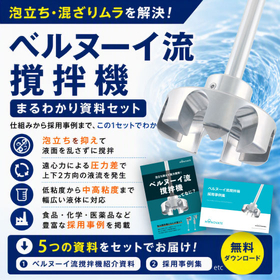
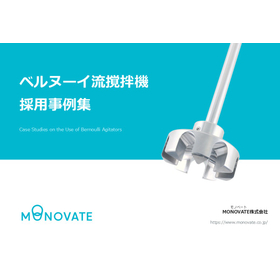
Are you struggling with foaming and uneven mixing during stirring? This document set clearly introduces the mechanism and features of the "Bernoulli flow mixer," which stirs powerfully while minimizing air entrapment, using diagrams and examples. It also includes case studies on uniform mixing of seasoning liquids, cooling of cooking oils, powder cleaning, dissolution of food ingredients, and dilution of resin materials. This document set answers questions like "What is a Bernoulli flow mixer?" and "What types of liquids or processes is it suitable for?" It can be widely used from the initial information gathering stage of consideration, to determining suitability for your application, and for internal explanations. This is a recommended introductory document set for those who want to understand the Bernoulli flow mixer from the basics. For more details, please download the document.
Added to bookmarks
Bookmarks listBookmark has been removed
Bookmarks listYou can't add any more bookmarks
By registering as a member, you can increase the number of bookmarks you can save and organize them with labels.
Free membership registration
Are you struggling with foaming and uneven mixing during stirring? This document set clearly introduces the mechanism and features of the "Bernoulli flow mixer," which stirs powerfully while minimizing air incorporation, using diagrams and examples. It also includes case studies on uniform mixing of seasoning liquids, cooling of edible oils, cleaning of powders, dissolving of food ingredients, and dilution of resin materials. This document set answers questions such as "What is a Bernoulli flow mixer?" and "What types of liquids and processes is it suitable for?" It can be widely used for information gathering in the early stages of consideration, determining suitability for applications, and internal explanations. This is a recommended introductory document set for those who want to understand the Bernoulli flow mixer from the basics.
Added to bookmarks
Bookmarks listBookmark has been removed
Bookmarks listYou can't add any more bookmarks
By registering as a member, you can increase the number of bookmarks you can save and organize them with labels.
Free membership registration
Aren't you lifting heavy pails every day to refill cutting fluid? In many workplaces, refilling cutting fluid for CNC lathes and machining centers has become the norm to be done "manually each time." Are you actually struggling with the strain on your back and the loss of time every time you stop to refill? This product is a mobile tank that reduces that burden. You can prepare cutting fluid in bulk and simply divide it into familiar pails. No electricity, air, or piping is required, allowing for immediate implementation without any installation work. In our internal operations, we have reduced the refilling labor by about 3.5 hours per month. The feature is that you can reduce the burden in a way that is close to your current operations without introducing automation equipment costing several million yen.
Added to bookmarks
Bookmarks listBookmark has been removed
Bookmarks listYou can't add any more bookmarks
By registering as a member, you can increase the number of bookmarks you can save and organize them with labels.
Free membership registration
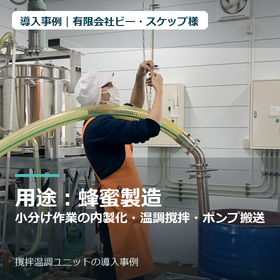
At Be-Skepp Co., Ltd., there was no equipment for water bath heating of 200L drums, and the process of transferring to smaller cans was outsourced. Additionally, manual stirring and transferring became labor-intensive. In this case study, we will introduce a system that integrates the water bath tank, transportation, temperature control stirring, and pre-filling processes into a single line, with adjustments made to the heater and pump specifications to suit the characteristics of honey.
Added to bookmarks
Bookmarks listBookmark has been removed
Bookmarks listYou can't add any more bookmarks
By registering as a member, you can increase the number of bookmarks you can save and organize them with labels.
Free membership registration
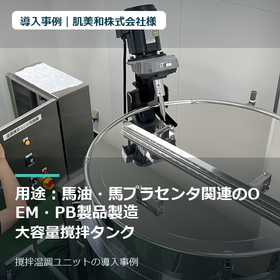
At Kirei Biwa Co., Ltd., a variety of OEM and private brand products are manufactured using a single high-functionality tank, which has posed challenges due to the inefficiency of using high-functionality equipment for simpler products. This case study introduces the use of a jacketed tank with a control panel, making it easier to differentiate between products with a large-capacity 600L mixing tank. It is an example of re-evaluating the production line operations while utilizing existing equipment.
Added to bookmarks
Bookmarks listBookmark has been removed
Bookmarks listYou can't add any more bookmarks
By registering as a member, you can increase the number of bookmarks you can save and organize them with labels.
Free membership registration
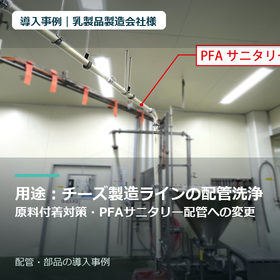
In a dairy manufacturing company, cheese at approximately 80°C was adhering to the pipes, necessitating pig cleaning, pipe disassembly, circulation cleaning, and manual brush cleaning. This case introduces the modification of stainless steel pipes to PFA sanitary pipes, with dimensions customized to fit the on-site line. It is an example of efforts to reduce the burden of cleaning operations in processes that handle materials prone to adhesion.
Added to bookmarks
Bookmarks listBookmark has been removed
Bookmarks listYou can't add any more bookmarks
By registering as a member, you can increase the number of bookmarks you can save and organize them with labels.
Free membership registration
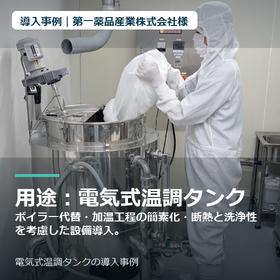
At Daiichi Yakuhin Sangyo Co., Ltd., there was a demand for easy-to-use electric temperature control equipment in the manufacturing site, against the backdrop of discontinuing boilers. This case introduces the implementation of a temperature control tank using electric heaters, which simplifies the heating process while reducing the hassle associated with the startup and inspection of boilers. Specifications suitable for operation are being considered through pre-implementation heating tests.
Added to bookmarks
Bookmarks listBookmark has been removed
Bookmarks listYou can't add any more bookmarks
By registering as a member, you can increase the number of bookmarks you can save and organize them with labels.
Free membership registration
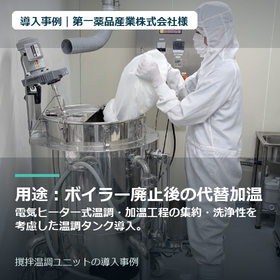
At Daiichi Yakuhin Sangyo Co., Ltd., it was necessary to consider alternative heating methods due to the discontinuation of the factory boiler. The burden of boiler operation, including inspections, preliminary operations, and error handling, was also a challenge. This case study introduces the transition to a temperature control tank using electric heaters, while adjusting specifications with consideration for heating tests, heater output, and cleaning performance.
Added to bookmarks
Bookmarks listBookmark has been removed
Bookmarks listYou can't add any more bookmarks
By registering as a member, you can increase the number of bookmarks you can save and organize them with labels.
Free membership registration
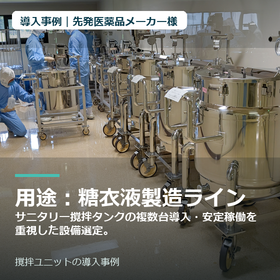
A leading pharmaceutical manufacturer required multiple sanitary mixing tanks for the establishment of a sugar-coated liquid production line associated with a new project. This case study introduces the implementation of a mixing unit while considering the stable operation and documentation requirements demanded by the pharmaceutical industry. It is an example of equipment selection based on past delivery records and discussions regarding design aspects.
Added to bookmarks
Bookmarks listBookmark has been removed
Bookmarks listYou can't add any more bookmarks
By registering as a member, you can increase the number of bookmarks you can save and organize them with labels.
Free membership registration
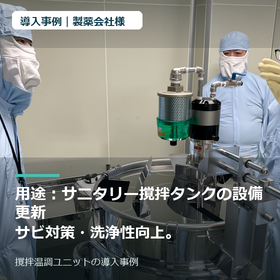
In the pharmaceutical company, the aging of equipment that had been in use for many years posed challenges such as quality risks due to rust and the risk of glass ball filter breakage. This case introduces the equipment updates made with consideration for cleanliness and operational stability through electropolishing treatment inside the tank and the design of dedicated hangers. It is an example that takes into account the hygiene requirements necessary for pharmaceutical manufacturing.
Added to bookmarks
Bookmarks listBookmark has been removed
Bookmarks listYou can't add any more bookmarks
By registering as a member, you can increase the number of bookmarks you can save and organize them with labels.
Free membership registration
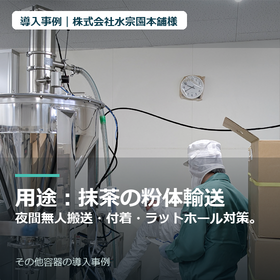
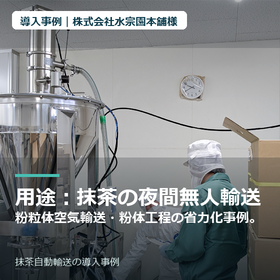
At Mizusouen Honpo Co., Ltd., the increase in nighttime collection volume due to the expansion of the fine grinding machine has reached the limits of manual collection and transportation. This case study introduces the automation of the transportation process from the fine grinding machine to the sifter and filling hopper by implementing a pneumatic conveying system for powder and granules, along with an aeration hopper. It also includes measures to address issues related to matcha adhesion and clogging.
Added to bookmarks
Bookmarks listBookmark has been removed
Bookmarks listYou can't add any more bookmarks
By registering as a member, you can increase the number of bookmarks you can save and organize them with labels.
Free membership registration
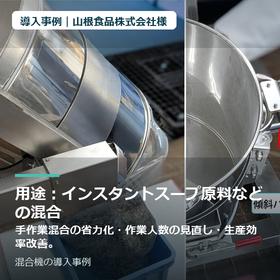
At Yamane Foods Co., Ltd., ingredients for instant soup were spread out on a workbench and mixed by hand. Due to challenges related to worker burden and production efficiency, this case introduces the implementation of a rotary drum mixer, which has revised the system to allow mixing operations to be carried out by a small number of people. It is also notable that the mixing conditions and operational aspects were verified during pre-introduction testing.
Added to bookmarks
Bookmarks listBookmark has been removed
Bookmarks listYou can't add any more bookmarks
By registering as a member, you can increase the number of bookmarks you can save and organize them with labels.
Free membership registration
At Mizusouen Honpo Co., Ltd., the increase in production volume due to the addition of a fine grinding machine made manual collection and transportation difficult. Additionally, there were concerns about discharge to the next process due to the adhesion characteristic of matcha and rat holes. This case introduces the efforts to combine pneumatic transport of powder and granular materials with an aeration hopper to improve unmanned transport and discharge during the night.
Added to bookmarks
Bookmarks listBookmark has been removed
Bookmarks listYou can't add any more bookmarks
By registering as a member, you can increase the number of bookmarks you can save and organize them with labels.
Free membership registration
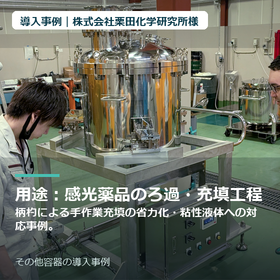
At Kurita Chemical Research Institute Co., Ltd., manual filling using ladles is performed many times a day, which poses challenges such as physical strain on workers and limitations on the number of workers. In this case study, we introduce a custom-made tank designed for viscous liquids, consolidating the filtration and filling processes into one machine. Through pre-introduction testing, we are refining the specifications while confirming the ease of handling the target liquid.
Added to bookmarks
Bookmarks listBookmark has been removed
Bookmarks listYou can't add any more bookmarks
By registering as a member, you can increase the number of bookmarks you can save and organize them with labels.
Free membership registration
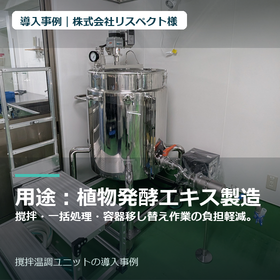
At Respect Co., Ltd., due to the expansion of production volume, there were limitations in processing with three small heating units, and there were burdens associated with transferring containers and manual stirring. In this case study, we will introduce how the introduction of a heater unit enabled bulk processing of 200 liters and revised the process to combine heating and stirring. We are considering the specifications while confirming the heating capacity and stirring conditions during pre-introduction tests.
Added to bookmarks
Bookmarks listBookmark has been removed
Bookmarks listYou can't add any more bookmarks
By registering as a member, you can increase the number of bookmarks you can save and organize them with labels.
Free membership registration
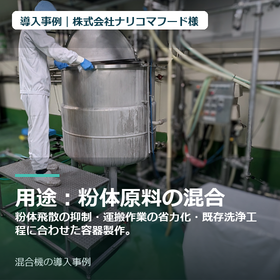
At Narikoma Food Co., Ltd., the lack of a dedicated mixing machine led to inefficiencies in the process, increased cleaning burdens due to powder scattering, and challenges with transporting heavy powders. This case study introduces our efforts to reduce the workload and create a clean working environment by combining a rotary drum mixer for sealed mixing with a lifter. It also includes the production of custom containers, taking into consideration compatibility with existing cleaning machines.
Added to bookmarks
Bookmarks listBookmark has been removed
Bookmarks listYou can't add any more bookmarks
By registering as a member, you can increase the number of bookmarks you can save and organize them with labels.
Free membership registration
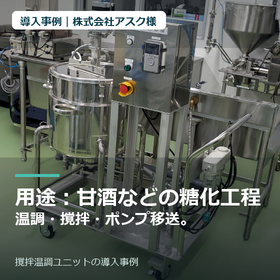
At Ask Corporation, the preparation of sweet sake and other products is done using an 18L pot, which presents challenges such as limitations on the amount that can be prepared, the physical burden of lifting containers, and hygiene concerns related to stirring in an open state. In this case, we introduced a unit that integrates a 60L tank, a stirrer, a pump, and a control panel on a cart, also accommodating temperature management through a chiller connection. This example demonstrates the expansion of preparation capacity, reduction of the burden of transfer work, and stabilization of temperature control and mixing.
Added to bookmarks
Bookmarks listBookmark has been removed
Bookmarks listYou can't add any more bookmarks
By registering as a member, you can increase the number of bookmarks you can save and organize them with labels.
Free membership registration
This is a collection of case studies introducing examples of mixing tanks that utilize Bernoulli flow mixers. The Bernoulli flow mixer is equipped with the "Bernoulli flow mixing body BEAG" and generates liquid flow within the container based on a different principle (pressure difference due to centrifugal force) compared to conventional mixing bodies, achieving "less foaming" and "powerful" mixing. It is primarily suitable for mixing volumes of approximately 30 to 300 liters. If you are facing issues such as: - "It takes a long time to defoam (de-bubble) after mixing high-viscosity liquids." - "The liquid surface foams after mixing, making accurate measurement impossible." - "I want to prevent overflow when mixing foamy liquids." Please consider the Bernoulli flow mixer.
Added to bookmarks
Bookmarks listBookmark has been removed
Bookmarks listYou can't add any more bookmarks
By registering as a member, you can increase the number of bookmarks you can save and organize them with labels.
Free membership registration
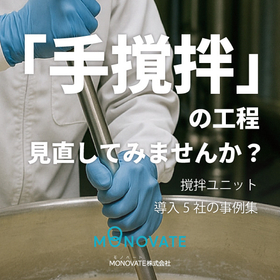
Dear food, cosmetics, and pharmaceutical manufacturers, Are you facing the "limitations of manual mixing" in stirring, such as: - Variability in mixing consistency due to different operators - Limited quantity that can be mixed at one time - Significant physical strain - Tasks that can only be performed by specific individuals We will clearly introduce how the introduction of MONOVATE's stirring unit (stirring machine + stainless steel tank) has significantly improved productivity, quality, and working environment through case studies addressing issues like "mixing inconsistency," "heavy labor," and "quality reproducibility." For more details, please download the materials or contact us.
Added to bookmarks
Bookmarks listBookmark has been removed
Bookmarks listYou can't add any more bookmarks
By registering as a member, you can increase the number of bookmarks you can save and organize them with labels.
Free membership registration
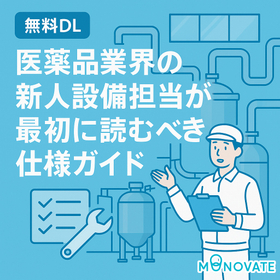
To the new employee who has just taken on the responsibility of equipment installation in the pharmaceutical industry: You can download explanatory materials on the basic specifications required in the pharmaceutical field. The content focuses on themes related to "containers" among pharmaceutical equipment, such as tanks and stirring devices. We will explain topics that are often too specialized to grasp in books, using examples from actual delivery sites. This is highly recommended for new personnel who will be considering equipment specifications and meeting with vendors. Please make good use of it. Content of the materials: 1. Why do stainless steel containers rust immediately under certain conditions? Causes and countermeasures for rusting. 2. Are you familiar with the high-grade stainless steel material "SUS316L" that is resistant to rust? 3. What is the cleaning method that prolongs the lifespan of stainless steel containers? 4. Professional expertise shared! Basic knowledge of stainless steel and surface treatment. 5. What is a "gapless" stainless steel container that can shorten cleaning time? 6. Explanatory document on electropolishing of stainless steel containers. 7. [For new employee training and internal study!] "Pipe fittings for stainless steel containers" that you can’t ask about anymore. 8. Introduction of manufacturing achievements for stainless steel containers and stirring devices for the pharmaceutical industry | MONOVATE Co., Ltd. 9. Company overview (MONOVATE Co., Ltd.)
Added to bookmarks
Bookmarks listBookmark has been removed
Bookmarks listYou can't add any more bookmarks
By registering as a member, you can increase the number of bookmarks you can save and organize them with labels.
Free membership registration
There are two main methods for temperature control of liquids in stainless steel containers: direct heating/cooling and indirect heating/cooling. Temperature control tanks, also known as preparation tanks, brewing tanks, mixing tanks, and fermentation tanks, are widely used in various manufacturing fields such as pharmaceuticals, cosmetics, food, and chemicals. This document introduces the temperature control methods that our company frequently proposes to customers, along with their details and delivery records. At MONOVATE, a manufacturer of stainless steel containers and stirring tanks, we can provide custom-made proposals for the optimal combination of temperature control methods, peripheral equipment, and tanks based on target temperatures, heating (cooling) speeds, and the viscosity and characteristics of the contents, starting from just one unit. If you have any challenges in your temperature control processes, please feel free to consult with us.
Added to bookmarks
Bookmarks listBookmark has been removed
Bookmarks listYou can't add any more bookmarks
By registering as a member, you can increase the number of bookmarks you can save and organize them with labels.
Free membership registration
This is a PDF document summarizing the basic knowledge needed to understand the viscosity of liquids. In addition to a basic explanation of viscosity, it includes a comparison table of viscosities for substances such as honey and mayonnaise. Furthermore, it introduces common issues and countermeasures that may arise when handling high-viscosity liquids. You can use it as a foundational resource when considering liquid handling equipment or designing processes such as mixing and transportation.
Added to bookmarks
Bookmarks listBookmark has been removed
Bookmarks listYou can't add any more bookmarks
By registering as a member, you can increase the number of bookmarks you can save and organize them with labels.
Free membership registration
We have compiled the data and materials used in the design and manufacturing of stainless steel containers into one book. This is a recommended resource for those who are "considering the introduction of stainless steel containers" or "handling stainless steel containers for the first time." We would be grateful if you could keep it on hand. If you are considering stainless steel containers or mixing devices, please feel free to consult MONOVATE, a stainless steel container manufacturer.
Added to bookmarks
Bookmarks listBookmark has been removed
Bookmarks listYou can't add any more bookmarks
By registering as a member, you can increase the number of bookmarks you can save and organize them with labels.
Free membership registration
This document includes the following two materials as a set. 【1】Filtration demonstration case of carbon dispersion slurry (related to electronic components manufacturer) We introduce a demonstration conducted with an electronic components manufacturer to confirm the performance of the filtration equipment and determine the direction of specifications. Since it was difficult to bring out the actual raw materials for filtration, we had the customer prepare 1L of carbon dispersion slurry (water + carbon) that closely resembles the actual raw materials for experimental purposes, and we conducted the demonstration. 【2】Custom case studies of filtration containers We present six case studies of custom-made stainless steel filtration containers that are essential for slurry filtration, powder cleaning, and foreign matter filtration.
Added to bookmarks
Bookmarks listBookmark has been removed
Bookmarks listYou can't add any more bookmarks
By registering as a member, you can increase the number of bookmarks you can save and organize them with labels.
Free membership registration
This is a basic information set aimed at reducing on-site troubles such as "corrosion" and "stain adhesion" in stainless steel. 【What you can learn from this document】 - Basics of stainless steel (passivation film / concept of corrosion resistance) - Electrolytic polishing: mechanism / features / applicable scenes / precautions - Fluororesin coating: characteristics / film thickness / precautions / pinhole countermeasures - Q&A organized around points that are often confusing on-site - Terminology explanations to aid understanding - Causes and countermeasures for stainless steel rusting - Information about rust-resistant stainless steel material "SUS316L," among others 【Recommended for】 Personnel in charge of equipment, quality, production technology, development, and purchasing 【Usage scenarios】 Organizing causes of troubles, selecting surface treatments, internal sharing and training, etc. *This document can be viewed immediately from the [Download] section.
Added to bookmarks
Bookmarks listBookmark has been removed
Bookmarks listYou can't add any more bookmarks
By registering as a member, you can increase the number of bookmarks you can save and organize them with labels.
Free membership registration
Manufacturers of food, cosmetics, and pharmaceuticals that had been relying on manual stirring have improved productivity, quality, and working conditions by introducing MONOVATE's stirring unit (stirring machine + stainless steel tank). We will clearly present how five companies solved common challenges such as "inconsistent mixing," "heavy labor," and "quality reproducibility" through their implementation stories.
Added to bookmarks
Bookmarks listBookmark has been removed
Bookmarks listYou can't add any more bookmarks
By registering as a member, you can increase the number of bookmarks you can save and organize them with labels.
Free membership registration
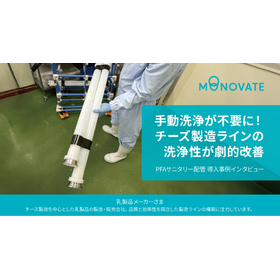
This is an interview case study of a dairy product manufacturer that switched from stainless steel piping to PFA sanitary piping. We achieved improvements in the long-standing issue of "cleanability of piping" in cheese production with piping fittings made of fluororesin (PFA). At MONOVATE, we propose a fully customized specification that perfectly fits the manufacturing line, including: - Changing the long piping sections to SUS material at the heel section to ensure strength - Using reducers at the connection points of different diameter pipes We have received feedback such as "the issue of raw material loss has dramatically improved" and "there's no going back to the previous piping."
Added to bookmarks
Bookmarks listBookmark has been removed
Bookmarks listYou can't add any more bookmarks
By registering as a member, you can increase the number of bookmarks you can save and organize them with labels.
Free membership registration
This is a "Glossary of Basic Terms" gently explained by the stainless steel container manufacturer MONOVATE, covering commonly used keywords from the basic structure of stainless steel containers to specialized terms such as Heller fittings, buff polishing, and electro-polishing. The basic section carefully selects essential terms that are indispensable for container selection and specification consideration. It is ideal for those handling stainless steel containers for the first time, as well as for personnel involved in design, purchasing, and quality control. It can also be used as supplementary material for in-house training and product understanding.
Added to bookmarks
Bookmarks listBookmark has been removed
Bookmarks listYou can't add any more bookmarks
By registering as a member, you can increase the number of bookmarks you can save and organize them with labels.
Free membership registration
Can such specifications be realized?" We have prepared a catalog that compiles examples and processing options, allowing you to feel at ease even with your first consultation. This book covers proposals related to liquid mixing and powder feeding, as well as custom manufacturing achievements and customization options, all handled by MONOVATE, a manufacturer of stainless steel containers and mixing devices. At MONOVATE, we offer flexible custom solutions tailored to various industries and applications. This introductory catalog is filled with hints for custom considerations, providing new perspectives and options such as "Can this specification be done?" and "Are there such usage methods?
Added to bookmarks
Bookmarks listBookmark has been removed
Bookmarks listYou can't add any more bookmarks
By registering as a member, you can increase the number of bookmarks you can save and organize them with labels.
Free membership registration
This is a PDF document summarizing six customization cases of filtration containers produced by the stainless steel container manufacturer MONOVATE.
Added to bookmarks
Bookmarks listBookmark has been removed
Bookmarks listYou can't add any more bookmarks
By registering as a member, you can increase the number of bookmarks you can save and organize them with labels.
Free membership registration
This is a piping made of fluororesin (PFA) with excellent corrosion resistance, featuring Cynergy fittings. There are pipes that can be adjusted in length according to customer preferences, along with fittings such as elbows and tees. - Being made of PFA, it offers superior corrosion resistance compared to stainless steel. There are no concerns about discoloration or pinholes. - It has high non-stick properties, making it difficult for fluids to adhere, which enhances cleanability. - Unlike stainless steel piping, it allows for easy observation of the flow inside the piping, making it easier to notice abnormalities. - The length of the piping can be changed according to customer requests.
Added to bookmarks
Bookmarks listBookmark has been removed
Bookmarks listYou can't add any more bookmarks
By registering as a member, you can increase the number of bookmarks you can save and organize them with labels.
Free membership registration
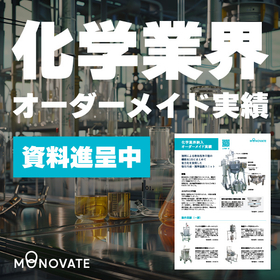
We are MONOVATE Co., Ltd., a manufacturer of stainless steel tanks and mixing equipment. In this PDF document, we introduce some of the custom-made examples that have been adopted by customers in the chemical industry. Please feel free to contact us for inquiries.
Added to bookmarks
Bookmarks listBookmark has been removed
Bookmarks listYou can't add any more bookmarks
By registering as a member, you can increase the number of bookmarks you can save and organize them with labels.
Free membership registration