We have compiled a list of manufacturers, distributors, product information, reference prices, and rankings for microscope.
ipros is IPROS GMS IPROS One of the largest technical database sites in Japan that collects information on.

microscope Product List and Ranking from 177 Manufacturers, Suppliers and Companies

Last Updated: Aggregation Period:Nov 19, 2025~Dec 16, 2025
This ranking is based on the number of page views on our site.

microscope Manufacturer, Suppliers and Company Rankings

Last Updated: Aggregation Period:Nov 19, 2025~Dec 16, 2025
This ranking is based on the number of page views on our site.

  1. スリーアールソリューション Fukuoka//Trading company/Wholesale
  2. null/null
  3. サーモフィッシャーサイエンティフィック株式会社/Thermo Fisher Scientific K.K. Tokyo//Testing, Analysis and Measurement
  4. 4 アズサイエンス 松本本社 Nagano//Trading company/Wholesale
  5. 5 アイテス Shiga//Electronic Components and Semiconductors

microscope Product ranking

Last Updated: Aggregation Period:Nov 19, 2025~Dec 16, 2025
This ranking is based on the number of page views on our site.

  1. Portable Microscope "Magic Loupe R" / 15x Magnification, Photo and Save Capability スリーアールソリューション
  2. White interference microscope equipped with laser 'VK-X4000 series'
  3. White interference microscope equipped with laser microscope 'VK-X3000'
  4. 4 All-in-one fluorescence microscope 'BZ-X1000 Series'
  5. 5 All-in-one fluorescence microscope 'BZ-X800'

microscope Product List

436~450 item / All 663 items

Displayed results

[Analysis Case] STEM/EDX and Image Simulation for Crystal Structure Evaluation

The evaluation of the crystal structure can be performed based on the STEM images and the results of atomic composition measurements.

By measuring the sample, it is possible to evaluate the crystal structure through the combination of results obtained and simulations. This document introduces a case study in which the crystal structure is discussed by comparing the results obtained from HAADF-STEM and EDX measurements on polycrystalline neodymium magnets with simulated images using the respective measurement conditions. The combination of measurement results and computational simulation results allows for a deeper understanding of the crystal structure.

Added to bookmarks

Bookmarks list

Bookmark has been removed

Bookmarks list

You can't add any more bookmarks

By registering as a member, you can increase the number of bookmarks you can save and organize them with labels.

Free membership registration

[Analysis Case] SiC by SMM and SNDM

You can evaluate the p/n polarity and carrier concentration distribution of the diffusion layer in SiC devices.

In recent years, SiC has attracted attention as a material for high-voltage devices. The trench MOSFET structure allows for high integration of the elements, and applications for SiC devices are also being advanced. On the other hand, there are challenges regarding the dopant activation rate of SiC devices, making performance evaluation important. In this instance, we will introduce a case where carrier polarity determination was conducted using SNDM (Scanning Nonlinear Dielectric Microscopy) and carrier concentration distribution was evaluated using SMM (Scanning Microwave Microscopy) for SiC trench MOSFETs.

  • Contract Analysis
  • Other electronic parts

Added to bookmarks

Bookmarks list

Bookmark has been removed

Bookmarks list

You can't add any more bookmarks

By registering as a member, you can increase the number of bookmarks you can save and organize them with labels.

Free membership registration

[Analysis Case] Structural Analysis of DRAM Chips using TEM and SEM

Reverse engineering of DRAM on the product's internal substrate.

We will conduct a comprehensive analysis of DRAM, a representative memory, from product level to device microstructure analysis through TEM observation. By performing appearance observation, layer analysis, and Slice & View, we will grasp the overall structure, control the FIB processing position at the nanoscale, and observe the microstructure of the memory section through TEM imaging after thin section formation.

Added to bookmarks

Bookmarks list

Bookmark has been removed

Bookmarks list

You can't add any more bookmarks

By registering as a member, you can increase the number of bookmarks you can save and organize them with labels.

Free membership registration

[Analysis Case] Observation of Crystal Grains on Cu Surface Using Scanning Ion Microscopy

It is possible to obtain insights into the size and distribution of crystal grains in metallic polycrystals.

The Scanning Ion Microscope (SIM) is a method that irradiates a solid sample with an ion beam and detects the secondary electrons generated. Since secondary electrons produce contrast according to the crystal orientation of each grain, it is possible to easily obtain insights into the size and distribution of crystal grains in polycrystalline metals such as Cu and Al using SIM. This document presents an example of measurements where the surface of Cu was observed using SIM.

Added to bookmarks

Bookmarks list

Bookmark has been removed

Bookmarks list

You can't add any more bookmarks

By registering as a member, you can increase the number of bookmarks you can save and organize them with labels.

Free membership registration

[MFM] Magnetic Force Microscopy Method

MFM is a measurement technique that uses a probe coated with a magnetic film to measure the leakage magnetic field occurring near the sample surface and obtain magnetic information.

- Qualitative information on the magnetic properties of the sample can be obtained. - Imaging of attraction and repulsion due to leakage magnetic fields is possible. - A signal of magnetic force proportional to the magnitude of the gradient of the leakage magnetic field can be obtained, but quantitative evaluation is not possible. - AFM images can also be obtained simultaneously.

Added to bookmarks

Bookmarks list

Bookmark has been removed

Bookmarks list

You can't add any more bookmarks

By registering as a member, you can increase the number of bookmarks you can save and organize them with labels.

Free membership registration

[Analysis Case] Evaluation of Skin Permeability Using Three-Dimensional Cultured Human Skin

It is possible to conduct various evaluations of cultured human skin (morphological observation, distribution assessment of components, quantitative analysis).

■Morphological Observation The morphology of the tissue can be confirmed by staining frozen sections (e.g., HE staining, Nile blue staining). ■Fluorescence Microscopy Observation If the transmitted components have fluorescence, the fluorescent components can also be observed using a fluorescence microscope. ■Mass Microscopy Observation The distribution of components can be evaluated. Temporal changes can also be confirmed with sections taken at different times (TOF-SIMS). ■Quantitative Analysis Temporal changes in the amount of fluorescent components in the skin can also be confirmed (e.g., LC/MS/MS, fluorescence detectors, etc.).

Added to bookmarks

Bookmarks list

Bookmark has been removed

Bookmarks list

You can't add any more bookmarks

By registering as a member, you can increase the number of bookmarks you can save and organize them with labels.

Free membership registration

[Analysis Case] Evaluation of Mechanical Properties of Food (Roast Ham) by AFM-MA

Quantifying texture with mechanical property parameters.

Factors that determine texture include various elements such as hardness and adhesion. Generally, the texture of food is evaluated through stress assessment using tools like texture analyzers, but measuring in micro-regions or thin samples is challenging. AFM-MA can measure not only the shape of surface roughness but also the Young's modulus representing mechanical properties like hardness, adhesion parameters related to texture, and energy dissipation data in micro-regions. Therefore, it is effective for evaluating physical properties related to texture and similar characteristics in extremely small areas.

Added to bookmarks

Bookmarks list

Bookmark has been removed

Bookmarks list

You can't add any more bookmarks

By registering as a member, you can increase the number of bookmarks you can save and organize them with labels.

Free membership registration

[Analysis Case] Extraction of Active Material from Battery Cathode Material and Data Analysis

We determined the particle size of active substances from SEM images using deep learning and data analysis.

Deep learning enables the extraction of target objects from images. Additionally, by analyzing the regions corresponding to the obtained targets, information can be obtained in numerical form. In this instance, we used deep learning to extract active material particles and detect cracks in cross-sectional SEM images of battery cathode materials. Extraction is also possible for 3D data, such as Slice&View data. We extracted particles with and without cracks from the 3D data and calculated their respective particle sizes. Measurement methods: SEM, Slice&View, computational science, AI, data analysis Product fields: Solar cells, secondary batteries, fuel cells Analysis purposes: Structural evaluation, shape evaluation, failure analysis, defect analysis For more details, please download the materials or contact us.

  • C0690_2.png
  • Contract Analysis
  • Contract measurement

Added to bookmarks

Bookmarks list

Bookmark has been removed

Bookmarks list

You can't add any more bookmarks

By registering as a member, you can increase the number of bookmarks you can save and organize them with labels.

Free membership registration

[Analysis Case] Surface Shape Analysis of GaN Substrates

Visualization of step-terrace structures by AFM.

Gallium nitride (GaN), a wide bandgap semiconductor, is used in a wide range of fields such as power devices and communication/optical devices. When fabricating devices, the shape and roughness of the wafer surface significantly impact device performance. During the growth of GaN wafers, a step-terrace structure is formed on the surface due to stress effects from lattice mismatch with the supporting substrate. This document introduces a case where the step-terrace structure of the GaN substrate surface was visualized using AFM, and the terrace width, step height, surface roughness, and off-angle were evaluated. Measurement method: AFM Product fields: Power devices, electronic components, lighting Analysis purpose: Shape evaluation, structural evaluation For more details, please download the document or contact us.

Added to bookmarks

Bookmarks list

Bookmark has been removed

Bookmarks list

You can't add any more bookmarks

By registering as a member, you can increase the number of bookmarks you can save and organize them with labels.

Free membership registration

[Analysis Case] Composition Analysis of Particles on a Wafer

Shape observation and simple quantitative analysis using SEM-EDX.

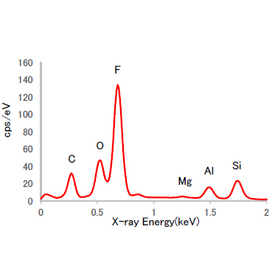
Control of particles in the semiconductor wafer manufacturing process is extremely important for ensuring wafer quality. In this case study, we estimated what the particles were on a Si wafer through SEM observation, EDX analysis, and simple quantification. The SEM equipment, which has high spatial resolution in the submicron range and can scan areas of several centimeters, allows for rapid inference of what the particles on the wafer are based on shape and composition information, enabling quick identification of the generation process. Analysis linked to coordinate data from defect inspection equipment is also possible.

  • img_C0736_2.jpg
  • Contract Inspection
  • Wafer
  • Other semiconductor manufacturing equipment

Added to bookmarks

Bookmarks list

Bookmark has been removed

Bookmarks list

You can't add any more bookmarks

By registering as a member, you can increase the number of bookmarks you can save and organize them with labels.

Free membership registration

[Analysis Case] Composite Analysis of Specific Areas within Electronic Devices (C0572)

Non-destructive assessment of specific areas inside the device! Evaluation of detailed structure and composition information of specific areas through cross-sectional observation.

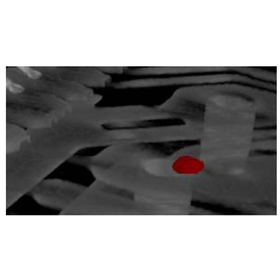
Our company offers technologies suitable for structural evaluation of electronic devices, and we propose analytical methods tailored to the observation field and objectives. In a case where we investigated specific areas of a device using X-ray CT and FIB-SEM, we first used X-ray CT to observe the internal structure of the entire sample and identify specific areas. Next, we used FIB-SEM to confirm the detailed structure of the specific structures identified on the vias. 【Measurement and Processing Methods】 ■[SEM] Scanning Electron Microscopy ■[SEM-EDX] Energy Dispersive X-ray Spectroscopy (SEM) ■X-ray CT Method ■[FIB] Focused Ion Beam Processing *For more details, please download the PDF or feel free to contact us.

Added to bookmarks

Bookmarks list

Bookmark has been removed

Bookmarks list

You can't add any more bookmarks

By registering as a member, you can increase the number of bookmarks you can save and organize them with labels.

Free membership registration

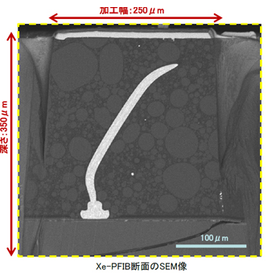
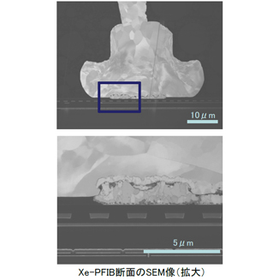
[Analysis Case] SEM Observation of Wide-Area Cross-Section Using Xe-PFIB

Observation of cross-sections with an accuracy of several tens of nanometers and a size of several hundred micrometers is possible!

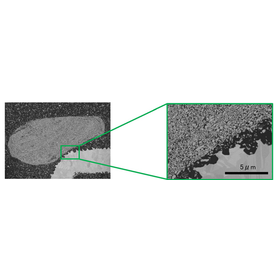
We offer wide-area cross-sectional SEM observation (C0610) using Xe-PFIB. The metal bonding that electrically connects the electrodes of integrated circuits, electrodes, printed circuit boards, and semiconductor packages has a diameter of several tens of μm to several hundred μm. With Xe-PFIB (Xe-Plasma Focused Ion Beam), we can target processing positions on the order of several tens of nm and create cross-sections of several hundred μm square, allowing for a detailed understanding of the entire view at the center of the bonding. 【Measurement and Processing Methods】 ■ [SEM] Scanning Electron Microscopy ■ X-ray CT Method ■ [FIB] Focused Ion Beam Processing *For more details, please download the PDF or feel free to contact us.

Added to bookmarks

Bookmarks list

Bookmark has been removed

Bookmarks list

You can't add any more bookmarks

By registering as a member, you can increase the number of bookmarks you can save and organize them with labels.

Free membership registration

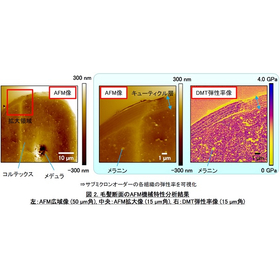
[Analysis Case] Evaluation of Mechanical Properties of Hair Cross-Sections Prepared by Microtome Method

It is possible to evaluate the elastic modulus of the internal structure of soft materials.

When evaluating the internal structure of materials, it is necessary to expose the internal structure while maintaining it through cross-sectional processing techniques such as cutting and polishing. This document introduces a case where the microtome method, which has a relatively small impact from processing damage, was used to create cross-sections of hair, followed by AFM observation of the internal structure and evaluation of elastic modulus. The microtome method is a cutting processing technique widely used in the field of soft materials, such as rubber materials and biological samples, and this approach has made it possible to evaluate the mechanical properties of the internal structure of these materials. [Measurement and Processing Methods] [AFM] Atomic Force Microscopy [AFM-MA・AFM-DMA] Mechanical Property Evaluation (Elastic Modulus Measurement, Dynamic Viscoelasticity Measurement) Ultra Microtome Processing *For more details, please download the PDF or feel free to contact us.

  • img_c0670_3_Microtome_Modulus_DMT_JKR_Hair_diagram.jpg
  • Contract measurement
  • Contract Analysis

Added to bookmarks

Bookmarks list

Bookmark has been removed

Bookmarks list

You can't add any more bookmarks

By registering as a member, you can increase the number of bookmarks you can save and organize them with labels.

Free membership registration

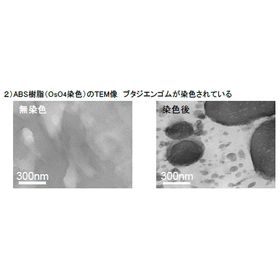
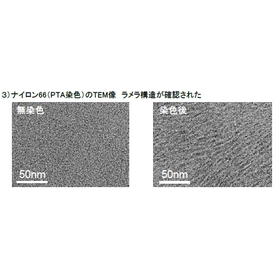
[Analysis Case] (S)TEM Observation of Polymer Materials Using Electronic Staining

We will introduce examples of observing polymer materials using SEM-STEM and (S)TEM!

Our organization offers (S)TEM observation of polymer materials using electron staining. Since polymer materials are composed of light elements, it is difficult to obtain clear contrast in (S)TEM observations. Staining can enhance the contrast for such materials. This document introduces examples of staining and observation using a method called electron staining with ruthenium tetroxide (RuO4), osmium tetroxide (OsO4), and phosphotungstic acid (H3[P(W3O10)4]·xH2O, abbreviated as PTA). [Measurement and Processing Methods] ■ [(S)TEM] (Scanning) Transmission Electron Microscopy ■ Others *For more details, please download the PDF or feel free to contact us.

Added to bookmarks

Bookmarks list

Bookmark has been removed

Bookmarks list

You can't add any more bookmarks

By registering as a member, you can increase the number of bookmarks you can save and organize them with labels.

Free membership registration

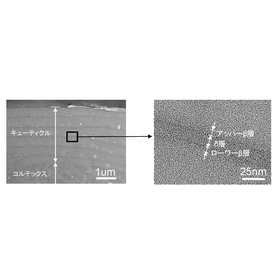
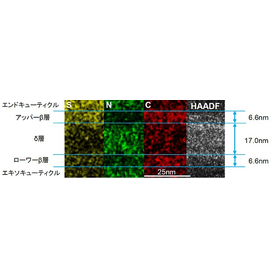
[Analysis Case] Fine Structure of Hair Cross-Section (S)TEM Analysis

We will introduce examples of observations of hair cell membrane complexes (CMC)!

Our organization offers (S)TEM analysis of the fine structure of hair cross-sections. The hair cell membrane complex (CMC) serves as a pathway for chemicals during processes such as bleaching and dyeing hair. In particular, the CMC between the cuticle layers has a three-layer structure, which we have visualized. We present a case where osmium tetroxide (OsO4) was used for electron staining targeting unsaturated fatty acids in lipids, followed by TEM observation and STEM-EDX analysis. [Measurement and Processing Methods] ■ [(S)TEM] Scanning Transmission Electron Microscopy ■ [TEM-EDX] Energy Dispersive X-ray Spectroscopy (TEM) ■ Ultramicrotome processing ■ Others *For more details, please download the PDF or feel free to contact us.

Added to bookmarks

Bookmarks list

Bookmark has been removed

Bookmarks list

You can't add any more bookmarks

By registering as a member, you can increase the number of bookmarks you can save and organize them with labels.

Free membership registration