iPROS Manufacturing
  • Search for products by classification category

    • Electronic Components and Modules
      Electronic Components and Modules
      61673items
    • Machinery Parts
      Machinery Parts
      75932items
    • Manufacturing and processing machinery
      Manufacturing and processing machinery
      102034items
    • Scientific and Physics Equipment
      Scientific and Physics Equipment
      36334items
    • Materials
      Materials
      37776items
    • Measurement and Analysis
      Measurement and Analysis
      55166items
    • Image Processing
      Image Processing
      15377items
    • Control and Electrical Equipment
      Control and Electrical Equipment
      54564items
    • Tools, consumables, and supplies
      Tools, consumables, and supplies
      65604items
    • Design and production support
      Design and production support
      12662items
    • IT/Network
      IT/Network
      45647items
    • Office
      Office
      14181items
    • Business support services
      Business support services
      25380items
    • Seminars and Skill Development
      Seminars and Skill Development
      6559items
    • Pharmaceutical and food related
      Pharmaceutical and food related
      34177items
    • others
      75345items
  • Search for companies by industry

    • Manufacturing and processing contract
      7338
    • others
      4986
    • Industrial Machinery
      4445
    • Machine elements and parts
      3330
    • Other manufacturing
      2883
    • Trading company/Wholesale
      2650
    • IT/Telecommunications
      2571
    • Industrial Electrical Equipment
      2319
    • Building materials, supplies and fixtures
      1816
    • software
      1666
    • Electronic Components and Semiconductors
      1587
    • Resin/Plastic
      1500
    • Service Industry
      1478
    • Testing, Analysis and Measurement
      1130
    • Ferrous/Non-ferrous metals
      986
    • environment
      699
    • Chemical
      640
    • Automobiles and Transportation Equipment
      581
    • Printing Industry
      513
    • Information and Communications
      465
    • Consumer Electronics
      412
    • Energy
      333
    • Rubber products
      317
    • Food Machinery
      308
    • Optical Instruments
      279
    • robot
      273
    • fiber
      254
    • Paper and pulp
      230
    • Pharmaceuticals and Biotechnology
      173
    • Electricity, Gas and Water Industry
      167
    • Warehousing and transport related industries
      149
    • Glass and clay products
      139
    • Food and Beverage
      130
    • CAD/CAM
      124
    • retail
      108
    • Medical Devices
      107
    • Educational and Research Institutions
      107
    • Ceramics
      98
    • wood
      87
    • Transportation
      84
    • Petroleum and coal products
      63
    • Medical and Welfare
      62
    • Shipbuilding and heavy machinery
      51
    • Aviation & Aerospace
      48
    • Fisheries, Agriculture and Forestry
      41
    • equipment
      40
    • Materials
      33
    • Public interest/special/independent administrative agency
      31
    • Research and development equipment and devices
      29
    • Government
      24
    • self-employed
      24
    • Mining
      17
    • cosmetics
      15
    • Finance, securities and insurance
      14
    • Restaurants and accommodations
      10
    • Individual
      10
    • Police, Fire Department, Self-Defense Forces
      7
    • Laboratory Equipment and Consumables
      5
    • Raw materials for reagents and chemicals
      4
    • Contracted research
      3
  • Special Features
  • Ranking

    • Overall Products Ranking
    • Overall Company Ranking
Search for Products
  • Search for products by classification category

  • Electronic Components and Modules
  • Machinery Parts
  • Manufacturing and processing machinery
  • Scientific and Physics Equipment
  • Materials
  • Measurement and Analysis
  • Image Processing
  • Control and Electrical Equipment
  • Tools, consumables, and supplies
  • Design and production support
  • IT/Network
  • Office
  • Business support services
  • Seminars and Skill Development
  • Pharmaceutical and food related
  • others
Search for Companies
  • Search for companies by industry

  • Manufacturing and processing contract
  • others
  • Industrial Machinery
  • Machine elements and parts
  • Other manufacturing
  • Trading company/Wholesale
  • IT/Telecommunications
  • Industrial Electrical Equipment
  • Building materials, supplies and fixtures
  • software
  • Electronic Components and Semiconductors
  • Resin/Plastic
  • Service Industry
  • Testing, Analysis and Measurement
  • Ferrous/Non-ferrous metals
  • environment
  • Chemical
  • Automobiles and Transportation Equipment
  • Printing Industry
  • Information and Communications
  • Consumer Electronics
  • Energy
  • Rubber products
  • Food Machinery
  • Optical Instruments
  • robot
  • fiber
  • Paper and pulp
  • Pharmaceuticals and Biotechnology
  • Electricity, Gas and Water Industry
  • Warehousing and transport related industries
  • Glass and clay products
  • Food and Beverage
  • CAD/CAM
  • retail
  • Medical Devices
  • Educational and Research Institutions
  • Ceramics
  • wood
  • Transportation
  • Petroleum and coal products
  • Medical and Welfare
  • Shipbuilding and heavy machinery
  • Aviation & Aerospace
  • Fisheries, Agriculture and Forestry
  • equipment
  • Materials
  • Public interest/special/independent administrative agency
  • Research and development equipment and devices
  • Government
  • self-employed
  • Mining
  • cosmetics
  • Finance, securities and insurance
  • Restaurants and accommodations
  • Individual
  • Police, Fire Department, Self-Defense Forces
  • Laboratory Equipment and Consumables
  • Raw materials for reagents and chemicals
  • Contracted research
Special Features
Ranking
  • Overall Products Ranking
  • Overall Company Ranking
  • privacy policy
  • terms of service
  • About Us
  • Careers
  • Advertising
  1. Home
  2. environment
  3. トリイ
  4. Product/Service List
environment
  • Added to bookmarks

    Bookmarks list

    Bookmark has been removed

    Bookmarks list

    You can't add any more bookmarks

    By registering as a member, you can increase the number of bookmarks you can save and organize them with labels.

    Free membership registration

トリイ

addressAichi/Nishio-shi/36 Emukae, Ajihama, Isshikimachi
phone0563-72-8220
  • Special site
  • Official site
last updated:Sep 04, 2026
トリイlogo
  • Contact this company

    Inquiry Form
  • Before making an inquiry

    Download Profile
  • Company information
  • Products/Services(213)
  • catalog(61)
  • news(0)

トリイ Product Lineup

  • category

1~45 item / All 213 items

Displayed results

Filter by category

凝集剤・フロックの基礎知識 凝集剤・フロックの基礎知識
食品・薬品の基礎知識 食品・薬品の基礎知識
食品表示・添加物の基礎知識 食品表示・添加物の基礎知識
甘味料・うま味の基礎知識 甘味料・うま味の基礎知識
設備部品の基礎知識 設備部品の基礎知識
水道水・井戸水・水質基準 水道水・井戸水・水質基準
水質測定(pH・電気伝導率) 水質測定(pH・電気伝導率)
純水・超純水・工業用水 純水・超純水・工業用水
軟水・硬水の基礎知識 軟水・硬水の基礎知識
純水器・軟水器の提案 純水器・軟水器の提案
排水処理の基礎知識 排水処理の基礎知識
排水処理場の点検・保全サービス 排水処理場の点検・保全サービス
排水処理のトラブル事例 排水処理のトラブル事例
冷却塔の基礎知識とメンテナンス 冷却塔の基礎知識とメンテナンス
ボイラーの構造・運転・法規制 ボイラーの構造・運転・法規制
ボイラーの整備・点検・メンテナンス ボイラーの整備・点検・メンテナンス
ボイラーの更新・省エネ・コスト削減 ボイラーの更新・省エネ・コスト削減
ボイラーの薬品・スケール対策 ボイラーの薬品・スケール対策
class="retina-image"

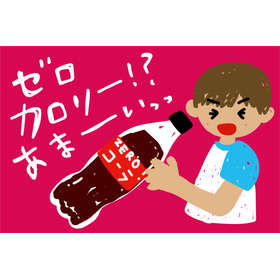
Is there a "sweetness curve" in sweeteners? What are the differences in taste? 【Basic Knowledge】

How do sucralose and acesulfame K differ in terms of sweetness perception?

■What is the "sweetness curve"? It is said that the timing of when sweetness is perceived and the duration of that sweetness vary depending on the type of sweetener. The changes in sweetness over time are represented by the sweetness curve. ■How do sucralose and acesulfame K differ? Sucralose has sweetness characteristics that are very similar to sugar, while acesulfame K is characterized by a quicker onset of sweetness compared to sugar and a sharp sweetness that lasts longer. Both of these sweeteners are used in Coca-Cola Zero. ■I see, the balance of sweeteners determines the taste! Coca-Cola Zero is thought to achieve a taste that starts with a strong sweetness but has a refreshing aftertaste by blending these sweeteners in the best proportions. The specific ratios are likely kept as trade secrets and are not disclosed. Please feel free to consult us first.

  • sweetener
  • Beverage ingredients (liquid)
  • seasoning

Added to bookmarks

Bookmarks list

Bookmark has been removed

Bookmarks list

You can't add any more bookmarks

By registering as a member, you can increase the number of bookmarks you can save and organize them with labels.

Free membership registration

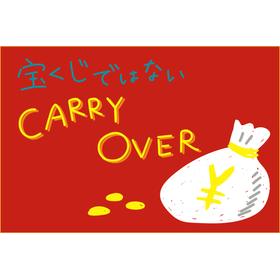
What is the "carry-over" of food additives? 【Basic Knowledge】

The reason why additives in raw materials are not displayed, what is carryover?

■What is "carryover" in the food industry? Unlike the rollover funds in lotteries, carryover in the food industry refers to additives that are present in the raw materials but do not have an effect in the food used due to their trace amounts, and therefore are exempt from labeling by law. ■What does that specifically mean? For example, soy sauce used as an ingredient in rice crackers contains preservatives, but the amount is so minimal that it has little to no impact on the rice crackers themselves, so there is no need to list preservatives in the ingredient declaration for the rice crackers. ■I see, it doesn't necessarily mean that additives in raw materials are displayed as they are! In the sense of "remaining," it is similar to the carryover in lotteries, but in terms of food labeling rules, it is a completely different system. At Torii, we custom blend and measure seasoning liquids and food additives according to our customers' requests. Please feel free to consult with us.

  • seasoning
  • Other additives
  • Preservatives

Added to bookmarks

Bookmarks list

Bookmark has been removed

Bookmarks list

You can't add any more bookmarks

By registering as a member, you can increase the number of bookmarks you can save and organize them with labels.

Free membership registration

Why is umami special? What is its relationship with the five basic tastes? 【Basic Knowledge】

Are umami components the same as the components that make up the human body? What is the secret of the five basic tastes?

■What are the five basic tastes? The basic elements that humans perceive as taste are the five: salty, sweet, bitter, sour, and umami, collectively referred to as the five basic tastes. This time, we will focus on umami. ■What is the essence of umami? Umami is the taste we experience when we consume amino acids such as glutamic acid, as well as nucleotides like guanylic acid and inosine. These three are collectively known as the three major umami components. ■I see, umami is the very components that build our bodies! Amino acids are the building blocks of proteins and are the components that make up our muscles and hair. On the other hand, nucleic acids are the components of our genetic material. In other words, the foods that provide umami contain the very components that make up the human body. Please feel free to consult with us.

  • seasoning
  • Food/beverage functional materials

Added to bookmarks

Bookmarks list

Bookmark has been removed

Bookmarks list

You can't add any more bookmarks

By registering as a member, you can increase the number of bookmarks you can save and organize them with labels.

Free membership registration

What is seasoning? The true nature of the "numbing" sensation of mala [spicy and numbing flavor]【Basic Knowledge】

What is the difference between the spiciness and numbing sensation created by chili peppers and Sichuan peppercorns in "mala"?

■ What is seasoning in the first place? Seasoning refers to a "flavoring powder" made by mixing salt, spices, and herbs. It is actually used in many familiar foods, such as consomme-flavored potato chips, seaweed salt, butter soy sauce flavor, and plum or wasabi-flavored rice crackers. ■ What is the difference between "spicy" and "numbing"? The stimulation from capsaicin found in chili peppers is what we describe as "spicy," while the stimulation from Sichuan peppercorns creates a different sensation known as "numbing." The combination of these two flavors is called mala, resulting in a strong seasoning that highlights the individuality of both chili peppers and Sichuan peppercorns. ■ I see, seasoning can be created through consultation! At our company, we listen to our customers' vague ideas of "this kind of flavor" and consider the ingredients to create samples for tasting, collaboratively exploring the ideal flavor during product development. Consultations and estimates are free, so please feel free to reach out to us.

  • seasoning
  • Food/beverage functional materials
  • Food ingredients (powder)

Added to bookmarks

Bookmarks list

Bookmark has been removed

Bookmarks list

You can't add any more bookmarks

By registering as a member, you can increase the number of bookmarks you can save and organize them with labels.

Free membership registration

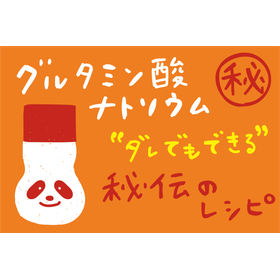
Why is umami seasoning delicious? The secret of the golden ratio [Basic Knowledge]

Ajinomoto, Haimi, and Inobiban: What is the golden ratio that creates the difference in flavor?

Did you know that there are three representative types of umami components? The three major umami components are monosodium glutamate, which is the umami of kombu, disodium inosinate, which is the umami of bonito, and monosodium guanylate, which is the umami of shiitake mushrooms. The latter two are also referred to as sodium ribonucleotides. Why do umami seasonings taste so good? The representative umami seasonings, such as Ajinomoto, Haimee, and I-no-Ichi-Ban, are based on monosodium glutamate and contain a few percent of disodium inosinate and monosodium guanylate. By combining multiple umami components, they create a synergistic effect that enhances the perception of umami, achieving a golden ratio. I see, the taste changes with the blending ratio! Haimee and I-no-Ichi-Ban have a higher ratio of disodium inosinate and monosodium guanylate compared to Ajinomoto, resulting in a more refined flavor. We also handle umami seasonings at Torii. Please feel free to consult with us.

  • seasoning
  • Food/beverage functional materials

Added to bookmarks

Bookmarks list

Bookmark has been removed

Bookmarks list

You can't add any more bookmarks

By registering as a member, you can increase the number of bookmarks you can save and organize them with labels.

Free membership registration

Sweeteners in shrimp crackers? What are the roles of stevia and licorice? 【Basic Knowledge】

What are the three reasons why sweeteners are used in shrimp crackers, as indicated by the ingredient label?

■Is it true that sweeteners are used in shrimp crackers? Shrimp crackers are often thought to be made only from shrimp, wheat flour, salt, and sugar, but when looking at the ingredient list of certain products, various materials are used, including starch and coloring agents, as well as natural sweeteners like stevia and licorice. ■Why add sweeteners to shrimp crackers? Sweeteners serve three purposes: enhancing umami, enriching texture and flavor, improving preservation, and reducing calories. They are used not just to add sweetness but also as components that affect texture and shelf life. ■I see, this product also contains natural sweeteners! It has been revealed that natural sweeteners like stevia and licorice are used as ingredients in familiar shrimp crackers. Torii also handles stevia and licorice. Please feel free to consult with us.

  • sweetener
  • seasoning
  • Food/beverage functional materials

Added to bookmarks

Bookmarks list

Bookmark has been removed

Bookmarks list

You can't add any more bookmarks

By registering as a member, you can increase the number of bookmarks you can save and organize them with labels.

Free membership registration

Why does Aichi Prefecture have a 95% share of the national market for shrimp crackers? 【Basic Knowledge】

What is the relationship between Aichi Prefecture's Isshiki Town, which has a 95% domestic share and is the number one in production, and shrimp crackers?

■Is Aichi Prefecture really the top producer of shrimp crackers? Aichi Prefecture ranks first in both production and consumption, accounting for about 95% of the domestic market share. Approximately 70% of this production comes from two cities, Hekinan and Nishio, which face Chita Bay, and it is deeply rooted as a representative industry of the region. ■Where is the birthplace of shrimp crackers? Ichinomiya Town in Nishio City is known as the birthplace of shrimp crackers. It is said that shrimp crackers made primarily from Akashi shrimp, caught in Mikawa Bay, were born in the mid-Meiji era, and currently, about 60% of the shrimp crackers in Japan are produced in this town. ■I see, the flavor changes between hand-baked and machine-baked! There are two methods for producing shrimp crackers: hand-baking, which uses plenty of fresh shrimp, and machine-baking, which is done automatically by machines. Hand-baked crackers are said to have a rich shrimp flavor, and their irregular sizes and shapes are also part of their appeal. Our company is based in this Ichinomiya Town and works with many local shrimp cracker manufacturers. Please feel free to consult with us.

  • seasoning
  • Food ingredients (solid)

Added to bookmarks

Bookmarks list

Bookmark has been removed

Bookmarks list

You can't add any more bookmarks

By registering as a member, you can increase the number of bookmarks you can save and organize them with labels.

Free membership registration

What are the intestinal health effects of resistant dextrin? [Basic Knowledge]

Is it easy to mix with coffee and yogurt? What is gentle dietary fiber for the stomach?

■What is the mechanism of the intestinal regulation effect of indigestible dextrin? It serves as food for intestinal bacteria, increasing beneficial bacteria and improving the intestinal environment. While some people feel that "laxatives suddenly cause stomach pain" or "intestinal regulators require taking many tablets," indigestible dextrin can support natural bowel movements simply by mixing it into coffee or yogurt. ■Why is it easy to mix into food? It is a water-soluble dietary fiber that dissolves easily in water, has little stickiness or sweetness, and is almost transparent, making it difficult to alter the taste or appearance of food when added. It also has excellent heat and acid resistance, allowing it to be mixed into a wide range of beverages, including hot coffee and orange juice. ■I see, it has high safety but caution is needed for excessive intake! It is considered to have high safety, to the extent that there is no need to clearly define an upper limit for daily intake. However, excessive consumption may lead to diarrhea or abdominal pain, so it is recommended to consume about 10g per day. Please feel free to consult us first.

  • Food/beverage functional materials
  • Supplement materials
  • seasoning

Added to bookmarks

Bookmarks list

Bookmark has been removed

Bookmarks list

You can't add any more bookmarks

By registering as a member, you can increase the number of bookmarks you can save and organize them with labels.

Free membership registration

What is indigestible dextrin? The secret to suppressing fat and sugar absorption [Basic Knowledge]

Is it safe after yakiniku and fast food? What is the true nature of the ingredients hidden in functional beverages?

■Why are there products that "suppress fat absorption"? The functional beverages labeled "suppress fat absorption" and "moderate sugar absorption" contain a common ingredient. Its true identity is resistant dextrin, a type of soluble dietary fiber made from corn starch. It is difficult to digest and has the property of being used as food for intestinal bacteria. ■What effects does resistant dextrin have? In addition to its intestinal regulation effects, it has been reported to suppress post-meal blood sugar spikes and the rise of triglycerides in the blood. It is an ingredient that is sometimes used in functional beverages like Mets Cola that suppress fat and sugar absorption. ■I see, dietary fiber is involved in the absorption of fat and sugar! When we think of dietary fiber, we often associate it with intestinal regulation, but there are types like resistant dextrin that work on the speed of fat and sugar absorption by utilizing their difficult-to-digest properties. Please feel free to consult us first.

  • Food/beverage functional materials
  • Supplement materials
  • seasoning

Added to bookmarks

Bookmarks list

Bookmark has been removed

Bookmarks list

You can't add any more bookmarks

By registering as a member, you can increase the number of bookmarks you can save and organize them with labels.

Free membership registration

Are natural sweeteners really good for your health? How to choose them? 【Basic Knowledge】

The key to choosing natural sweeteners like stevia and erythritol is to select them based on your purpose!

■What exactly are natural sweeteners? Natural sweeteners are those that are extracted from sweet components found in plants, such as leaves and fruits, and common "sugar" is one of the natural sweeteners. There are various types, including plant-derived stevia, monk fruit, and licorice, sugar alcohols like erythritol and xylitol, as well as honey and maple syrup. ■Do different sweeteners have completely different characteristics? Stevia and monk fruit are 200 to 300 times sweeter than sugar, licorice is 30 to 40 times sweeter, erythritol is about 70% as sweet as sugar and provides a cooling sensation with a gradual increase in blood sugar levels. Xylitol has cavity-preventing effects, and agave syrup is sweeter than sugar and contains the dietary fiber inulin. ■I see, just because they are natural doesn't mean I can consume them freely! Even natural sweeteners can cause a rapid increase in blood sugar levels depending on the type, so it’s important to choose them according to your goals and health condition. If you want to reduce calories, stevia is a good choice; if you want to avoid a rapid spike in blood sugar, agave syrup is preferable. It’s important to use them appropriately. Please feel free to consult with us first.

  • sweetener
  • Food/beverage functional materials
  • seasoning

Added to bookmarks

Bookmarks list

Bookmark has been removed

Bookmarks list

You can't add any more bookmarks

By registering as a member, you can increase the number of bookmarks you can save and organize them with labels.

Free membership registration

What is the real reason sugar is needed for bread making? 【Basic Knowledge】

Did it fail when you replaced sugar with a sweetener? An explanation of the unexpected role in bread making!

■Why doesn't the bread rise when replaced with sweeteners? The basic ingredients for bread making are flour, water, yeast, and salt, but for fluffy bread, ingredients with moisture-retaining properties, such as eggs and sugar, are important. When I tried replacing sugar with a sweetener that contains no sugars (a mix of erythritol and sucralose), the fermentation weakened, and the bread only rose to about half the usual height, resulting in a lack of browning. ■Does sugar have five roles in bread making? Sugar has five roles: 1. It serves as food for yeast, 2. It enhances the flavor of the bread, 3. It contributes to browning, 4. It makes the dough soft and moist, and 5. It helps regulate gluten formation. ■I see, sweeteners that contain no sugars do not serve as food for yeast! Sweeteners that do not contain sugars do not provide nutrition for yeast, which weakens fermentation and results in bread that does not rise well. When replacing sugar with the aim of reducing carbohydrates, it is important to choose sweeteners that consider these five roles. Please feel free to consult with us first.

  • sweetener
  • seasoning
  • Food ingredients (powder)

Added to bookmarks

Bookmarks list

Bookmark has been removed

Bookmarks list

You can't add any more bookmarks

By registering as a member, you can increase the number of bookmarks you can save and organize them with labels.

Free membership registration

What is "Triple Down" to prevent coordination mistakes? 【Basic Knowledge】

What is the system that reduces coordination, management, and waste loss all at once?

■Why do blending mistakes occur? Food manufacturers mix seasonings according to their meticulously researched "secret recipes," but as long as this is done by human hands, mistakes are unavoidable. This led to the idea of packaging seasonings that are pre-mixed according to the secret recipes, allowing for a simple process of just opening the bag and adding them. ■What is the mechanism of "Triple Down"? This method can only be implemented by trading companies that handle all kinds of food additives and seasonings uniformly. It allows for the reduction of blending mistakes, weighing errors, the labor involved in blending, the management of purchased seasonings, and waste losses due to expired products, all at once. It was named "Triple Down" because it can simultaneously reduce the three aspects of "blending, management, and waste loss." ■I see, it's a system used by major beverage manufacturers! By outsourcing the packaging of multiple food additives to several companies, it is possible to reduce blending, management, and waste losses without revealing the recipe. In fact, this method has also been adopted in the recipe management of major beverage manufacturers like a certain cola brand. Please feel free to consult with us first.

  • seasoning
  • sweetener
  • Food/beverage functional materials

Added to bookmarks

Bookmarks list

Bookmark has been removed

Bookmarks list

You can't add any more bookmarks

By registering as a member, you can increase the number of bookmarks you can save and organize them with labels.

Free membership registration

What is the "secret recipe" for seasoning blends? 【Basic Knowledge】

What is the "secret flavor" created by food additives like monosodium glutamate?

■What are food additives in the first place? Food additives are substances used in the manufacturing process or for the purpose of processing and preserving food, such as preservatives, sweeteners, colorings, and flavorings. Familiar examples include "monosodium glutamate" (Ajinomoto) used in shrimp crackers and sweeteners like sucralose and acesulfame K used in cola. ■How are blended seasonings made? Food manufacturers create finished products that we consume daily by adding "blended seasonings," which combine multiple food additives to adjust taste, aroma, and appearance. The combination of additives is a "secret recipe" that each manufacturer researches and develops continuously. ■I see, a slight miscalculation in proportions can lead to defective products! This "secret recipe" can result in a change in taste and produce defective products that cannot be released to the market if the quantities or proportions are slightly incorrect. The occurrence of defective products is a significant setback for manufacturers, and efforts are required to prevent this. Please feel free to consult with us first.

  • seasoning
  • sweetener
  • Food/beverage functional materials

Added to bookmarks

Bookmarks list

Bookmark has been removed

Bookmarks list

You can't add any more bookmarks

By registering as a member, you can increase the number of bookmarks you can save and organize them with labels.

Free membership registration

Is sulfur dioxide in wine, even if it's additive-free? 【Basic Knowledge】

Is the antioxidant (sulfur dioxide) really the cause of hangovers? Clarifying misconceptions!

■What is the purpose of sulfur dioxide in the first place? Sulfur dioxide has two roles. One is its antioxidant effect, which utilizes its property of easily binding with oxygen to prevent the oxidation of wine and to recover from deterioration by binding with acetaldehyde produced from alcohol oxidation. The other is its sterilizing effect, which helps in the prevention and treatment of bacterial contamination. ■Is sulfur dioxide really the cause of hangovers? In the past, there was a theory that the antioxidant (sulfur dioxide) was the cause of headaches, but in recent years, biogenic amines such as histamine and tyramine found in wine are considered the main culprits. Histamine, which dilates blood vessels, and tyramine, which constricts them, can both lead to migraines. ■I see, even natural wine contains sulfur dioxide! Sulfur dioxide is naturally produced during the fermentation process of yeast at around 10 mg/L without any addition, and labeling is only required for levels above 10 mg/L. Many wines that appear to be additive-free actually keep their levels below the labeling threshold through methods such as heat treatment, filtration, and the use of specialized yeast. Please feel free to consult with us first.

  • Antioxidants
  • Beverage ingredients (liquid)
  • Preservatives

Added to bookmarks

Bookmarks list

Bookmark has been removed

Bookmarks list

You can't add any more bookmarks

By registering as a member, you can increase the number of bookmarks you can save and organize them with labels.

Free membership registration

Why are preservatives necessary? What is the key to preventing food poisoning? 【Basic Knowledge】

A clear explanation of the roles of typical preservatives such as sorbic acid and benzoic acid!

■What are preservatives in the first place? Preservatives are a type of food additive. Food additives include various types such as preservatives, flavorings, colorings, and antioxidants, all of which are scientifically evaluated for safety and "usefulness," and only those recognized by the Minister of Health, Labour and Welfare are permitted for use. ■What are some typical preservatives? 1. Sorbic acid: Highly safe and used for a long time, derived from components found in the unripe fruit juice of the rowan tree. 2. Benzoic acid: Recognized for its bacteriostatic effect in 1875, it has been used for a long time. 3. Propionic acid: Effective against mold but less effective against yeast, used in bread and Western confections. 4. Nisin: An antibacterial peptide produced by lactic acid bacteria, used in meat products, cheese, and whipped cream. ■I see, preservatives exist to prevent food poisoning! The most important role of preservatives is to reduce the risk of food poisoning. While additives are often a concern regarding their impact on the human body, they are essential for preventing food poisoning, which is why consumers can safely purchase safe products. Please feel free to consult us first.

  • Preservatives
  • Other additives
  • seasoning

Added to bookmarks

Bookmarks list

Bookmark has been removed

Bookmarks list

You can't add any more bookmarks

By registering as a member, you can increase the number of bookmarks you can save and organize them with labels.

Free membership registration

Are color additives banned overseas? What are Japan's standards? 【Basic Knowledge】

What is the reason that color additives like Red 2 are banned overseas but can be used in Japan?

■What are color additives in the first place? Color additives are pigments used to add color during the manufacturing and processing of food, and they can be synthetic or natural. Colors are said to influence appetite and visual impressions, and by adding color additives to foods that are difficult to maintain their color for long periods, appealing colors and color retention are achieved. ■What are some representative synthetic color additives? Synthetic color additives from the tar category include "Red 2," used in soft drinks and confectionery, "Yellow 4," used in traditional Japanese sweets and beverages, and "Blue 1," used in confectionery and soft drinks. Red 2 is banned in the United States, Yellow 4 is regulated in Europe, and Blue 1 is banned in Europe. ■It's interesting that judgments differ between Japan and overseas! In Japan, the use of color additives is permitted with an established ADI (Acceptable Daily Intake), and they are not completely banned. However, some foods may have restrictions on their use, indicating that the degree of regulation on color additives varies by country and food. Please feel free to consult us first.
  • Coloring
  • seasoning
  • Food/beverage functional materials

Added to bookmarks

Bookmarks list

Bookmark has been removed

Bookmarks list

You can't add any more bookmarks

By registering as a member, you can increase the number of bookmarks you can save and organize them with labels.

Free membership registration

Why is zero sugar sweet? What is the true nature of artificial sweeteners? 【Basic Knowledge】

Why is it sweet even though it has zero sugar? A simple explanation of the secrets behind the sweetness of artificial sweeteners!

■Why does it taste sweet even though it's zero sugar? Foods that do not use sugar can taste sweet because synthetic sweeteners and other alternatives are used instead of sugar. Sweeteners can be broadly categorized into "sugar-based sweeteners," which include sugars derived from sugar and starch, and "non-sugar-based sweeteners," which combine natural sweeteners (like stevia) and synthetic sweeteners (like sucralose and acesulfame K). ■How sweet are synthetic sweeteners? Looking at the ingredient list of Coca-Cola Zero, it shows that sweeteners (sucralose, acesulfame K) are used, and there is no sugar. The sweetness of these synthetic sweeteners is said to be hundreds of times sweeter than sugar, allowing for a strong sweetness to be replicated with just a small amount, which is the mechanism behind zero sugar. ■I see, it's a system that keeps calories low with a small amount! Because they are so sweet, only a small amount is needed, which significantly reduces calories and may help in preventing lifestyle-related diseases and obesity. On the other hand, there are concerns about the health effects of synthetic sweeteners, and there is no scientifically clear conclusion yet. Please feel free to consult with us first.

  • sweetener
  • Beverage ingredients (liquid)
  • seasoning

Added to bookmarks

Bookmarks list

Bookmark has been removed

Bookmarks list

You can't add any more bookmarks

By registering as a member, you can increase the number of bookmarks you can save and organize them with labels.

Free membership registration

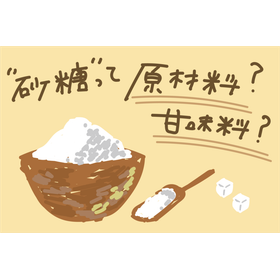
Is sugar an ingredient? An additive? What is the boundary in labeling? [Basic Knowledge]

Sugar is a sweetener, but why is it listed as an ingredient? A clear explanation of food labeling rules!

■What exactly is a sweetener? Sweeteners are components that provide sweetness to food. They can be categorized into two types: "sugar-based sweeteners," which include sugars like sugar and starch-derived sugars, and "non-sugar-based sweeteners," which include natural sweeteners like stevia and synthetic sweeteners like acesulfame potassium and sucralose. Sugar itself is considered a legitimate sweetener in this classification. ■So, is sugar an additive? In fact, according to the rules for ingredient labeling on processed foods, sugar is listed as a raw material rather than an additive. The labeling rules state that the ingredients before the "/" are raw materials, while those after it are additives, placing sugar on the raw materials side of this boundary. ■It's interesting that one component can have two faces! While it has the properties of a sweetener, it is treated as a raw material in labeling. This discrepancy indicates that the rules for food labeling categorize components based on their usage and origin, rather than whether they are sweet or not. When looking at the ingredient list on the back of a package, paying attention to the position of the "/" can reveal the composition of that food. Please feel free to reach out for any inquiries.

  • sweetener
  • Food/beverage functional materials
  • seasoning

Added to bookmarks

Bookmarks list

Bookmark has been removed

Bookmarks list

You can't add any more bookmarks

By registering as a member, you can increase the number of bookmarks you can save and organize them with labels.

Free membership registration

Top 5 Allergy Case Numbers: What Are the Surprising Results? 【Basic Knowledge】

Are 56% of nuts walnuts? What are the allergy tendencies that change with age?

■What are the top 5 allergy cases? According to data from the Consumer Affairs Agency for the fiscal year 2021, the number of allergy cases related to specific ingredients ranked as follows: 1st place - chicken eggs with 2028 cases, 2nd place - milk with 1131 cases, 3rd place - tree nuts with 819 cases, 4th place - wheat with 533 cases, and 5th place - peanuts with 370 cases. ■What is the breakdown of tree nuts? Out of the 819 cases of tree nuts in 3rd place, walnuts accounted for 463 cases, making up 56%, followed by cashews with 174 cases and macadamia nuts with 45 cases. These numbers justify why walnuts are included as a specific ingredient. ■Do trends change by age? Allergies to chicken eggs are overwhelmingly high at 60.6% in infants, and as individuals grow older, allergies to shellfish increase, with wheat and shellfish becoming more prevalent in those aged 18 and above. Allergies can become severe if not managed properly, so it is important to acquire accurate knowledge. Please feel free to consult us first.

  • Allergen testing
  • Quality Display
  • Food ingredients (solid)

Added to bookmarks

Bookmarks list

Bookmark has been removed

Bookmarks list

You can't add any more bookmarks

By registering as a member, you can increase the number of bookmarks you can save and organize them with labels.

Free membership registration

Are there 7 or 8 specific ingredients? Basics of allergen labeling [Fundamental knowledge]

Is walnut joining the group? What is the difference between specified ingredients and allergen labeling?

■What are specific raw materials? Allergens are antigens that cause allergies. Among them, foods that are clearly known to trigger food allergy symptoms and are deemed necessary to be labeled due to the number of cases and severity are referred to as "specific raw materials." The eight items that fall under this category are milk, eggs, wheat, buckwheat, crab, shrimp, peanuts, and walnuts. ■What is the difference between "items equivalent to specific raw materials"? While labeling specific raw materials is "mandatory," items equivalent to specific raw materials are those for which there are a considerable number of cases and severe symptoms, but fewer than specific raw materials, so labeling is "recommended" as much as possible. Almonds, abalone, squid, soybeans, and apples are among the 20 items that fall under this category. ■Can the list of specific raw materials change? Walnuts were originally classified as "items equivalent to specific raw materials," but they were added to the specific raw materials list in March 2023. The list of specific raw materials can increase over time. Please feel free to reach out with any inquiries regarding the latest labeling rules.
  • Allergen testing
  • Quality Display
  • Food ingredients (solid)

Added to bookmarks

Bookmarks list

Bookmark has been removed

Bookmarks list

You can't add any more bookmarks

By registering as a member, you can increase the number of bookmarks you can save and organize them with labels.

Free membership registration

Does kelp not release dashi in the sea? What is the reason for that? 【Basic Knowledge】

Does the cell membrane break down to release umami? What is the mechanism behind the extraction of umami from kombu?

■Does kombu not release dashi in the sea? If umami components are being released from kombu, it wouldn't be surprising if there were a dashi aroma coming from the sea, but in reality, dashi does not come out in the ocean. The reason is that kombu is alive. Amino acids like glutamic acid, which are umami components, are trapped inside the cells. ■Why does dried kombu release dashi? To protect the essential amino acids for survival, kombu keeps them trapped in the cells while it is alive, but when it dies and dries, the cell membranes break down and the barrier is lost. Therefore, when soaked in hot water, glutamic acid dissolves and creates dashi. ■What role does kombu play in the sea? When kombu is present, plankton gathers around it, and small fish that eat the plankton also gather, enriching the ecosystem in the ocean. Additionally, through photosynthesis, it absorbs a large amount of CO2 and releases oxygen, contributing to the reduction of CO2 in the atmosphere and the purification of the sea. Please feel free to consult with us first.

  • Umami
  • seasoning
  • Food ingredients (solid)

Added to bookmarks

Bookmarks list

Bookmark has been removed

Bookmarks list

You can't add any more bookmarks

By registering as a member, you can increase the number of bookmarks you can save and organize them with labels.

Free membership registration

What are the differences in umami components between kombu, katsuobushi, and dried shiitake mushrooms? 【Basic Knowledge】

Is the fat content of bonito flakes 3 to 11.8%? What is the other side of one of the three major umami foods?

■What are the three major umami components? The three major umami components refer to glutamic acid, inosinic acid, and guanylic acid. The representative foods for each are kombu, katsuobushi, and dried shiitake mushrooms. ■Are there any other characteristics besides umami components? Kombu contains a high amount of aspartic acid in addition to glutamic acid. Aspartic acid is an amino acid named after asparagus and is believed to be related to nitrogen and energy metabolism in the body. On the other hand, katsuobushi contains fat in addition to inosinic acid. ■What differences are there in the fat content of katsuobushi? In general, when examining about seven pieces of katsuobushi referred to as "arabon," the fat content varied from as low as 3% to as high as 11.8%. The guideline for a delicious fat content is considered to be around 3-10%. By the way, it was found that the umami component in dried shiitake mushrooms is mostly guanylic acid. Please feel free to consult with us first.

  • Umami
  • seasoning
  • Food ingredients (solid)

Added to bookmarks

Bookmarks list

Bookmark has been removed

Bookmarks list

You can't add any more bookmarks

By registering as a member, you can increase the number of bookmarks you can save and organize them with labels.

Free membership registration

What are artificial sweeteners? What are the benefits and precautions? 【Basic Knowledge】

Sweeter than sugar but zero calories? The mechanism and precautions of synthetic sweeteners.

■What are synthetic sweeteners? Synthetic sweeteners are artificially blended sweet components that do not exist in nature. Unlike natural sweeteners like sugar, they are characterized by being chemically produced. Aspartame, acesulfame potassium, sucralose, saccharin, and neotame are known as the main types. ■What foods are they used in? They are used in a wide range of foods, including soft drinks, candies, and processed foods, and are found in many items we consume daily. By checking the ingredient list on food packaging, you may find these component names. ■Are there both benefits and precautions? They are used in low-calorie and zero-calorie products, and since they are sweeter than sugar, a small amount can provide sweetness. They are also said to help suppress post-meal blood sugar spikes and prevent cavities. While this may seem entirely positive, excessive intake can lead to constipation, diarrhea, and abdominal pain, so it is important to be cautious about the amount consumed. Please feel free to consult with us first.

  • sweetener
  • Food/beverage functional materials
  • Food ingredients (powder)

Added to bookmarks

Bookmarks list

Bookmark has been removed

Bookmarks list

You can't add any more bookmarks

By registering as a member, you can increase the number of bookmarks you can save and organize them with labels.

Free membership registration

Iron deposition in boilers, where does the cause come from? [Basic Knowledge]

Does it return to normal even after cleaning? The iron trouble in the boiler is related to the water supply tank.

■Why does iron accumulate in the boiler? Raw water, such as well water or industrial water, often contains dissolved iron, with varying concentrations depending on the water source. Iron that oxidizes when exposed to air settles at the bottom of the water supply tank as reddish-brown rust, and is gradually transported to the boiler each time water is supplied, accumulating on the heat transfer surfaces and the inside of the pipes. It is not uncommon to find significant accumulation by the time one feels that "efficiency seems to have dropped." ■How do you identify the cause? If chemicals are added based on guesses, they will not be effective if the cause is different. When the inside of the boiler was visualized with a fiberscope, reddish-brown deposits were confirmed on the heat transfer surfaces and the inside of the pipes, revealing the accumulation of iron. ■Why address the water supply tank as well? Cleaning only the inside of the boiler will not prevent recurrence as long as iron continues to enter from the raw water. In this case, in addition to removing iron from the heat transfer surfaces, internal cleaning of the water supply tank was also performed to discharge the settled rust. In this instance, after the response, the boiler's startup time was shortened, and improvements in fuel efficiency were also confirmed. Please feel free to consult us first.

  • boiler
  • tank
  • Chemicals

Added to bookmarks

Bookmarks list

Bookmark has been removed

Bookmarks list

You can't add any more bookmarks

By registering as a member, you can increase the number of bookmarks you can save and organize them with labels.

Free membership registration

How much does boiler scale of 1mm worsen fuel efficiency? [Basic Knowledge]

Is it the same mechanism as limescale? The reason why scale buildup reduces boiler efficiency.

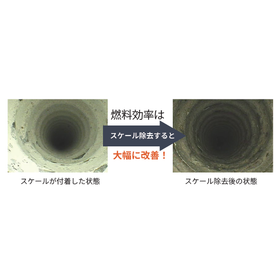
■What is scale? Scale refers to the minerals such as magnesium, calcium, and silica that precipitate from water. A common example is the limescale that accumulates in kettles and electric pots. ■What happens when scale accumulates? When scale accumulates on the interior surface of a boiler, it reduces thermal efficiency and can lead to serious problems such as valve sticking, operational issues, and water leaks due to cracks, which in the worst case can cause the boiler to stop functioning. This is similar to how using a kettle continuously requires extra energy to reach boiling. ■How much does the thickness of scale affect performance? It is said that scale can cause a deterioration in fuel efficiency of about 1-3% for every 1mm of thickness, which means that for a monthly fuel cost of 1 million yen, it could result in an annual loss of about 360,000 yen. In one factory case, it was confirmed that after chemical treatment, the exhaust gas temperature decreased by about 15°C compared to conventional chemical treatments. Please feel free to consult us first.
  • boiler
  • Chemicals
  • Heat exchanger

Added to bookmarks

Bookmarks list

Bookmark has been removed

Bookmarks list

You can't add any more bookmarks

By registering as a member, you can increase the number of bookmarks you can save and organize them with labels.

Free membership registration

What are the roles of coagulants and flocculants? 【Basic Knowledge】

Do negative particles gather with positive force? What is the mechanism of coagulants and aggregants?

■ What is a coagulant? A coagulant is a cationic polymer with a relatively low molecular weight. In water, negatively charged colloidal particles float while repelling each other, but the positive action of the coagulant cancels out this repulsive force, allowing intermolecular forces (Van der Waals forces) to create small aggregates (microflocs). ■ What does a flocculant do? A flocculant is a chemical used to aggregate substances dispersed in water. The colloidal particles contained in raw water can be removed more easily by using filtration or sedimentation, as the small flocs created by the coagulant are further gathered by the flocculant into larger sizes. ■ How do the two chemicals work together? The coagulant neutralizes the charges of the repelling colloidal particles to form small flocs, while the flocculant, which is a chain-like polymer, entangles these flocs together, allowing them to grow into larger clumps. The negative charges are neutralized by the positive forces, and they are connected like strings to increase in size. Please feel free to consult us first.

  • Chemicals
  • Water treatment equipment
  • Sludge treatment equipment and technology

Added to bookmarks

Bookmarks list

Bookmark has been removed

Bookmarks list

You can't add any more bookmarks

By registering as a member, you can increase the number of bookmarks you can save and organize them with labels.

Free membership registration

What is the difference between inorganic coagulants and polymer coagulants? 【Basic Knowledge】

Which one is used to make floc? The difference in roles between inorganic coagulants and polymer coagulants.

■What are inorganic coagulants? Inorganic coagulants are coagulants that do not contain carbon, used to neutralize the surface charge of fine impurities in water and to form flocs (clumps of impurities). They are broadly classified into aluminum-based and iron-based, with polyaluminum chloride (PAC) and ferric chloride being well-known examples. ■What is different about polymer coagulants? Unlike inorganic coagulants, polymer coagulants do not form new flocs; instead, chain-like polymers are added to entangle and bridge the existing flocs, promoting their aggregation. They are also referred to as "coagulation aids" because they support the function of inorganic coagulants. ■Why use a combination of the two types? In wastewater treatment, it is common to first create fine flocs using inorganic coagulants and then to aggregate them using polymer coagulants in a two-step process. The settling velocity of flocs increases proportionally to the square of their particle size, making sedimentation separation easier as they become larger. Please feel free to consult us.

  • Chemicals
  • Water treatment equipment
  • Sludge treatment equipment and technology

Added to bookmarks

Bookmarks list

Bookmark has been removed

Bookmarks list

You can't add any more bookmarks

By registering as a member, you can increase the number of bookmarks you can save and organize them with labels.

Free membership registration

What is the difference between BOD and COD? 【Basic Knowledge】

5 days for measurement? Or a few hours? Explaining the difference between BOD and COD!

■What do BOD and COD mean? Both are indicators that show the degree of water pollution. BOD stands for Biochemical Oxygen Demand, and COD stands for Chemical Oxygen Demand. A higher value indicates more severe water pollution, and they are important as regulatory items for industrial wastewater. ■How do the measurement methods differ? BOD measures the amount of oxygen consumed by microorganisms to decompose organic matter in water over a period of 5 days at 20°C in the dark. On the other hand, COD chemically decomposes organic matter using an oxidizing agent (potassium permanganate) and determines the amount of oxidizing agent consumed, allowing for measurement in a short time frame of about 30 minutes to 2 hours. ■Why use two different indicators? In rivers, where there is water flow and self-purification by microorganisms occurs, BOD is used. In lakes and marine areas, where water stagnates and organic matter that is difficult for microorganisms to decompose needs to be evaluated, COD is used as a standard item for environmental criteria. The fact that BOD takes 5 days to measure, while COD provides results in a short time, also contributes to the practical differentiation in their use. Please feel free to consult us first.
  • Water quality testing
  • Wastewater/wastewater treatment equipment
  • Dissolved Oxygen Meter

Added to bookmarks

Bookmarks list

Bookmark has been removed

Bookmarks list

You can't add any more bookmarks

By registering as a member, you can increase the number of bookmarks you can save and organize them with labels.

Free membership registration

Used Boiler + Chemicals | Review of Fuel Costs and Water Treatment Chemicals [With Case Studies]

We will provide flexible proposals from the selection of pharmaceuticals to the utilization of used equipment!

In the textile industry, where large amounts of steam are required in the manufacturing process, do you have any of these concerns regarding boiler maintenance? - The response from the maintenance company is slow, and deficiencies are found even during regular inspections. - Fuel efficiency is poor, and running costs are increasing year by year. - Considering future boiler expansions, but costs are a bottleneck. By switching chemicals and utilizing used boilers, it is possible to reduce unexpected troubles and transition to a preventive maintenance operation. ◇ We provide plans that include collaboration with existing boilers and installation conditions. ◇ Improvement of operational efficiency through a review of fuel costs and water treatment chemicals. ◇ Ensuring boiler capacity while keeping initial costs down, making it possible to accommodate future production expansion. We are currently offering free case studies on boiler environmental improvements.

  • boiler

Added to bookmarks

Bookmarks list

Bookmark has been removed

Bookmarks list

You can't add any more bookmarks

By registering as a member, you can increase the number of bookmarks you can save and organize them with labels.

Free membership registration

Factory wastewater pH management | Automatic detection and shutdown of pH anomalies [with case studies]

Comprehensive support from automatic control design and construction to alert settings and equipment maintenance!

Do you have any concerns regarding factory wastewater? - The pH of the wastewater occasionally shows abnormal values, raising worries about potential external discharge. - If water exceeding the standard values were to flow out, it could lead to environmental regulation violations or conflicts with neighboring areas. - Continuous monitoring by human resources is difficult, so we want to implement automatic safety measures. A system that automatically controls electric valves in response to pH meter readings contributes to the prevention of factory shutdowns and penalty risks. ◇ Achieving zero discharge of abnormal water ◇ Real-time response to pH anomalies ◇ Assurance in explaining risks to local residents and authorities ◇ Reducing the mental burden on site and contributing to improved work efficiency We are currently offering free case studies on the important pH management as part of wastewater treatment management.

  • Wastewater/wastewater treatment equipment

Added to bookmarks

Bookmarks list

Bookmark has been removed

Bookmarks list

You can't add any more bookmarks

By registering as a member, you can increase the number of bookmarks you can save and organize them with labels.

Free membership registration

Dehydrator | Simultaneously eliminates color contamination and foul odor in raw materials for paper companies [with case study]

For those troubled by foreign matter contamination and spoilage during raw material switching! Feel free to consult us about improvements in the molding line on-site.

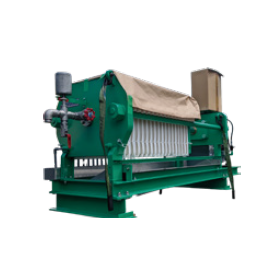
Do you have any concerns regarding the pulp materials handled in the molding process? - There is an issue of the previous color mixing in during the material switch, which could affect the appearance and quality of the product. - Foreign substances such as film pieces and lint may mix in with the materials, raising concerns about the finish of the product and negative impacts on the molding machine. - The occurrence of foul odors during the storage and disposal of materials is also a problem. By introducing a dewatering machine and using deodorants, improvements in the molding line can be achieved. ◇ Prevent color mixing troubles during material switching ◇ Reduce moisture content and mitigate odor risks through dewatering of waste ◇ Remove foreign substances from materials to prevent product defects and equipment troubles ◇ Reduce maintenance workload and improve hygiene in the work environment ◇ Positive changes not only in quality but also in the working environment We are currently offering free case studies on improvements in molding line operations.

  • Paper and pulp

Added to bookmarks

Bookmarks list

Bookmark has been removed

Bookmarks list

You can't add any more bookmarks

By registering as a member, you can increase the number of bookmarks you can save and organize them with labels.

Free membership registration

Update of aeration tank diffuser | Restoration of normal aeration and DO levels [with case study]

Abnormalities in drainage treatment may have causes in areas that are not visible. Please feel free to consult us about the inspection and maintenance of aeration tanks.

Do you have any of these concerns regarding the inspection and maintenance of aeration tanks? - The water that used to be brown has become darker. - The DO (dissolved oxygen concentration) is not increasing at all. - There is a strong odor, and it feels like the biological treatment is not working. By updating the diffusers in the aeration tank, we will achieve normal aeration and restore DO levels. ◇ The DO in the aeration tank has returned to normal range. ◇ The activity of microorganisms has returned, stabilizing the color of the treated water. ◇ The odor has been reduced, making wastewater management easier. ◇ We also inspected other aeration piping to prevent recurrence. We are currently offering free case studies on wastewater treatment facilities and aeration tanks.

  • Wastewater/wastewater treatment equipment

Added to bookmarks

Bookmarks list

Bookmark has been removed

Bookmarks list

You can't add any more bookmarks

By registering as a member, you can increase the number of bookmarks you can save and organize them with labels.

Free membership registration

Boiler Renewal | Proposal for Fuel Conversion from Heavy Oil to Gas [With Case Studies]

For those who want to keep both initial costs and running costs low! We handle everything from subsidy applications to construction in one package.

In the context of boiler upgrades at sites with heating processes such as food factories and beverage manufacturing, do you have any of the following concerns? - The heavy oil boiler that has been in use for over a decade is now at a point where performance has declined and repair costs have increased, making it time to consider an upgrade. - Repairs are no longer keeping up. - If we are going to upgrade anyway, we want to reduce utility costs as much as possible. - However, there is a budget constraint. We propose boiler upgrades through fuel conversion from heavy oil to gas utilizing subsidies. - By utilizing subsidies, gas becomes a lower-cost option. - We provide information on applicable subsidy programs and support with applications. - We offer selection and upgrade proposals for high-efficiency gas boilers. - We suggest specifications based on steam usage and waste heat utilization. We are currently offering free case studies on fuel conversion and energy-saving measures for boilers.

  • boiler

Added to bookmarks

Bookmarks list

Bookmark has been removed

Bookmarks list

You can't add any more bookmarks

By registering as a member, you can increase the number of bookmarks you can save and organize them with labels.

Free membership registration

Deodorants | Proposing suitable deodorization measures tailored to the site environment and challenges [with examples]

In addition to deodorant compatibility testing and selection testing, installation work for spraying devices is also possible!

Are you facing any of these concerns when selecting deodorants for sewage treatment facilities at purification centers? - A demand for higher deodorizing effectiveness due to consideration for the work environment and surrounding areas - A lack of means to quantitatively evaluate the effectiveness of deodorants previously used - Uncertainty about whether the deodorant is actually working Our company selects multiple types of deodorants and conducts deodorizing effectiveness tests under actual usage conditions. You can quantitatively grasp the changes in odor specific to each site. ◇ Quantifying and objectively evaluating the strength and quality of odors ◇ Test results are compiled into a visually clear report for easy understanding ◇ We consistently handle the selection of highly effective products, from delivery to sales We are currently offering free case studies on deodorants used on-site.

  • Wastewater/wastewater treatment equipment

Added to bookmarks

Bookmarks list

Bookmark has been removed

Bookmarks list

You can't add any more bookmarks

By registering as a member, you can increase the number of bookmarks you can save and organize them with labels.

Free membership registration

Energy-saving boiler chemicals | Suppressing scale adhesion in boilers [with case studies]

For those struggling with boiler scale removal! Significantly improve fuel efficiency.

Do you have any of these concerns regarding the boilers used in manufacturing sites? - Scale buildup in pipes due to water containing hardness components - Fuel loss due to decreased heat transfer efficiency - Extended heating time - The hassle and cost of regular scale removal work To address these issues, we propose energy-saving boiler chemicals that contain scale-dissolving components. This will achieve gradual scale removal and suppression of reattachment. ◇ Reduction in fuel consumption by recovering heat transfer efficiency ◇ Shortened heating time ◇ Decreased frequency of regular cleaning, leading to labor savings in maintenance work We are currently offering free case studies on the suppression of scale attachment in boilers.

  • boiler

Added to bookmarks

Bookmarks list

Bookmark has been removed

Bookmarks list

You can't add any more bookmarks

By registering as a member, you can increase the number of bookmarks you can save and organize them with labels.

Free membership registration

Raw Water Tank | Review of Stirring Method and Complete Resolution of Air Pipe Clogging [With Case Study]

For those struggling with the stirring and circulation of water in the raw water tank! Improvements in stirring efficiency, energy saving, and conservation.

Do you have any concerns such as clogging in the air piping of the raw water tank? - You have to stop production and clean every time there is a clog, resulting in additional cleaning time and effort. - The power consumption due to air usage is also significant. We propose switching from air agitation to an electric agitation mixer system. This will completely eliminate air piping clogs and reduce power consumption. ◇ Regular cleaning tasks will no longer be necessary, reducing maintenance labor. ◇ The uniformity of agitation will improve, preventing the sedimentation of suspended substances and ensuring stability. ◇ Power consumption will be significantly reduced, providing cost benefits as well. ◇ Equipment troubles will decrease, contributing to stable production operations. We are currently offering free case studies on reviewing the agitation method of the raw water tank.

  • Other Mixers

Added to bookmarks

Bookmarks list

Bookmark has been removed

Bookmarks list

You can't add any more bookmarks

By registering as a member, you can increase the number of bookmarks you can save and organize them with labels.

Free membership registration

Lime Control Device | Transitioning to Smart Operations Based on Numerical Data [With Case Studies]

For those struggling with the control of quicklime and calcium carbonate! Both environmental measures and cost measures come from "evidence-based control."

Do you have any concerns regarding the addition of quicklime in waste treatment facilities? - Manual adjustments while monitoring HCl concentration in exhaust gas - Increased chemical costs due to "extra injection" just to be safe - Increased load on dust collection equipment due to excessive quicklime injection - Inability to visualize the effects relative to the amount injected We propose the introduction of a quicklime control system based on an analysis of the site conditions and operational data. You can transition to a smart operation based on numerical data. ◇ Continuous real-time measurement of hydrochloric acid concentration in exhaust gas ◇ Automatic control of the rotation speed of the quicklime injection pump based on measurement values ◇ By injecting the optimal amount without excess or deficiency, you can manage both costs and exhaust gas components effectively We are currently offering free case studies on the addition of quicklime in waste treatment facilities.

  • Waste disposal

Added to bookmarks

Bookmarks list

Bookmark has been removed

Bookmarks list

You can't add any more bookmarks

By registering as a member, you can increase the number of bookmarks you can save and organize them with labels.

Free membership registration

DO Measurement Maintenance | Improving Unknown Drainage Treatment Issues [With Case Study]

When the condition is poor, suspect the "measuring instrument"! Deterioration, dirt, or calibration errors of the sensor—please consult us at least once.

Are you experiencing unexplained issues with wastewater treatment, such as: - Sludge not settling in the secondary sedimentation tank - Treated water being cloudy - Feeling that microorganisms are not functioning properly Our company conducts maintenance of DO meters and cleaning and recalibration of sensor components to improve sedimentation. ◇ Recovery of activity in biological treatment tanks ◇ Improvement of sludge settling in sedimentation tanks ◇ Reduction of wastewater turbidity and stabilization of effluent ◇ Restoration of reliability as a management indicator through recovery of DO meter accuracy We are currently offering free case studies on issues related to wastewater treatment.

  • Wastewater/wastewater treatment equipment

Added to bookmarks

Bookmarks list

Bookmark has been removed

Bookmarks list

You can't add any more bookmarks

By registering as a member, you can increase the number of bookmarks you can save and organize them with labels.

Free membership registration

Boiler Maintenance | Streamlining Maintenance and Measurement Together [With Case Studies]

To the boiler personnel at the manufacturing site! We can handle everything from measurement, recording, to report creation by qualified personnel, all in one company.

Are you troubled by the double work of boiler maintenance and smoke emission measurement? - You have to coordinate the schedule with each contractor and conduct the measurement work again after maintenance. - The measurement results are not linked to the maintenance content. - The boiler load is low, making smoke emission measurement impossible. We propose a total solution that conducts smoke emission measurement simultaneously with boiler maintenance. ◇ The setup work can be completed in one go, reducing coordination effort. ◇ The measurement and maintenance content are linked, making the results easy to understand. ◇ No need for the hassle of selecting measurement contractors or arranging outsourcing. ◇ Results reporting is speedy and accurate. ◇ Schedule adjustments consider boiler load, ensuring smooth smoke emission measurement. We are currently offering free case studies on boiler maintenance and smoke emission measurement.

  • boiler

Added to bookmarks

Bookmarks list

Bookmark has been removed

Bookmarks list

You can't add any more bookmarks

By registering as a member, you can increase the number of bookmarks you can save and organize them with labels.

Free membership registration

Pure water system ion exchange resin | Replacement work and general maintenance [with examples]

For those struggling with boiler equipment and water softening systems! Leave your inquiries about updates, maintenance, and improvements to us.

Are you facing any of these concerns regarding the stable supply of high-quality pure water in boiler systems? - The effectiveness of the ion exchange resin currently in use is gradually declining, leading to an increase in the conductivity of softened water. - Although the resin regeneration is set to occur automatically, there is a risk that starting regeneration during operation could impact production, so we want to control the timing of regeneration. By replacing used ion exchange resin and consumable parts and adding a timer control function, it becomes possible to ensure a stable supply of high-purity softened water. ◇ Scale formation in the boiler is reduced, improving heat transfer efficiency. ◇ The quality of steam stabilizes, allowing for smooth supply to heating equipment. ◇ As a result, thermal efficiency increases, leading to a reduction in fuel consumption. ◇ The stable operation of the equipment also enhances the overall reliability of production. We are currently offering free case studies on boiler systems that support manufacturing lines.

  • boiler

Added to bookmarks

Bookmarks list

Bookmark has been removed

Bookmarks list

You can't add any more bookmarks

By registering as a member, you can increase the number of bookmarks you can save and organize them with labels.

Free membership registration

Special Reinforced Plastic Processing | Improving Yield in Paper Companies [With Case Studies]

For those struggling with contamination during raw material switching! Achieve the dual benefits of stabilizing product quality and reducing costs.

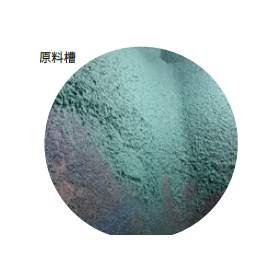
Do you have any concerns about the yield of raw material tanks in the paper manufacturing process for producing fruit and vegetable trays? - Residual raw material remains in the tank even after switching materials - Contamination leads to losses and worsens yield - Cleaning is labor-intensive, reducing work efficiency Our company applies a special reinforced plastic treatment to the inner surface of the raw material tanks, significantly reducing raw material residue by enhancing release properties. ◇ Improved surface slipperiness makes it harder for raw materials to adhere ◇ Easier cleaning reduces washing time ◇ Decrease in defects caused by raw material contamination We are currently offering free case studies on raw material residue and defects caused by contamination.

  • tray

Added to bookmarks

Bookmarks list

Bookmark has been removed

Bookmarks list

You can't add any more bookmarks

By registering as a member, you can increase the number of bookmarks you can save and organize them with labels.

Free membership registration

Drainage Treatment | Solving Problems through Proper Cause Investigation and Equipment Renewal [With Case Examples]

The cause of the trouble is not just one! We provide comprehensive proposals based on field investigations to assist with fundamental improvements.

Are you troubled by the chronic exceedance of water quality standards in treated water and frequent issues? - The water quality of treated water sometimes exceeds the standards, and you want to improve it. - When problems occur in wastewater treatment, it affects the entire factory's operations, so you want to fundamentally reassess it. - Concerns about safety arise when workers almost trip over pipes in the passageway. Our company will resolve wastewater treatment issues through appropriate identification of causes and equipment updates. ◇ Water quality has stabilized, and exceedance of standards has ceased. ◇ Dewatering processes have caught up, eliminating sludge retention. ◇ Work pathways have become safer, reducing the risk of work-related accidents. ◇ DO levels have improved, and biological treatment is functioning normally. We are currently offering free case studies on issues related to wastewater treatment.

  • Wastewater/wastewater treatment equipment

Added to bookmarks

Bookmarks list

Bookmark has been removed

Bookmarks list

You can't add any more bookmarks

By registering as a member, you can increase the number of bookmarks you can save and organize them with labels.

Free membership registration

Circulating Water Treatment Agent | Reduction of Sludge in Painting Booths [With Case Studies]

Troubles with water treatment and maintenance management in painting booths! We can provide proposals tailored to the site.

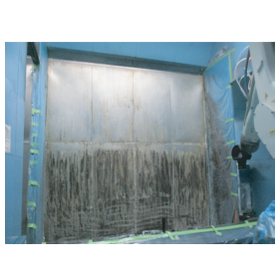
Are you troubled by the issue of excess paint mixing with circulating water in the paint booth, resulting in sludge (precipitates)? - It easily adheres and settles in tanks, pipes, and pumps. - Cleaning takes a lot of time, increasing the burden of maintenance work. - Changes in water quality can easily lead to odors and chemical loss. By introducing paint booth circulating water treatment agents and automatic chemical injection pumps, we can minimize the moisture content of sludge and reduce the risk of chemical excess or deficiency. ◇ Sludge becomes less likely to adhere to equipment surfaces, reducing cleaning frequency and work time. ◇ The water quality of the circulating water stabilizes, effectively suppressing odors and decay. ◇ The automatic injection pump optimizes chemical usage, reducing running costs. ◇ As a result, we achieve both stable paint quality and improved working environment simultaneously. We are currently offering free case studies on sludge adhesion in paint booths.

  • Other painting machines

Added to bookmarks

Bookmarks list

Bookmark has been removed

Bookmarks list

You can't add any more bookmarks

By registering as a member, you can increase the number of bookmarks you can save and organize them with labels.

Free membership registration

Boiler refractory materials | Relatively inexpensive with construction equivalent to that of manufacturers [with case studies]

To the equipment management personnel using boilers! How about we stop saying "It's too expensive, so let's postpone"?

To those in charge of using boilers in fiber manufacturing, dyeing processing, heat treatment, etc., are you struggling with the dilemma of cost and safety? - The refractory materials of the boiler that has been in use for many years are deteriorating, and it's about time for an update. - The estimate provided by the manufacturer I approached for the update is high. - Honestly, the budget is tight. It's not urgent, but leaving it as is is also concerning. Our company will check the structure and use of the boiler and propose a refractory material update plan that can be handled by manufacturers other than the original one. ◇ Achieve significant cost reductions compared to requesting the manufacturer. ◇ Restore the operational efficiency of the boiler and maintain stable heating performance. ◇ Avoid the risk of unexpected failures by addressing aging components early. ◇ Clarify future update timing, making it easier to establish medium- to long-term plans. We are currently offering free case studies on cost reduction through refractory material updates.

  • boiler

Added to bookmarks

Bookmarks list

Bookmark has been removed

Bookmarks list

You can't add any more bookmarks

By registering as a member, you can increase the number of bookmarks you can save and organize them with labels.

Free membership registration

Deodorizing Activated Carbon | One-stop service from selection and sales to replacement work [with case studies]

Shall we make annual water treatment lighter and safer? We can also accommodate the specific equipment conditions of disposal sites.

Do you have any of the following concerns regarding the activated carbon used for deodorization at waste disposal sites? - I've recently become more aware of odors. - I feel like the effectiveness has decreased. - I think it's about time to replace the activated carbon, but I don't know where to request it. - Construction is necessary, but it takes time to select a contractor. Our company offers activated carbon replacement services for deodorization systems at waste disposal sites. - We provide comprehensive support from selecting the appropriate activated carbon materials and shapes to the replacement construction, tailored to the site conditions. - We can participate in bidding and respond to specifications as needed. - We also provide past construction records and technical documentation upon request. We are currently offering free case studies on activated carbon replacement projects.

  • Other water treatment equipment

Added to bookmarks

Bookmarks list

Bookmark has been removed

Bookmarks list

You can't add any more bookmarks

By registering as a member, you can increase the number of bookmarks you can save and organize them with labels.

Free membership registration
Prev 12345 Next
  • 排気熱風なく気温-4.1℃の冷風を 工事不要で暑さ対策 店舗・工場の安全対策に! 気化式スポットクーラー Pure Drive
  • 技術・製品展示会 新技術創出交流会2026 入場無料 来場登録受付中 開催日時10月22日木・23日金 会場東京たま未来メッセ
    • Contact this company

      Inquiry Form
    • Before making an inquiry

      Download Profile

    Products

    • Search for Products

    Company

    • Search for Companies

    Special Features

    • Special Features

    Ranking

    • Overall Products Ranking
    • Overall Company Ranking

    support

    • site map
    IPROS
    • privacy policy Regarding external transmission of information
    • terms of service
    • About Us
    • Careers
    • Advertising
    IPROS Services
    • >IPROS GMS | Search site for the manufacturing industry
    • >IPROS | Search site for the B2B industry
    COPYRIGHT © 2001-2026 IPROS CORPORATION ALL RIGHTS RESERVED.
    Please note that the English text on this page is automatically translated and may contain inaccuracies.