1~45 item / All 150 items
Displayed results
Filter by category

Added to bookmarks
Bookmarks listBookmark has been removed
Bookmarks listYou can't add any more bookmarks
By registering as a member, you can increase the number of bookmarks you can save and organize them with labels.
Free membership registration
Contact this company
Inquiry Form1~45 item / All 150 items
Filter by category

As global discussions on environmental regulations for per- and polyfluoroalkyl substances (PFAS) progress, it has become urgent for food manufacturing sites to consider switching surface treatments towards "de-fluorination" and "enhanced hygiene safety." In particular, in the production of instant noodles, issues such as peeling and foreign matter contamination due to thermal degradation of fluoropolymer coatings have posed risks. ■ Ceramic Coating "Biceram 100" - This is an advanced surface treatment technology that is "completely PFAS-free," containing no organic fluorinated compounds (PFAS) at all. It can confidently comply with various future environmental regulations and hygiene standards. - Unlike traditional fluoropolymer coatings, which have soft films, Biceram 100 forms a high-hardness, dense ceramic coating that physically shuts out contamination caused by film peeling. It combines excellent non-stick and release properties with safety, establishing a sustainable and high-quality foundation for food production.
Added to bookmarks
Bookmarks listBookmark has been removed
Bookmarks listYou can't add any more bookmarks
By registering as a member, you can increase the number of bookmarks you can save and organize them with labels.
Free membership registration
This is a technical sample solution for metal wafer carriers (carrier jigs) used to store, hold, and transport silicon wafers in the semiconductor manufacturing process, featuring PEEK coating, fluoropolymer coating, or a composite coating of fluoropolymer and PEEK. It uniformly forms a coating from the delicate slots (grooves) where the wafers are stored to the intricate details of the complex frame structure. **Main Benefits of Implementation** - **Prevention of Wafer Scratches and Chipping** Completely eliminates metal contact with the substrate. It alleviates contact stress and friction, preventing minor chipping and scratches during wafer retrieval and insertion. - **Chemical Resistance & Metal Contamination Suppression** Exhibits strong resistance to acidic and alkaline cleaning solutions. Even under thermal conditions, outgassing and leaching of metal ions are extremely low, reducing the risk of contamination to the wafers. - **Electrostatic Discharge (ESD) and Particle Control** Options for anti-static grades are available. It suppresses triboelectric charging, preventing risks of electrostatic discharge (ESD) and issues with particle adhesion in cleanroom environments.
Added to bookmarks
Bookmarks listBookmark has been removed
Bookmarks listYou can't add any more bookmarks
By registering as a member, you can increase the number of bookmarks you can save and organize them with labels.
Free membership registration
In the manufacturing process of instant noodles (fried noodles and non-fried noodles), the "retainer," which is responsible for cooking and transporting, is a crucial part that influences quality and production efficiency. Traditional fluoropolymer coatings are prone to thermal degradation in harsh environments such as high-temperature oil and steam, leading to issues such as "chocolate stops due to reduced release properties," "burning of residual noodle scraps," and "contamination due to coating peeling," necessitating reapplication approximately every year. ■ High-performance ceramic coating "Biceram 100" - With ultra-low surface energy that surpasses fluoropolymers, it effectively prevents sticking and burning of oils and starches, thereby preventing transport errors. - The hard ceramic coating prevents chipping (coating peeling) due to wear and impact, significantly reducing the risk of foreign material contamination. - The durability has improved from the conventional "1 year" to "2 years," greatly contributing to the reduction of regular maintenance labor and running costs.
Added to bookmarks
Bookmarks listBookmark has been removed
Bookmarks listYou can't add any more bookmarks
By registering as a member, you can increase the number of bookmarks you can save and organize them with labels.
Free membership registration
Generally, "fluororesin coating" is widely used for non-stick and release purposes, but due to the softness of the coating film, using scrapers or spatulas during cleaning can damage the film, leading to wear and peeling. ■Features of Biceram 100 It is a high-performance surface treatment technology that forms a dense and hard coating based on ceramic components, achieving excellent non-stick properties and high coating hardness that surpass fluororesins. ■Prevention of scratches with the high hardness surface unique to ceramics Not only does it physically reduce the strong adhesion of high-viscosity resin varnishes and adhesives to the tank inner walls and receiving pans, but the coating is also less prone to scratches during cleaning with tools, allowing the initial excellent release effect to last for a long time. Additionally, it excels in chemical resistance and heat resistance against cleaning solvents, strongly supporting the longevity of equipment and maintenance-free operation in harsh industrial environments.
Added to bookmarks
Bookmarks listBookmark has been removed
Bookmarks listYou can't add any more bookmarks
By registering as a member, you can increase the number of bookmarks you can save and organize them with labels.
Free membership registration
This is a technical case study of conductive antistatic coatings for metal transport rolls (such as guide rolls and pass rolls) used in the converting and manufacturing processes of various plastic films, optical sheets, and packaging materials. The coating is applied with a uniform film thickness on the outer circumference of the roll, fundamentally eliminating static electricity issues that arise during high-speed transport. **Main Improvement Effects from Implementation** ■ Suppression of Adhesion and Stabilization of Transport A reliable grounding path (conductivity) is provided on the roll surface. By preventing the accumulation of static electricity and quickly dissipating charges, issues such as film pulling, wandering, wrinkles, and slipping during transport are proactively prevented. ■ Prevention of Static Marks and Dust Adhesion It prevents appearance scratches (static marks) on the film surface caused by static electricity discharge and the attraction of fine dust and particles from the surroundings. This directly contributes to improving the quality and yield of optical films and electronic component sheets in clean rooms. ■ Suppression of Aggressiveness to Counter Materials (Scratch Prevention) In addition to antistatic functionality, a coating film is formed that combines appropriate surface smoothness and hardness. This alleviates friction stress with the film, preventing scratches and abrasions on delicate product surfaces.
Added to bookmarks
Bookmarks listBookmark has been removed
Bookmarks listYou can't add any more bookmarks
By registering as a member, you can increase the number of bookmarks you can save and organize them with labels.
Free membership registration
In recent years, with the tightening of global regulations on per- and polyfluoroalkyl substances (PFAS), manufacturing sites have rapidly shifted towards "environmentally friendly, non-stick treatments" as alternatives to fluoropolymer coatings. ■ Ceramic Coating "Biceram 100" This next-generation release and non-stick coating achieves complete PFAS-free status. It physically suppresses the strong adhesion and stickiness of high-viscosity paints, adhesives, and other strongly adhesive resin varnishes that traditional fluoropolymers could not prevent. ■ High Hardness Coating Unique to Ceramics It overcomes the weaknesses of soft and easily scratched fluoropolymers, achieving high wear and scratch resistance with a hard ceramic coating. To prevent wear and peeling of the coating from cleaning tools, it reduces the frequency of re-coating, contributing to lower running costs. It is an optimal "fluoropolymer alternative solution" that simultaneously achieves environmental regulation compliance and improves on-site productivity.
Added to bookmarks
Bookmarks listBookmark has been removed
Bookmarks listYou can't add any more bookmarks
By registering as a member, you can increase the number of bookmarks you can save and organize them with labels.
Free membership registration
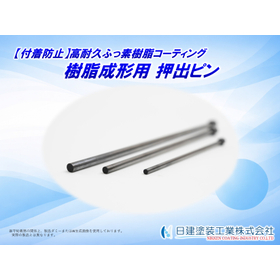
This is a technical case study on the application of a uniquely developed high-durability fluororesin coating, "Thermo Pro Release," on the tip of metal ejector pins used in the manufacturing lines of cosmetic containers and various plastic molded products. The coating imparts non-stick properties primarily to the tip of the pins that come into direct contact with the resin during the molding process, thereby resolving operational failures and resin sticking issues. 【Benefits of Implementation】 ■ Improvement in the quality of molded products (prevention of pin marks and whitening) The excellent release properties prevent molten resin from adhering to and accumulating on the pin tips. This reduces excessive load during ejection and significantly decreases appearance defects such as "pin marks" and "whitening," which are problematic in appearance-focused cosmetic containers. ■ Durability that withstands heat and wear Compared to conventional fluororesin coatings, this coating is more resistant to heat and wear (friction), making it less prone to wear and peeling of the coating film, thus prolonging the initial release performance. ■ Reduction in maintenance labor and shortening of takt time It suppresses the adhesion of resin debris and gases (tar and scale). This reduces the frequency of line stoppages for cleaning and helps prevent automatic retrieval errors, supporting unmanned operation.
Added to bookmarks
Bookmarks listBookmark has been removed
Bookmarks listYou can't add any more bookmarks
By registering as a member, you can increase the number of bookmarks you can save and organize them with labels.
Free membership registration
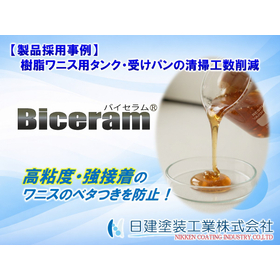
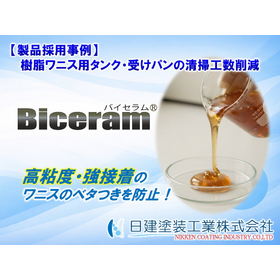
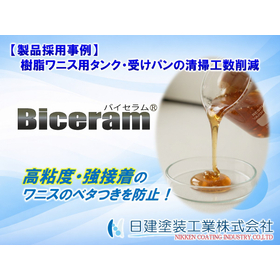
The resin varnish used in processes such as motors, transformers, and semiconductor encapsulation has extremely high viscosity and adhesion, making stickiness and adhesion to the inner walls of processing tanks and receiving pans a significant maintenance challenge. Conventional fluoropolymer coatings lack sufficient non-stick properties, resulting in enormous time and effort spent on manual solvent wiping and scraping. ■ We propose the ceramic coating "Biceram 100" Biceram is a surface treatment technology that boasts extremely high release properties, hardness, and durability, surpassing fluoropolymers. ■ Non-stick and release properties that exceed fluoropolymers Due to its low surface energy, even resin varnishes with strong adhesion are less likely to stick to the surface, physically suppressing strong adhesion caused by stickiness. ■ High-hardness inorganic-based coating The hard coating reduces wear and peeling from cleaning tools such as scrapers, maintaining excellent release performance for an extended period. This significantly shortens cleaning time and contributes to reducing equipment downtime and improving productivity.
Added to bookmarks
Bookmarks listBookmark has been removed
Bookmarks listYou can't add any more bookmarks
By registering as a member, you can increase the number of bookmarks you can save and organize them with labels.
Free membership registration
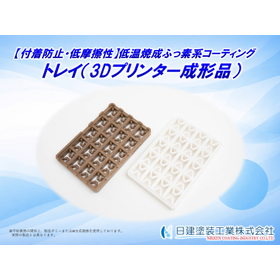
This is a technical case study of a mesh tray made of engineering plastics (such as nylon and PPS resin) shaped by a 3D printer, coated with our low-temperature sintering fluorine-based coating "FU-1240." **Features of the Low-Temperature Sintering Fluorine-Based Coating "FU Series"** Since it does not require the high-temperature baking process (300°C to 400°C) necessary for conventional fluorine resin coatings, it can form a coating directly on resin substrates with low heat resistance, such as nylon and PPS, without causing deformation or deterioration. **Main Benefits of Implementation** ■ High adhesion to resin & elimination of thermal effects The coating is applied at temperatures below the melting point and thermal deformation temperature of the substrate. It adheres strongly while maintaining the inherent strength and properties of the resin. ■ Prevention of adhesion and sticking (improved cleanability) With excellent non-stick properties, it prevents the sticking of liquids, powders, and adhesives. Even in complex shapes like mesh, dirt is easily removed, reducing cleaning effort. ■ Improved slip properties (reduced friction and wear) By lowering the coefficient of friction, it eliminates snagging between the tray and the counterpart material. This contributes to improved sustainability in transportation and movement, as well as reducing wear on the substrate.
Added to bookmarks
Bookmarks listBookmark has been removed
Bookmarks listYou can't add any more bookmarks
By registering as a member, you can increase the number of bookmarks you can save and organize them with labels.
Free membership registration
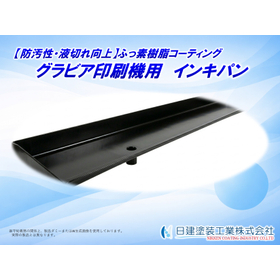
This is a technical case of applying a fluororesin PFA coating to a metal "ink pan" used for gravure printing machines, such as those for package printing and film printing, where liquid printing ink is stored. The coating process is uniformly and smoothly applied to the bottom and sides of the ink pan, including the rounded corners and areas near the drain outlet. **Purpose of the Coating** In an environment where printing inks containing various solvents, pigments, and resin components are constantly in contact, the coating provides top-tier "non-stick" properties and "water and oil repellency." It prevents ink stains from adhering, contributing to improved operational efficiency and quality stability in the printing process. **Main Benefits of Implementation** ■ Reduction of setup change time (downtime) Residual ink does not adhere to the surface, allowing for smooth wiping and recovery during frequent color changes. ■ Decrease in cleaning labor and solvent usage To prevent sticking, scrubbing during cleaning is no longer necessary. The amount of cleaning organic solvents (such as thinners) is significantly reduced, achieving cost savings and improving the work environment. ■ Prevention of foreign matter contamination It prevents "skinning" caused by the drying and peeling of inks from previous processes, aiming to enhance product quality and improve yield.
Added to bookmarks
Bookmarks listBookmark has been removed
Bookmarks listYou can't add any more bookmarks
By registering as a member, you can increase the number of bookmarks you can save and organize them with labels.
Free membership registration
The interior linings used in automotive interiors, such as door trims and ceiling materials, require high design quality as well as soundproofing and insulation performance. However, when cutting "glass fiber composite sheets" to enhance strength, if the blade quickly wears down and loses its sharpness, burrs and fraying occur on the cut surface, leading to a decline in product quality. Our ultra-thin, non-stick coating "NonStick STC" significantly contributes to maintaining the sharpness of the cutter for an extended period, stabilizing cutting quality. [Reasons for Contributing to Quality Improvement] ■ Maintains initial sharpness for 3 months Provides slip properties with a film thickness of less than 1µm. It suppresses blade wear and maintains sharp cutting for a long time. ■ Prevents processing defects (burrs and fraying) Since sharpness does not deteriorate, even composite materials can be cut smoothly, achieving stabilization of product quality. ■ Prevents adhesion due to non-stick effect Prevents the adhesion of resin components and adhesives to the blade, supporting stable cutting operations. This surface treatment is optimal for improving product yield and preventing quality complaints.
Added to bookmarks
Bookmarks listBookmark has been removed
Bookmarks listYou can't add any more bookmarks
By registering as a member, you can increase the number of bookmarks you can save and organize them with labels.
Free membership registration
The biggest challenge in coating industrial blades is "not to compromise the sharpness (cutting ability and precision) of the blade edge due to the thickness of the coating." Common fluoropolymer coatings tend to be thick, which can round off the blade edge and reduce cutting precision. Our "NonStick STC" is an "ultra" thin, non-stick coating that provides excellent slip properties without compromising the sharpness of the blade edge. 【Technical Approach】 ■ Ultra-thin film with a thickness of less than 1µm Can be coated without changing the blade edge angle or geometric shape. It completely maintains the sharp cutting ability of the cutter. ■ Reduction of sliding resistance By imparting excellent "slip properties (low friction)" comparable to fluoropolymer on the surface, it alleviates the friction load that hard materials like glass fibers exert on the blade edge. ■ Compatibility of wear resistance and non-stick properties Boasting adhesion and wear resistance that withstands harsh continuous cutting, it has achieved over 200,000 continuous cuts in internal tests. This approach of "maintaining sharpness with an ultra-thin film while resisting wear attacks" realizes the longevity of cutting tools.
Added to bookmarks
Bookmarks listBookmark has been removed
Bookmarks listYou can't add any more bookmarks
By registering as a member, you can increase the number of bookmarks you can save and organize them with labels.
Free membership registration
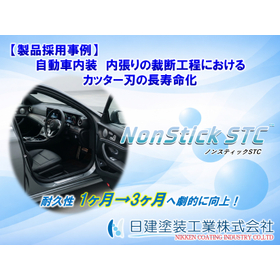
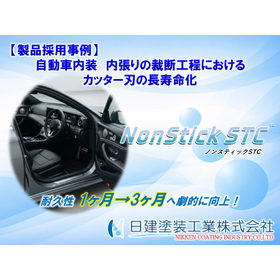
The interior linings used in automobiles (such as door trims and ceiling materials) often employ glass fiber (GF) composite sheets to enhance soundproofing and thermal insulation. However, in the manufacturing process, the extremely hard glass fibers cause significant wear on cutter blades, leading to blade replacements approximately every month. The downtime associated with line stoppages and the management and sharpening costs of spare blades have become a substantial burden. The solution to this issue is the ultra-thin, non-stick coating "NonStick STC." **Benefits of Introducing This Product:** - **Blade lifespan extended by "3 times":** It provides excellent slip properties (low friction), reducing the friction load caused by glass fibers. The sharpness lasts from one month to three months. - **Replacement frequency significantly reduced to "1/3":** It decreases the number of regular blade replacements, dramatically reducing labor hours and the management and sharpening costs of spare blades. - **Minimization of line stoppages (downtime):** It reduces the downtime associated with replacements, contributing to an overall increase in the operational efficiency of the factory. This is the optimal coating solution that simultaneously enhances durability and reduces maintenance.
Added to bookmarks
Bookmarks listBookmark has been removed
Bookmarks listYou can't add any more bookmarks
By registering as a member, you can increase the number of bookmarks you can save and organize them with labels.
Free membership registration
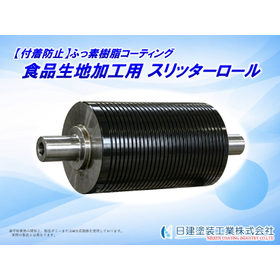
This is a surface treatment solution for metal "slitter rolls" used in the manufacturing lines of food products such as cookies, biscuits, bread, and noodles, which cuts and divides sheet-like dough into a consistent width. We apply fluoropolymer coatings such as PTFE and PFA, which have the highest level of non-stick properties (release properties), to highly adhesive dough. Using our unique precision technology, we create a uniform and smooth coating on the blade edges, roll grooves, and fine steps, effectively preventing the adhesion and sticking of sticky dough containing moisture, oil, sugar, and gluten. 【Benefits of Implementation】 ■ Prevention of chocolate stoppages and stable operation Our excellent release properties eliminate problems caused by dough sticking to the blade edges or being drawn in, preventing line stoppages (downtime) and improving operational efficiency. ■ Improved yield and stable quality Smooth separation from the blade prevents pulling and deformation during cutting, achieving uniform product dimensions and reducing defect rates. ■ Reduction in cleaning and maintenance time By preventing sticking and adhesion, cleaning tasks become easier, significantly shortening cleaning time. We will propose the optimal fluoropolymer specifications according to the dough characteristics (hardness, adhesiveness) and the usage environment.
Added to bookmarks
Bookmarks listBookmark has been removed
Bookmarks listYou can't add any more bookmarks
By registering as a member, you can increase the number of bookmarks you can save and organize them with labels.
Free membership registration
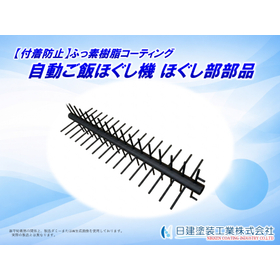
This is a surface treatment solution for the "automatic rice loosening machine" used in automatic rice cooking systems at rice processing plants, prepared food manufacturing lines, and large-scale meal centers. It involves applying a PTFE (polytetrafluoroethylene) fluororesin coating with excellent non-stick properties (release properties) to the metal "loosening blades (mixing and loosening components)" that fluff up the cooked rice. The coating forms a uniform fluororesin film even in the complex gaps of the thin loosening rods (pins) that extend radially from the central shaft component. This effectively prevents the sticking, scorching, and hardening of highly adhesive "freshly cooked rice," which contains a lot of moisture and starch. 【Benefits of Implementation】 ■ Improved Yield Reduces the carryover and residue of rice on the loosening pins, minimizing product loss and waste. ■ Reduced Cleaning Labor and Downtime Eliminates the need for scraping off or soaking stuck rice, allowing for quicker cleaning with water washing or light work, thus shortening cleaning time. ■ Safe and Reliable Quality The paint used complies with the "Food Sanitation Act," making it safe for use in environments where food comes into direct contact.
Added to bookmarks
Bookmarks listBookmark has been removed
Bookmarks listYou can't add any more bookmarks
By registering as a member, you can increase the number of bookmarks you can save and organize them with labels.
Free membership registration
This is a surface treatment solution that applies a fluororesin (PTFE/PFA) coating to the inner surface of metal "rice cookers" used in large food factories, prepared food manufacturing lines, and meal centers. By forming a non-stick fluororesin coating over the entire inner surface of the cooker, it effectively prevents the sticking and burning of "freshly cooked rice," which has a very high tendency to adhere. **Value of Introducing This Technology** - **Improved Yield During Transfer**: When rice is inverted for transfer, it falls smoothly without leaving any residue on the inner surface, minimizing product loss and remaining adhesion. - **Significant Reduction in Cleaning Labor (Downtime)**: The need for scraping off stuck-on residues is eliminated, and dirt can be removed with simple washing or light cleaning, dramatically shortening cleaning time. - **Optimal Selection Based on Application**: Depending on usage conditions such as heating temperature, cleaning frequency, and mechanical wear, we propose the best specifications with excellent wear resistance using "PTFE" or superior continuous use and weather resistance with "PFA." Of course, all paints and processing methods used comply with the standards of the "Food Sanitation Act," ensuring a safe and secure specification.
Added to bookmarks
Bookmarks listBookmark has been removed
Bookmarks listYou can't add any more bookmarks
By registering as a member, you can increase the number of bookmarks you can save and organize them with labels.
Free membership registration
Our company is a specialized manufacturer of contract processing that provides high-performance resin coatings (such as PEEK and fluororesin) that impart wear resistance, slip properties, non-stick properties, and chemical resistance to a wide variety of industrial fields, including semiconductors, food, automotive, and precision machinery. To help you gain a deeper understanding of "what kind of equipment is used for processing" and "what kind of engineers and technical philosophy the company has," we have released a company introduction video on YouTube. ■ Highlights and content of the YouTube video - Our core technologies and strengths: unique formulation technology and capability to handle large workpieces and high-precision processing - Key person interviews: department heads and key personnel from areas such as technology development, manufacturing, quality assurance, and sales - Commitment to technology: our proactive approach to solving customer challenges, production systems, and equipment You can intuitively understand the "technical backbone of the company" and the "passion and technical structure on the ground" that cannot be fully conveyed through text or catalogs. If you are a development or production technology representative considering product customization or prototype processing, please watch the video through the related links on Ipros.
Added to bookmarks
Bookmarks listBookmark has been removed
Bookmarks listYou can't add any more bookmarks
By registering as a member, you can increase the number of bookmarks you can save and organize them with labels.
Free membership registration
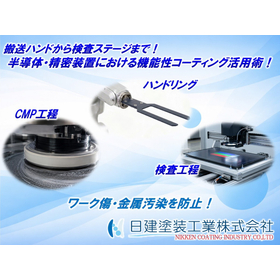
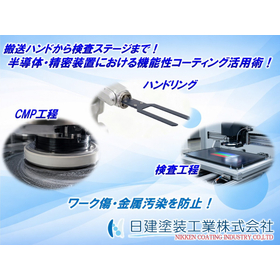
In the manufacturing lines of semiconductors and precision electronic components, wear of transport hands and deterioration or detachment of protective rubber and resin parts can lead to catastrophic line stoppages in clean rooms. Additionally, in CMP processes and chemical treatment areas, corrosion of metal parts and contamination from strong acids and strong alkalis are significant challenges. Our company achieves the long lifespan of equipment parts through "high-performance resin coating," which forms a coating of fluororesin or PEEK resin tailored to harsh operating environments. ■ Features and Effects - Transport Hands: PEEK coating prevents chipping of wafers due to metal contact, completely eliminating the risk of "peeling and detachment" associated with attached parts. - Chemical Area Parts: Fluororesin coating prevents corrosion of the substrate and provides cleanability and insulation. This reduces the frequency of regular part replacements, contributing to lower maintenance costs and improved equipment operating rates.
Added to bookmarks
Bookmarks listBookmark has been removed
Bookmarks listYou can't add any more bookmarks
By registering as a member, you can increase the number of bookmarks you can save and organize them with labels.
Free membership registration
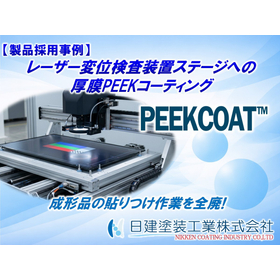
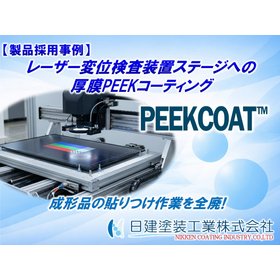
In the inspection equipment stage for the LCD and semiconductor fields (1-2m class), structures that attach or screw PEEK molded parts onto metal surfaces are commonly used to prevent scratches on the workpieces. However, this method has posed challenges in manufacturing costs and quality control due to "the hassle of positioning and drilling," "the enormous labor involved in achieving high-precision leveling adjustments," and "the accumulation of foreign substances at the joints." We propose a solution that eliminates the need for this protective part attachment process by using "thick-film PEEK coating + machining." ■ Solution Approach For large stages, we directly apply a thick coating of PEEK resin that exceeds the specified values. Subsequently, we perform high-precision machining on the surface to create a completely flat coating surface without any seams. This approach completely eliminates the labor involved in manual attachment and adjustment, significantly supporting the reduction of manufacturing lead times and total costs. We can also respond quickly to evaluation samples and prototype construction from a single unit.
Added to bookmarks
Bookmarks listBookmark has been removed
Bookmarks listYou can't add any more bookmarks
By registering as a member, you can increase the number of bookmarks you can save and organize them with labels.
Free membership registration
In the manufacturing and inspection processes of semiconductor wafers and glass substrates, minute contact scratches and the adhesion of metallic microparticles (contamination) can lead to critical product defects. Traditionally, measures such as processing resin blocks or attaching resin plates to metal parts were mainstream, but there were many challenges, including "a huge amount of labor required for fine adjustments during assembly," "foreign substances accumulating at joints," and "the need for regular replacement due to peeling and wear." Our "functional coating" fundamentally resolves these issues by directly forming a high-performance resin (PEEK or fluororesin) as a single integrated film on metal parts. ■ Advantages of this technology - Elimination of the risk of foreign substance accumulation and peeling due to a seamless integrated coating - Simultaneous achievement of high-precision dimensional control and excellent scratch prevention and resistance to metal contamination - Complete elimination of the processes of attaching resin molded products or using screws, significantly reducing manufacturing costs We can flexibly respond to prototype construction and test processing from a single piece.
Added to bookmarks
Bookmarks listBookmark has been removed
Bookmarks listYou can't add any more bookmarks
By registering as a member, you can increase the number of bookmarks you can save and organize them with labels.
Free membership registration
"I want to prevent the adhesion of sticky substances, but the thickness of the fluororesin coating is too thick (several tens of µm) to achieve dimensional accuracy." "The clearance is narrow, and it gets caught when applied." Do you have similar challenges in precision machining and tool design? Our "NonStick STC" is an "ultra" thin film, non-stick coating technology that solves the concerns of such designers and engineers. With a film thickness of less than 1µm, it can be applied without significantly compromising the cutting edge angle of tools or the strict dimensional tolerances of precision parts. Furthermore, it possesses a lower surface energy and non-stick performance that surpasses fluororesin, physically blocking the adhesion of strongly adhesive adhesives, glues, and adhesive tapes. 【Main Advantages】 ■ High Dimensional Accuracy Ideal for precision molds and tools with tight clearances. ■ Strong Adhesion Prevention Smoothly releases even strongly adhesive resins like epoxy and polyester. ■ Durability of Performance Fundamentally suppresses adhesion and maintains initial non-stick performance for an extended period. We support precision manufacturing environments as an alternative technology to fluororesin.
Added to bookmarks
Bookmarks listBookmark has been removed
Bookmarks listYou can't add any more bookmarks
By registering as a member, you can increase the number of bookmarks you can save and organize them with labels.
Free membership registration
In the cutting process of composite materials (laminated boards) made by overlapping resin sheets or films with adhesives, adhesive adhesion to the blade tip directly impacts product quality. When highly adhesive glue components adhere and accumulate on the blade tip, not only does the cutting performance significantly decline, but the accumulated adhesive also transfers and adheres to the product's cut surface, causing appearance defects and dimensional defects that worsen yield. Conventional fluororesin coatings are too thick, at several tens of micrometers, causing the blade tip to round off and reducing cutting precision, making them unsuitable for use. Our "NonStick STC" is a "super-thin film" non-stick coating with a thickness of less than 1 micrometer. 【Quality Improvements Achieved by This Product】 ■ Maintenance of Sharp Cutting Performance Due to its ultra-thin film, it does not alter the blade tip shape, maintaining sharp cutting performance. ■ Prevention of Adhesive Transfer and Adhesion With release properties surpassing fluororesins, it physically repels even highly adhesive materials. ■ Dramatic Improvement in Yield Significantly reduces defect rates caused by adhesive transfer on cut surfaces. It contributes to the stability of cutting quality and the reduction of defect rates.
Added to bookmarks
Bookmarks listBookmark has been removed
Bookmarks listYou can't add any more bookmarks
By registering as a member, you can increase the number of bookmarks you can save and organize them with labels.
Free membership registration
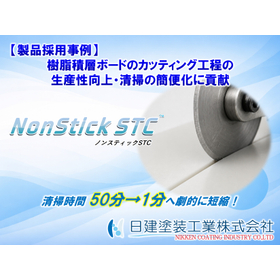
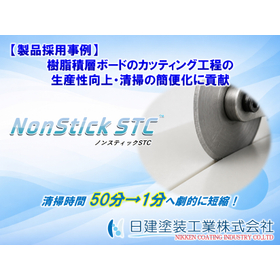
In the cutting process of laminated boards such as resin sheets, a major challenge is the "adhesion of adhesive to the circular blade and the cleaning work." Due to continuous cutting, the highly adhesive adhesive between the sheets accumulates on the blade edge, necessitating manual cleaning that takes about 50 minutes and requires solvents each time. Additionally, line stoppages due to blade changes have been a major cause of reduced equipment operating rates. The solution to this problem is the ultra-thin, non-stick coating "NonStick STC," which does not compromise the sharp shape of the blades. **Main Achievements from Implementation** - Cleaning time reduced from "50 minutes" to "1 minute." Stuck adhesive can now be easily removed, significantly reducing maintenance burdens. - Operating period extended by more than twice. The replacement cycle, which was traditionally 500-600 cuts, has improved to over 1,000 cuts, halving the frequency of replacements. - Minimization of line stoppage time. By reducing the hassle of changing and cleaning the circular blades, it contributes to improved equipment operating rates. This surface treatment technology simultaneously reduces the burden on operators and enhances overall factory productivity.
Added to bookmarks
Bookmarks listBookmark has been removed
Bookmarks listYou can't add any more bookmarks
By registering as a member, you can increase the number of bookmarks you can save and organize them with labels.
Free membership registration
In semiconductor and liquid crystal (FPD) manufacturing and inspection equipment, where high cleanliness and micron-level precision are required, the surface treatment of stages and transport components that come into direct contact with the workpiece significantly affects the reliability of the equipment. Our company offers contract processing solutions for large precision components using high-performance PEEK coating "PEEKCOAT." [Our Strengths and Value Proposition] ■ Large Equipment Available We can perform bulk processing of large stages and long arms sized 1 to 2 meters. ■ "Thick Film + Post-Processing" Technology By baking a PEEK coating film of over 1mm and then finishing it with precision machining, we achieve both stringent dimensional accuracy and smooth surface protection performance. ■ Advanced Distortion Control We possess specialized jig technology that suppresses deformation and shrinkage stress of the substrate due to firing heat of approximately 400°C. [Horizontal Expansion and Abundant Processing Achievements] We have numerous surface treatment achievements for various components in semiconductor and liquid crystal equipment, including inspection stages, transport hands, CMP peripheral components, cleaning and etching tanks, piping, and chambers. Please feel free to consult us for test processing (prototyping) tailored to your challenges.
Added to bookmarks
Bookmarks listBookmark has been removed
Bookmarks listYou can't add any more bookmarks
By registering as a member, you can increase the number of bookmarks you can save and organize them with labels.
Free membership registration
In laser inspection devices that perform precise measurements of LCD panels and silicon wafers, the "surface smoothness" and "high dimensional accuracy" of the metal stage that holds the workpiece directly influence measurement accuracy. In conventional hand-applied PEEK molded products, the presence of seams and screw fastening areas posed a risk of snagging and scratching the workpiece. Additionally, common coatings faced challenges with warping and distortion of the substrate due to "approximately 400°C firing heat." Our thick-film PEEK coating technology is a solution for designers that balances high precision and surface quality. 【Technical Approach】 ■ Distortion-free Construction Using our proprietary "deformation prevention fixture," we eliminate warping of the substrate caused by thermal shrinkage stress. High precision is maintained even for large substrates (1-2m). ■ Seamless Integrated Flat Surface Machining can be performed after applying a thick coating of over 1mm. A smooth flat surface is formed without screw holes or seams. ■ Scratch Prevention for Workpieces Eliminating metal exposure and unevenness reduces the risk of damage to delicate products. This technology is ideal for large precision components that require high dimensional accuracy and clean surface quality.
Added to bookmarks
Bookmarks listBookmark has been removed
Bookmarks listYou can't add any more bookmarks
By registering as a member, you can increase the number of bookmarks you can save and organize them with labels.
Free membership registration
In metal stages (such as aluminum) for precision inspection equipment, "the application of PEEK resin molded products" was performed to prevent scratches on the workpieces (such as glass substrates and wafers) during transport. However, the attachment process for large stages measuring 1 to 2 meters involved significant labor and costs due to "high-precision positioning," "drilling for fixing holes," "screwing," and "micron-level precision adjustments," which posed a major challenge. ■ Elimination of Attachment Work through PEEK Coating Our thick-film PEEK coating "PEEKCOAT N" directly forms a coating of over 1mm on metal substrates and provides a solution for high-precision mechanical cutting and finishing of the surface. 【Main Benefits of Implementation】 ■ Complete Elimination of Labor Hours Manual tasks such as attaching, drilling, screwing, and positioning are no longer necessary. ■ Reduced Lead Time The assembly and adjustment processes are simplified, dramatically shortening the production period. ■ Over 30% Cost Reduction Significant cuts in material costs, processing costs, and labor costs for molded products. We propose overwhelming rationalization to equipment manufacturers struggling with manufacturing costs and labor hours due to the attachment of molded products.
Added to bookmarks
Bookmarks listBookmark has been removed
Bookmarks listYou can't add any more bookmarks
By registering as a member, you can increase the number of bookmarks you can save and organize them with labels.
Free membership registration
In the design and development of advanced semiconductor manufacturing equipment, measures against chemical corrosion and the maintenance of cleanliness are the most critical design challenges that affect the reliability of the equipment. ■ Issues of slurry adhesion and corrosion resistance in the CMP process The head parts of CMP (Chemical Mechanical Polishing) equipment, which face the wafer at a close distance, are constantly exposed to splashes of slurry containing acids and alkalis, as well as intense corrosion stress, making it difficult to maintain long-term quality with simple water-repellent treatments. ■ PFA coating with fluoropolymer It possesses chemical stability that does not react with almost all chemical substances, completely preventing the leaching of impurities due to metal substrate corrosion. Additionally, due to its strong adhesion and uniform coating formation technology, it exhibits long-lasting corrosion resistance and non-stick properties even for complex-shaped parts. Its high reliability has been recognized, and it boasts a track record of being officially adopted as "standard specification parts" by equipment manufacturers. From head parts to surrounding covers and flow path components, it enhances the overall reliability of the equipment and enables differentiation.
Added to bookmarks
Bookmarks listBookmark has been removed
Bookmarks listYou can't add any more bookmarks
By registering as a member, you can increase the number of bookmarks you can save and organize them with labels.
Free membership registration
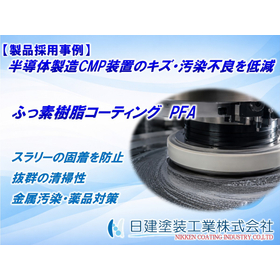
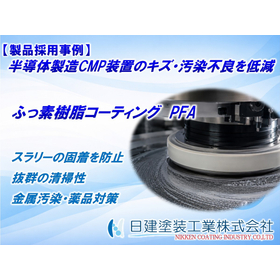
A major bottleneck hindering the stable operation of semiconductor manufacturing lines is the "cleaning and maintenance work of slurry that has adhered to equipment parts." ■ The problem of slurry adhesion troubling the site The polishing slurry that splashes during processes such as CMP (Chemical Mechanical Polishing) in semiconductor manufacturing strongly adheres to the surface of parts over time, consuming a significant amount of time and labor for cleaning in clean rooms. Regular line stoppages (downtime) associated with maintenance become a cause of reduced productivity for the entire factory. ■ Fluoropolymer PFA coating that drastically reduces maintenance labor and downtime By applying a PFA coating with extremely low surface energy (high non-stick properties), we can prevent the strong adhesion of slurry. This achieves excellent cleanability, allowing for easy removal even if it adheres. As scraping off the adhered material becomes unnecessary, it can be quickly removed by simply rinsing, dramatically shortening maintenance time. This increases the average time between failures (MTBF) of the equipment and contributes to improved continuous operation rates and reduced burden on operators.
Added to bookmarks
Bookmarks listBookmark has been removed
Bookmarks listYou can't add any more bookmarks
By registering as a member, you can increase the number of bookmarks you can save and organize them with labels.
Free membership registration
In the CMP (Chemical Mechanical Polishing) process of semiconductor manufacturing, major factors causing a decrease in wafer yield are "scratches due to the detachment of adhered slurry" and "ion contamination (metal contamination) caused by chemical corrosion." ■ Scratch Issues from Adhered Slurry When slurry that has splattered onto equipment parts dries and adheres, it can become trapped in the polishing surface and damage the delicate wafer surface. ■ Contamination from Chemical Corrosion Corrosion of the substrate by strong acids and strong alkalis can be a source of contaminating impurities that destroy circuit characteristics. ■ Preventing Slurry Adhesion and Improving Component Corrosion Resistance Our "Fluoropolymer PFA Coating" is a high-performance surface treatment solution that addresses these quality issues. With excellent "non-stick and water-repellent" properties, it prevents the adhesion of high-viscosity slurry. Even if it dries, it does not adhere and can be easily removed. Furthermore, it possesses high "chemical resistance and corrosion resistance" that is inert to chemicals, reducing the risk of metal leaching and ion contamination. The high purity and smooth coating also suppress particle generation, directly contributing to maximizing yield in the CMP process.
Added to bookmarks
Bookmarks listBookmark has been removed
Bookmarks listYou can't add any more bookmarks
By registering as a member, you can increase the number of bookmarks you can save and organize them with labels.
Free membership registration
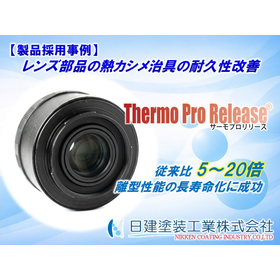
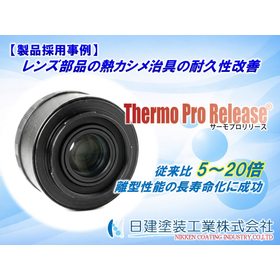
Have you faced the challenges of 'trying various surface treatments in the process improvement of heat staking and heat welding, but the coating peels off quickly under high temperature and high load' and 'not being able to find a surface treatment compatible with the resin of the counterpart material'? The causes of failure in surface treatments for heating jigs lie in the lack of coating design tailored to the specific thermal cycles, load conditions, and the resin used in the process. Our high-durability fluoropolymer coating, 'Thermo Pro Release,' is a heat process specialized solution that leverages our proprietary formulation technology for flexible coating customization and robust wear resistance. [Key Features] We possess our unique 'Release Performance Evaluation Testing Machine' designed for heat staking and heat welding. This allows for pre-validation that traces actual conditions in the field (temperature, applied load, contact time, etc.), enabling highly reliable specification selection. [Strengths of Our Proposal] ■ Proprietary Formulation According to Resin Setting the optimal release and hardness balance for the work material (counterpart material). ■ Pre-validation System Testing before implementation is possible with our unique evaluation testing machine. ■ Dramatic Longevity By enhancing adhesion strength, we achieve durability 5 to 20 times greater compared to conventional fluoropolymer coatings.
Added to bookmarks
Bookmarks listBookmark has been removed
Bookmarks listYou can't add any more bookmarks
By registering as a member, you can increase the number of bookmarks you can save and organize them with labels.
Free membership registration
In the "thermal crimping" process, which does not use adhesives for fixing lenses to resin tubes, the manufacturing site suffers from appearance defects and reduced yield due to "stringing of molten resin" and "adhesion of resin debris to jigs." When resin adheres and accumulates on the surface of the jig due to heating and pressurization during crimping, the detached resin debris can stick to the product, causing critical quality issues. Even release coatings designed to prevent these problems become meaningless if they wear out or degrade prematurely due to high-temperature and high-load thermal cycles. Our high-durability fluoropolymer coating "Thermo Pro Release" is a surface treatment solution that achieves the highest level of "non-stick (release)" and "wear resistance" against molten resin. ■ Benefits in terms of quality - Thorough prevention of stringing and adhesion Excellent slip and release properties ensure smooth separation of the jig after thermal crimping. - Dramatic improvement in yield Prevents the accumulation of resin debris, significantly reducing appearance defects in products. - Long-lasting performance The coating is resistant to wear even in high-load environments, maintaining its high release performance over an extended period.
Added to bookmarks
Bookmarks listBookmark has been removed
Bookmarks listYou can't add any more bookmarks
By registering as a member, you can increase the number of bookmarks you can save and organize them with labels.
Free membership registration
In the "thermal staking process" for the manufacturing of precision optical devices and resin components, issues such as appearance defects caused by resin stringing and resin debris sticking to jigs, as well as frequent jig replacements and downtime due to early wear of conventional release coatings, have become significant challenges. ■ High-Durability Fluoropolymer Coating "Thermo Pro Release" This surface treatment solution combines excellent release properties and heat resistance with robust film characteristics that withstand harsh thermal cycles and physical loads. Compared to conventional fluoropolymer coatings, it dramatically enhances adhesion to the substrate and wear resistance, maintaining release performance for extended periods even at high temperatures. ■ Implementation Effects - Overwhelming Longevity Durability has significantly improved by 5 to 20 times compared to conventional coatings from other manufacturers. - Operational Performance Jigs that had a limit of 300 shots can now operate non-stop for 4,000 shots, and jigs with a limit of 2,000 shots can now reach up to 20,000 shots. - Cost Reduction By reducing the frequency of jig replacements and the costs of re-coating and spare management, total maintenance costs are significantly cut.
Added to bookmarks
Bookmarks listBookmark has been removed
Bookmarks listYou can't add any more bookmarks
By registering as a member, you can increase the number of bookmarks you can save and organize them with labels.
Free membership registration
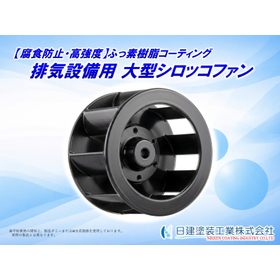
This is a high-performance ETFE (ethylene-tetrafluoroethylene copolymer) coating contract processing service for metal fans (impellers, rotor wheels, casings, and sirocco fans) that discharge corrosive gases such as acids and alkalis in exhaust and ventilation systems of various chemical plants, semiconductor manufacturing facilities, and plating treatment plants. ■ ETFE with Mechanical Strength and Chemical Resistance Fans are constantly rotating at high speeds and are subjected to harsh conditions as "driving components," exposed to contact (friction) with dust and fine particles contained in wind pressure and airflow. Therefore, this method employs ETFE, which possesses particularly excellent "mechanical strength (hardness, impact resistance, wear resistance)" and "chemical resistance" among fluororesins. It forms a uniform coating without pinholes, reaching into the intricate gaps of the fan blades and the unevenness of welding lines. ■ Thick Film Specification that Shuts Out Liquid/Gas Penetration To prevent the penetration and permeation of corrosive gases, the coating is applied in a "thick film specification (hundreds of micrometers level)" that is thicker than standard fluororesin coatings. This protects the metal substrate from gas, preventing corrosion and premature failure of the fan. It is a reliable surface treatment solution that contributes to the longevity, safety maintenance, and stable operation of equipment in harsh exhaust environments.
Added to bookmarks
Bookmarks listBookmark has been removed
Bookmarks listYou can't add any more bookmarks
By registering as a member, you can increase the number of bookmarks you can save and organize them with labels.
Free membership registration
This is a contract processing service for fluororesin coatings for metal "long steel belts (conveyor belts)" used in large automated mass production lines that manufacture baked goods such as biscuits, cookies, and cakes. ■ Capable of handling very long workpieces (long items) that can reach several tens of meters By using our large continuous baking furnace, we ensure reliable curing under the same conditions. We form a coating film with extremely stable quality, free from color unevenness and variations in film thickness, across the entire belt. ■ Coating functions The main features are the provision of "non-stick (release)" and "heat resistance." - The coating film is resistant to degradation even in harsh thermal environments where it continuously passes through high-temperature ovens, thoroughly shutting out the sticking of delicate doughs that contain high levels of sugars and fats, as well as stubborn burning. - Finished products smoothly peel off the belt surface, significantly reducing product deformation and damage (product loss). - This surface treatment solution directly contributes to stabilizing the continuous production process and improving the overall productivity and yield of the factory.
Added to bookmarks
Bookmarks listBookmark has been removed
Bookmarks listYou can't add any more bookmarks
By registering as a member, you can increase the number of bookmarks you can save and organize them with labels.
Free membership registration
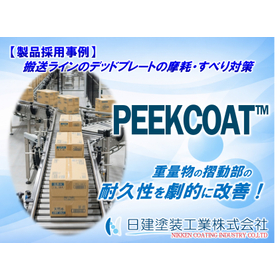
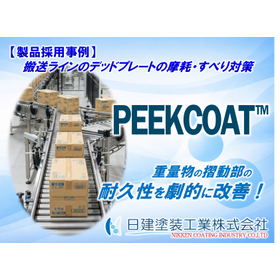
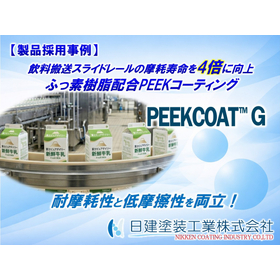
The dead plate of an automatic transport line is a crucial component for smoothly transferring products. However, due to intense friction from heavy items, the surface treatment tends to wear out quickly, leading to significant hassle and costs each time it is necessary to "stop the line, retrieve the parts, and perform repainting (recoating)." ■ PEEK Coating Sliding Grade "PEEKCOAT G10" Our sliding-specialized coating "PEEKCOAT G10" is a highly durable solution that directly contributes to dramatically reducing maintenance costs and preservation labor. ■ Technical Features The exceptional mechanical strength of the underlying super engineering plastic "PEEK resin" exhibits high physical resistance to continuous rubbing from heavy items (such as cardboard boxes containing 2L PET bottles). Since the coating itself is difficult to wear away, it greatly exceeds the limitations of conventional fluoropolymer coatings, achieving an astonishing long life that is 3 to 4 times greater. ■ Implementation Effects By significantly extending the frequency of part replacements and maintenance cycles, the total running costs—including management expenses for spare parts, outsourcing costs for disassembly and recoating, and labor costs for maintenance personnel—are dramatically reduced. This contributes to improving cost structure and ensuring sustainable profits for the factory.
Added to bookmarks
Bookmarks listBookmark has been removed
Bookmarks listYou can't add any more bookmarks
By registering as a member, you can increase the number of bookmarks you can save and organize them with labels.
Free membership registration
In automatic transport lines, including beverage manufacturing plants, the reduction in slip properties of the "dead plate" installed at the joints between conveyors can cause products to snag or topple, leading to serious bottlenecks that result in line stoppages (chocolate stops). This time, we will introduce the resolution of transport troubles using PEEK coating "PEEKCOAT G10." ■ Fusion of the toughness of PEEK resin and the slip properties of fluororesin "PEEKCOAT G10" uniformly combines the excellent lubricity of "fluororesin" within the robust framework of "PEEK resin," which boasts overwhelming toughness. As a result, even in harsh environments where heavy items, such as cardboard containing 2L PET bottles, continuously rub against each other, the film does not wear out and peel off as it does with typical fluororesin coatings. ■ Maintaining lubricity even when worn Even if wear progresses, the fluororesin (lubricating component) uniformly dispersed within the film continues to be exposed, allowing the initial smooth slip properties to be maintained for a long time. This thoroughly eliminates transport delays and damage to workpieces, as well as the associated unexpected downtime, strongly supporting the continuous stable operation and throughput improvement of the entire factory.
Added to bookmarks
Bookmarks listBookmark has been removed
Bookmarks listYou can't add any more bookmarks
By registering as a member, you can increase the number of bookmarks you can save and organize them with labels.
Free membership registration
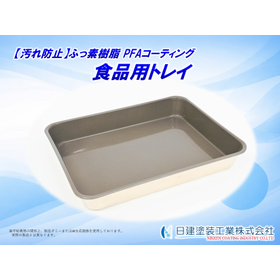
This is a surface treatment solution that applies fluororesin (PTFE or PFA) to metal food trays used in the manufacturing and processing lines of foods such as bread, side dishes, and frozen foods. ■ Technical Features - Forms a completely uniform coating without pinholes, even in the corner areas of the trays and the details of ribs (reinforcement shapes) that ensure strength. - Provides excellent "non-stick (release)" properties, thoroughly preventing ingredients such as sauces, dressings, and dough from sticking or burning onto the tray surface, even in harsh baking and heating environments. - Naturally complies with food sanitation laws, making it safe for use in areas where food comes into direct contact. It dramatically improves the yield of products by eliminating deformation of delicate ingredients and strongly supports the continuous stable production of high-quality foods. Because ingredients are less likely to remain, the time required for rinsing and cleaning after use (downtime) is significantly reduced. This not only increases the operating rate of the manufacturing line but also greatly contributes to cutting costs related to water, electricity, and labor associated with cleaning maintenance.
Added to bookmarks
Bookmarks listBookmark has been removed
Bookmarks listYou can't add any more bookmarks
By registering as a member, you can increase the number of bookmarks you can save and organize them with labels.
Free membership registration
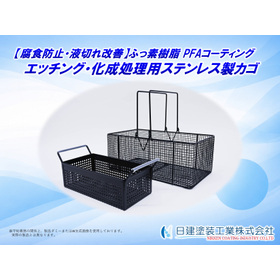
In metal etching and chemical treatment processes, cleaning and transport mesh baskets exposed to harsh chemicals such as strong acids and strong alkalis, even if made of stainless steel (SUS), are prone to corrosion and leaching of metal components due to repeated use, posing a risk of metal contamination in the products. This technology provides a surface treatment solution that applies fluororesin (PFA) to stainless steel mesh baskets with a complex woven structure to address these challenges in manufacturing environments. ■ Technical Features - It forms a thick anti-corrosion and release layer without pinholes, reaching the intersections of the mesh and fine gaps. - The superior chemical resistance of PFA completely isolates the metal substrate from the chemicals. - The extremely high water and oil repellency unique to fluororesins dramatically improves the "drainage" of liquids from the basket surface. ■ Implementation Benefits - It prevents corrosion of the baskets over the long term, contributing to the longevity of the equipment. - It minimizes the residual adhesion of chemicals during lifting, significantly reducing carryover to the next process.
Added to bookmarks
Bookmarks listBookmark has been removed
Bookmarks listYou can't add any more bookmarks
By registering as a member, you can increase the number of bookmarks you can save and organize them with labels.
Free membership registration
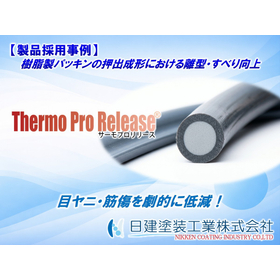
In the extrusion molding of "resin packings" that maintain airtightness in general industries and the chemical and food sectors, the fluidity inside the mold (die) significantly affects product quality. If the slip properties of the die surface are poor, or if the resin stagnates or adheres, it can lead to the occurrence of "eye mucus (protrusion defects)" and "line scratches (line defects)" on the product surface, resulting in reduced yield. ■ Measures Against Eye Mucus and Line Scratches To prevent these issues, fluororesin coatings are often used; however, if they peel off early due to high-load resin flow, it defeats the purpose. Our unique technology, "Thermo Pro Release," is a coating solution that maximizes "adhesion strength" and "wear resistance" while maintaining excellent release properties and slip characteristics. Traditionally, the pre-treatment blasting (roughening) for coatings was difficult to apply to fine hole inner diameters of Φ10mm or less, which was a cause of early peeling. However, our proprietary binder technology allows for a strong adhesion that is more than three times the strength of typical fluororesin coatings. ■ Introduction Effects It effectively shuts out resin stagnation and adhesion inside the die, thoroughly preventing the occurrence of eye mucus and scratches. This stabilizes the quality of delicate molded products and directly contributes to a significant increase in the good product rate in manufacturing sites.
Added to bookmarks
Bookmarks listBookmark has been removed
Bookmarks listYou can't add any more bookmarks
By registering as a member, you can increase the number of bookmarks you can save and organize them with labels.
Free membership registration
In the manufacturing process of packings and other products using a resin extrusion molding machine, fluororesin coating is essential to prevent resin adhesion to the die (mold), which is the core component, and to ensure smooth extrusion. ■ Issues with Conventional Specifications The wear load from molten resin is extremely high, and conventional fluororesin coatings have the problem of peeling off in just two weeks. This is particularly problematic in narrow inner diameters of Φ10mm or less, where blast treatment is difficult to apply uniformly, leading to early peeling. ■ Unique Technology "Thermo Pro Release" - Strong Adhesion Our original fluororesin coating "Thermo Pro Release" not only provides a physical anchor effect to the substrate but also employs a special formulation that enhances adhesion to the base material (metal). Even in narrow inner diameter surfaces where blast treatment may be insufficient, it boasts more than three times the adhesion strength of conventional fluororesin coatings. - Wear Resistance With an optimal formulation of wear-resistant binders, it is resistant to wear even in high-temperature and high-pressure sliding environments, maintaining initial release and lubrication performance for an extended period. The lifespan of the die, which was two weeks, has been extended to approximately three months, achieving about six times the duration and enabling planned line operations.
Added to bookmarks
Bookmarks listBookmark has been removed
Bookmarks listYou can't add any more bookmarks
By registering as a member, you can increase the number of bookmarks you can save and organize them with labels.
Free membership registration
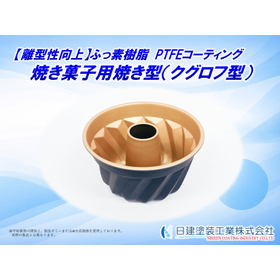
The shape defects of products caused by "dough sticking" and "poor release from molds" in the manufacturing process of Western-style confections and food are significant challenges that reduce production efficiency and yield. ■ Release Coating for Traditional Baked Goods and Gugelhupf Molds For metal Gugelhupf molds with very complex and three-dimensional shapes, such as beautifully spiraled wave patterns and central protrusions, a uniform thickness of fluoropolymer PTFE coating is applied down to the finest details. ■ Purpose of the Coating The primary goal is to impart "non-stick (release)" and "heat resistance." The coating is resistant to degradation even in the harsh thermal environment during baking, thoroughly preventing dough from sticking and corner adhesion. This allows the baked Gugelhupf to smoothly and cleanly release from the mold, significantly reducing the deformation of delicate products and directly improving yield in the production process. Additionally, it minimizes (or eliminates) the need for the application of release oils (butter or oil), leading to cost savings on raw materials and reducing the time required for application. This strongly supports the streamlining and automation of the manufacturing line.
Added to bookmarks
Bookmarks listBookmark has been removed
Bookmarks listYou can't add any more bookmarks
By registering as a member, you can increase the number of bookmarks you can save and organize them with labels.
Free membership registration
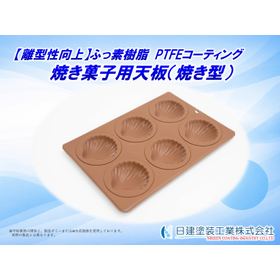
The issues of "dough sticking" and "poor mold release" leading to product shape defects in the manufacturing process of Western-style confections and food products are significant challenges that reduce production efficiency and yield. This time, we introduce an example of a metal madeleine mold with a complex shell shape (scallop shape) that has been uniformly coated with a fluororesin (PTFE) to ensure consistent film thickness down to the details. ■ Top-notch non-stick properties (release properties) Thoroughly prevents dough from sticking and burning. The baked madeleines easily and cleanly release from the mold, significantly reducing the deformation of delicate products and directly contributing to improved yield in production environments. ■ Heat resistance (continuous use temperature 260°C) The coating is resistant to degradation even under the harsh thermal conditions during baking, maintaining excellent release performance over a long period. ■ Reduction of release oil and prolongation of mold lifespan By eliminating or minimizing the application process of release oils (butter or oil) that were previously essential, we can cut raw material costs and reduce the time spent on application. This strongly supports the streamlining and automation of manufacturing lines. Additionally, it protects the surface of the mold, preventing wear and corrosion of the base materials such as aluminum and steel, thus contributing to the longevity of the tooling.
Added to bookmarks
Bookmarks listBookmark has been removed
Bookmarks listYou can't add any more bookmarks
By registering as a member, you can increase the number of bookmarks you can save and organize them with labels.
Free membership registration
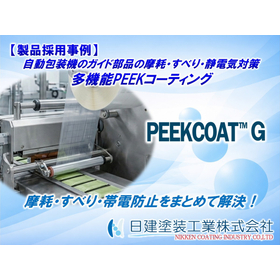
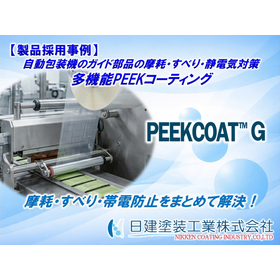
The guide components of automatic packaging machines experience significant wear due to constant high-speed friction with films and transported items, leading to major challenges such as "short-term component replacement" and "increased maintenance labor and costs associated with replacements." In the case of the customer we consulted with, they had been applying fluororesin coating to the guide components, but the issue arose that conventional fluororesin coatings have soft films that quickly reach the end of their lifespan in harsh environments. ■ Proposal for PEEK Coating "PEEKCOAT G10" Therefore, we proposed PEEKCOAT G10, which has excellent wear resistance and mechanical strength. - A high-durability sliding coating that uniformly combines fluororesin with a tough PEEK resin film. - Unlike pure fluororesin, the film does not easily wear away, maintaining a "smooth and slippery surface" for an extended period even in harsh high-speed sliding environments. ■ Implementation Effect: Compared to conventional specifications, durability is improved by 3 to 4 times. By significantly extending the component replacement cycle, we achieve both a reduction in spare parts costs and a decrease in equipment downtime associated with maintenance (improving operational efficiency), dramatically enhancing overall cost performance.
Added to bookmarks
Bookmarks listBookmark has been removed
Bookmarks listYou can't add any more bookmarks
By registering as a member, you can increase the number of bookmarks you can save and organize them with labels.
Free membership registration
Are you experiencing troubles such as "film sticking due to static electricity" and "frequent chocolate stops caused by wandering or entanglement" in the guide components of automatic packaging machines? ■ Multifunctional PEEK Coating "PEEKCOAT G10" Our PEEK coating "PEEKCOAT G10" is the optimal solution that addresses the challenges of wear, sliding, and static electricity all at once. It is based on PEEK resin, which boasts high mechanical strength, and has been uniquely formulated with fluororesin and conductive materials. ■ Reliable Wear Resistance Supported by PEEK Resin By adopting PEEK resin as the base matrix, we achieve wear resistance that leverages the robust mechanical strength of PEEK. ■ Smooth and Slippery Surface Thanks to the effects of the blended fluororesin, the surface of the PEEK film is endowed with low friction properties similar to those of a fluororesin coating. ■ Antistatic Function By incorporating conductive materials, we effectively discharge static electricity generated during sliding. We fundamentally suppress transport troubles caused by static electricity, alleviating the unexpected burden on on-site workers. This contributes to the creation of an "unstoppable line" in automatic packaging lines.
Added to bookmarks
Bookmarks listBookmark has been removed
Bookmarks listYou can't add any more bookmarks
By registering as a member, you can increase the number of bookmarks you can save and organize them with labels.
Free membership registration
In a harsh manufacturing line that operates continuously for 24 hours, the frequent replacement of parts due to early wear is a significant factor that heavily burdens the factory's maintenance costs. Maintenance in environments where cleanliness and hygiene management are required particularly increases labor costs and working hours for maintenance personnel, becoming a substantial burden alongside the procurement costs of spare parts. ■ Fluororesin-Composite PEEK Coating Our fluororesin-composite PEEK coating, "PEEKCOAT G09," is a sliding-specialized coating that directly contributes to reducing maintenance costs. It uniformly disperses fluororesin (solid lubricant) with excellent sliding properties within the robust structure of PEEK resin at an optimal ratio. ■ Balancing Low Friction and Wear Resistance The uniformly dispersed fluororesin components in the coating act to maintain smooth "low friction characteristics" while exhibiting "high wear resistance" at a level incomparable to fluororesin coatings. This significantly extends the replacement cycle of parts. We respond to the requests of maintenance and management departments that want to "reduce the hassle of repeated part replacements" and "advance factory labor-saving and efficiency while keeping long-term running costs down."
Added to bookmarks
Bookmarks listBookmark has been removed
Bookmarks listYou can't add any more bookmarks
By registering as a member, you can increase the number of bookmarks you can save and organize them with labels.
Free membership registration